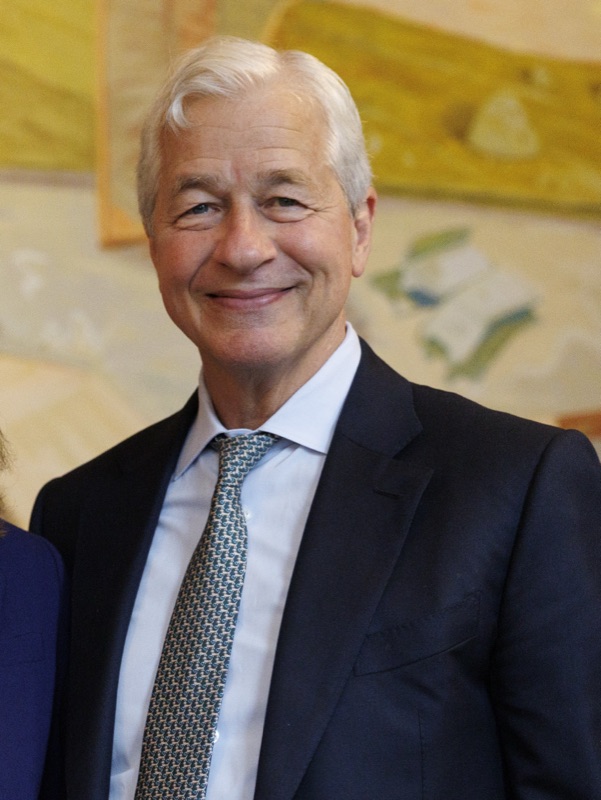
JAMIE DIMON
Running JPMorgan Chase — the biggest bank in America — for nearly two decades and making it look easy while everyone else kept blowing up.
Jamie Dimon is the only major bank CEO who came out of the 2008 financial crisis looking smarter than when he went in. While Lehman collapsed, Bear Stearns imploded, and Citigroup had to be bailed out by taxpayers, JPMorgan not only survived but actually acquired the wreckage at fire-sale prices. He runs a bank with $3.9 trillion in assets and still sends handwritten notes to clients. Love him or hate him — and plenty of people do both — the man has run the most consistently profitable large bank in American history for nearly twenty years. That's not luck. That's just being better at the job than everyone else.
Net Worth
$2.1 billion
Nationality
American
Time Horizon
Long-Term
Risk Appetite
6 / 10
Fund
JPMorgan Chase & Co.
Net Worth Context
- · Still a billionaire — just the quiet kind at the end of the table.
CAREER & BACKGROUND
Jamie Dimon grew up in Queens, New York, the grandson of a Greek immigrant who worked as a stockbroker. His father and grandfather were both in finance, which means he didn't stumble into Wall Street — he was practically born into it.
He studied psychology and economics at Tufts University, then went to Harvard Business School, where he graduated in 1982.
His first real break came from Sandy Weill, the legendary dealmaker who would go on to build Citigroup. Weill hired Dimon as his assistant right out of Harvard Business School — not a glamorous start, but Dimon used it the way smart people use unglamorous starts: he learned everything.
When Weill left American Express after an internal power struggle, Dimon followed him. The two of them then went on a nearly decade-long acquisition spree, building what would eventually become Citigroup through a series of mergers that rewrote how big American banks could get.
Then Weill fired him. In 1998, after years of working side by side, Sandy Weill pushed Dimon out of Citigroup in what was essentially a boardroom coup.
It was public, it was humiliating, and it was probably the best thing that ever happened to Jamie Dimon.
He spent about a year figuring out what came next. Then in 2000, he took over as CEO of Bank One — a mid-sized bank based in Chicago that was struggling badly.
He cut costs, rebuilt the culture, and turned it around faster than most people expected. JPMorgan Chase acquired Bank One in 2004 for $58 billion, and Dimon came with the deal.
By 2005, he was CEO of JPMorgan Chase.
What followed was one of the most consequential runs in modern banking history. Dimon steered JPMorgan through the 2008 financial crisis while most of his peers were drowning.
He bought Bear Stearns for $2 a share in March 2008 — a price so low it was essentially a government-assisted rescue — and then Bear's headquarters. In September 2008, he acquired Washington Mutual's banking assets out of FDIC receivership for $1.9 billion, making it one of the largest bank failures in American history turned into a shopping opportunity.
Since then, JPMorgan has become the dominant American bank by almost every measure. It's consistently the most profitable large bank in the country, it survived multiple market crises without a government bailout, and Dimon has become one of the most influential voices in American business and economic policy.
He's written annual letters to shareholders that get read by people who have nothing to do with banking — because they're actually well-written and say things other executives won't.
COMPANIES & ROLES
JPMorgan Chase is the main event — the largest bank in the United States by assets, at roughly $3.9 trillion. It does everything: consumer banking (Chase branches on every corner), investment banking (the deals, the IPOs, the M&A advisory), asset management (trillions in client money), and commercial banking for businesses of every size.
Dimon has run it since 2005 and owns roughly $1.6 billion worth of JPMorgan stock, which means his interests and shareholder interests are unusually well-aligned for a CEO of a public company.
Before JPMorgan, he ran Bank One, a major retail bank he took from struggling to attractive enough that JPMorgan paid $58 billion to buy it. Before that, he spent most of the 1980s and 1990s helping Sandy Weill build what became Citigroup — working on the acquisitions of Commercial Credit, Primerica, Smith Barney, Travelers Group, and eventually the merger with Citicorp itself.
He was part of creating the model of the modern financial supermarket before being unceremoniously removed from it.
He's also been a fixture on corporate boards and policy councils over the years — serving on the Federal Reserve Bank of New York's board, chairing the Business Roundtable, and generally being the person that presidents, treasury secretaries, and finance ministers call when they want a frank assessment of what's actually happening in the economy.
INVESTING STYLE & PHILOSOPHY
Dimon isn't a hedge fund manager picking stocks — he's a banker who thinks about risk the way a general thinks about war. His whole approach is built around one question: what can kill us, and how do we make sure it doesn't?
At JPMorgan, this means running what he calls a 'fortress balance sheet.' The idea is simple: carry enough capital and liquidity that even a catastrophic market event doesn't threaten the institution's survival. While competitors were loading up on leverage and complex derivatives in the mid-2000s, JPMorgan was quietly building its cash reserves and pulling back from the riskiest mortgage products.
It wasn't exciting. It wasn't what shareholders were demanding.
But when the crisis hit, it meant the difference between being the buyer and being the bought.
On the equity side, his personal investing philosophy is fairly conventional for someone in his position — he's heavily concentrated in JPMorgan stock. He's bought shares consistently over the years, including large purchases in early 2016 when the market was volatile and in 2020 when the pandemic cratered bank stocks.
Buying your own company's stock when it's down is either a sign of genuine conviction or a PR move — in Dimon's case, the track record suggests it's the former.
He's deeply skeptical of financial complexity for its own sake. One of his consistent critiques of the pre-2008 banking system was that banks had built products so complicated that even the people selling them didn't fully understand the risks.
His preference is for transparency — know what you own, know what can go wrong, and make sure you have enough cushion to survive it going wrong.
THE PLAYBOOK
Risk Approach
Dimon's relationship with risk is basically the opposite of a hedge fund manager's. He doesn't chase asymmetric upside.
He obsesses over downside scenarios that other people have convinced themselves can't happen.
He talks about 'tail risks' — the low-probability, catastrophic-outcome events that most institutions model as essentially impossible. His view is that they're not impossible.
They're just rare. And rare events happen to unprepared institutions.
So JPMorgan runs internal stress tests that are deliberately more severe than the Fed's official stress tests. He wants to know what happens if everything goes wrong at once — and then he wants enough capital to survive it.
Personally, he describes himself as comfortable taking large, calculated risks — but only when he understands the full picture. He's said repeatedly that the risks that kill institutions are the ones nobody is watching.
His job, as he sees it, is to be watching them. He was one of the first major bank CEOs to publicly warn about emerging risks in the subprime mortgage market.
He was largely ignored. Then he was proven right in the most expensive possible way for everyone who didn't listen.
On cryptocurrency, he's been famously dismissive — calling Bitcoin a 'pet rock' and a 'fraud' at various points, then walking back some of those statements while still maintaining he doesn't personally believe in it as a long-term store of value. For someone who runs a bank building blockchain infrastructure, it's a complicated position — but it reflects his broader risk worldview: he doesn't like assets whose value depends entirely on someone else's willingness to buy them at a higher price.
Money Habits
For someone with $2 billion, Dimon lives relatively modestly by billionaire standards — though 'relatively modestly' does still include a townhouse in Park Avenue, a vacation home in Florida, and a private security detail. He's not exactly clipping coupons.
He is, by all accounts, a genuinely early riser — reportedly in the office by 7:30am most days, having already read multiple newspapers and reviewed overnight market data. He reads voraciously: newspapers, annual reports, government data releases, competitor filings.
His staff says he'll often surface a detail from a footnote in a quarterly report that nobody else caught.
He's known for handwritten notes — sending them to employees, clients, and colleagues in an era when most executives communicate exclusively through email chains and corporate memos. People who've received them say they're substantive, not perfunctory.
His JPMorgan compensation has been consistently large — he earned roughly $34.5 million in 2022, making him one of the highest-paid bank CEOs in the country. But most of his wealth is in JPMorgan stock that he hasn't sold.
He's been buying more of it, not less — he purchased $150 million in JPMorgan shares in early 2016, a move that got significant attention precisely because it was so large and so public.
He had a health scare in March 2020 — emergency heart surgery for an acute aortic dissection, which is the kind of event that typically ends careers if not lives. He was back working within weeks.
By his own account, it didn't fundamentally change his outlook on work or risk.
BIGGEST WIN
The 2008 crisis is his biggest win, and it wasn't one decision — it was a series of calls made years before anyone else accepted what was coming.
Starting around 2006, JPMorgan's risk team began pulling back from the subprime mortgage market. The bank reduced its exposure to collateralized debt obligations, tightened its underwriting standards, and built up its capital cushion while everyone else was leveraging up.
This wasn't popular. Competitors were booking massive profits.
Shareholders were asking why JPMorgan was being so conservative. The answer became clear in 2008.
In March 2008, Bear Stearns — a storied Wall Street investment bank — collapsed over a weekend. The Fed brokered an emergency sale to JPMorgan for $2 a share (initially $2; later renegotiated to $10 under shareholder pressure, still a fraction of Bear's recent value).
JPMorgan got Bear's prime brokerage, its headquarters building, and its client relationships. Bear's staff got a very bad Monday morning.
In September 2008, after Lehman Brothers failed and Washington Mutual became the largest bank failure in American history, JPMorgan acquired WaMu's banking assets from the FDIC for $1.9 billion — a transaction that gave JPMorgan a massive retail banking presence on the West Coast essentially overnight.
By the end of 2008, while Citigroup was accepting a $45 billion government bailout and Bank of America was fighting off collapse, JPMorgan had made money for the year. The bank had turned its rivals' catastrophes into acquisitions.
Dimon's net worth roughly doubled in the decade that followed, driven almost entirely by the appreciation of his JPMorgan equity stake.
BIGGEST MISTAKE
The London Whale is the one that still stings.
In 2012, JPMorgan's Chief Investment Office — a unit that was supposed to hedge the bank's risk — made a series of enormous, complex bets on credit derivatives that went spectacularly wrong. A trader nicknamed 'the London Whale' had accumulated positions so large they were visibly moving the market, and other traders on the other side of those trades started noticing and betting against him.
The final loss was $6.2 billion. Which, to be clear, JPMorgan could absorb — the bank made $21 billion in profit that year.
But that almost makes it worse. The loss wasn't existential.
It was embarrassing. The unit responsible for managing risk had itself become the source of a massive, avoidable risk.
What made it worse for Dimon was that he had initially dismissed early reports of the problem. In April 2012, when questions were first raised publicly about large positions in the CIO, Dimon called it 'a tempest in a teapot.' Two months later, he was announcing a $2 billion loss that would eventually grow to $6.2 billion.
The 'tempest in a teapot' line became one of the most quoted things he's ever said — for all the wrong reasons.
He appeared before Congress, took full responsibility, and did not blame subordinates publicly. The bank subsequently paid over $900 million in regulatory penalties related to the incident.
He's since cited it as a reminder that no institution is immune to the exact failures it thinks it's protected against — which, to his credit, is exactly the right lesson, and one he's apparently internalized enough to keep saying out loud.
FINANCIAL PHILOSOPHY
Dimon's financial philosophy comes down to a few principles he's stated so many times they've basically become his brand.
First: capital is oxygen. You can be profitable, well-managed, and beloved by customers — and still die if you run out of capital during a crisis.
His obsession with maintaining strong capital ratios isn't regulatory box-ticking; it's existential risk management. 'A fortress balance sheet' is the phrase he uses constantly, and it's not just a slogan.
It's the organizing principle of how he runs the bank.
Second: culture eats strategy for breakfast — though he'd probably say it more directly than that. He's spoken extensively about how the 2008 crisis wasn't caused by bad regulations or bad luck.
It was caused by bad culture — institutions where risk-taking was rewarded without accountability, where people said things looked fine because saying otherwise was bad for their careers. He believes you can't sustainably run a financial institution unless the people inside it are genuinely trying to do right by clients.
Whether JPMorgan has always lived up to that standard is a fair debate — the bank has paid tens of billions in legal settlements over the years — but it's what he says, consistently.
Third: long-term thinking is a competitive advantage because most people can't do it. Dimon has consistently resisted quarterly earnings pressure in ways that most public company CEOs won't.
He refuses to provide quarterly earnings guidance. He's made investments with ten-year payoff horizons that Wall Street analysts hated in the short term.
His argument is that if you run a business for the next quarter, you'll eventually destroy it. If you run it for the next decade, you might actually build something.
Fourth: read everything. His annual letters to JPMorgan shareholders are famous partly because they're extraordinarily detailed — covering everything from the bank's financial results to geopolitical risks to his views on American competitiveness.
He writes them himself. He reads obsessively.
He's said that one of the biggest mistakes executives make is surrounding themselves with people who confirm their existing views.
FAMILY & PERSONAL LIFE
Dimon married Judith Kent in 1983, after they met at Harvard Business School. They've been together for over forty years, which in Wall Street terms is roughly equivalent to a geological era.
They have three daughters: Julia, Laura, and Kara.
His father Theodore Dimon was a stockbroker, and his grandfather — a Greek immigrant named Panos Papademetriou, who anglicized the family name — was also in the brokerage business. Finance runs in the family in a fairly literal sense.
His emergency open-heart surgery in March 2020 — discovered when he felt chest pain and went to the hospital — was publicly disclosed by JPMorgan in a way that briefly spooked markets. He recovered fully and was back at work within weeks, which his colleagues described as 'very Jamie Dimon of him.'
He's known for being direct to the point of bluntness in personal interactions, and people who've worked for him describe a mix of exacting standards and genuine personal loyalty — the kind of boss who will push you hard and also remember your kids' names. He keeps a relatively low public profile outside of his professional role — no reality TV, no social media presence, no podcast.
Just annual letters and congressional testimony.
EDUCATION
Dimon went to Tufts University, graduating in 1978 with a degree in economics and psychology. He then worked for a few years before heading to Harvard Business School, where he earned his MBA in 1982.
He's said that Sandy Weill's offer to hire him right out of HBS was so good he turned down offers from Goldman Sachs and other firms — a decision that shaped the next three decades of his career. The Harvard credential matters less in his story than what he did with the access it gave him.
BOOKS & RESOURCES
Dimon hasnt written a traditional book, though his annual shareholder letters to JPMorgan investors are essentially required reading for anyone in finance — or anyone trying to understand whats actually happening in the American economy from someone who sees most of the data before anyone else
They run 30–40 pages, cover everything from JPMorgan's financial results to geopolitics to his views on American infrastructure, and he writes them himself. Find them on JPMorgan's investor relations page. Start with the 2010 and 2019 editions
For books he recommends and that reflect how he thinks, look for anything by Walter Isaacson
Dimon has cited biography as essential reading for understanding how leaders actually make decisions under pressure
The kind of management classic he'd assign to a new hire
Particularly relevant given how he thinks about fintech's threat to traditional banking
Gives you the best possible context for the world Dimon came up in — the era of mega-mergers and Wall Street deal culture that produced him
As an Amazon Associate, Netfigo earns from qualifying purchases. Book links above may be affiliate links.
QUOTES (7)
The biggest risk is not taking any risk. In a world that is changing really quickly, the only strategy that is guaranteed to fail is not taking risks.
I've been dealmaking for 30 years and I've learned that when you get hit by a truck, the only thing that matters is whether you're still alive.
A bank that cannot make a profit is not serving its clients. It won't be able to invest in people, technology, or the communities it works in.
Bitcoin is a fraud that will ultimately blow up. It's like tulip bulbs. It will end badly.
Being honest with yourself is not easy. Most of us, including me, are subject to confirmation bias and can't admit our mistakes easily.
It's a tempest in a teapot. We're very comfortable with our positions.
When I go to sleep at night, I'm thinking of everything that could go wrong — not everything that could go right.
NETFIGO SCORE
Proprietary 5-dimension investor rating
Risk Appetite
Contrarian Index
Track Record
Accessibility
Time Horizon
Related Profiles
Investors
Ken Griffin
Griffin and Dimon both operate at the institutional apex of American finance, with overlapping views on regulation, capital markets, and the risks of financial populism
Ray Dalio
Dalio and Dimon represent two of the most prominent macro-economic voices in finance — both speak extensively on systemic risk, debt cycles, and the future of the dollar, often reaching different conclusions from similar starting points
Warren Buffett
Buffett and Dimon co-authored a Wall Street Journal op-ed in 2018 arguing against quarterly earnings guidance, two of the most influential voices in American finance aligned on the damage short-termism does to business culture
Head-to-Head
Compare Jamie Dimon vs another investor.