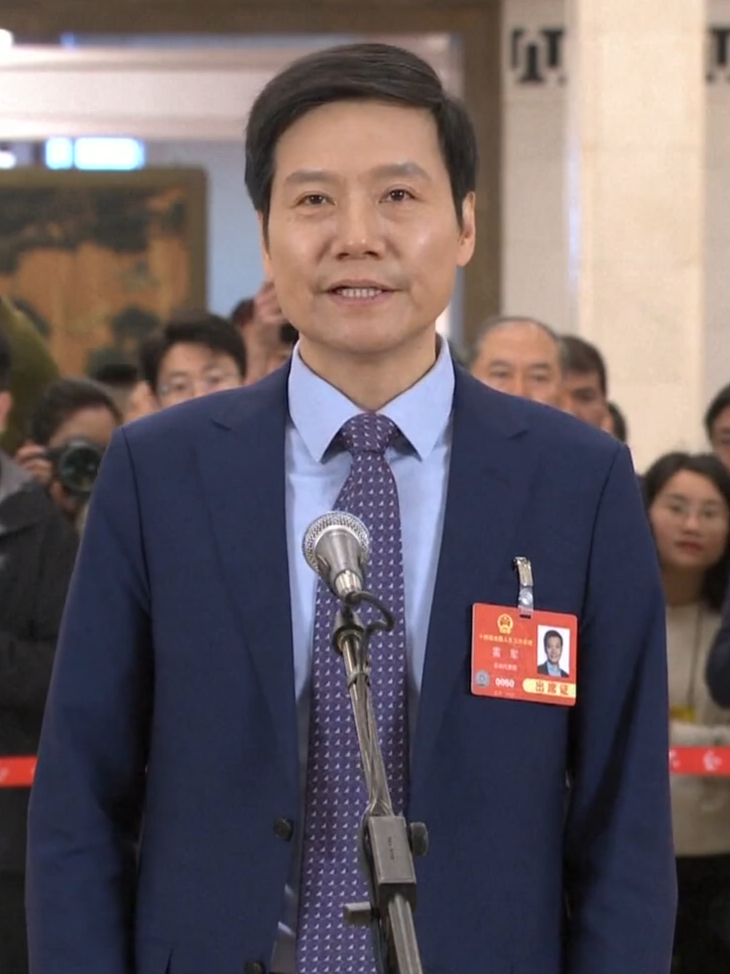
LEI JUN
Xiaomi founder — China's Steve Jobs who sells flagship phones at half the price
Lei Jun built Kingsoft (China's Microsoft Office competitor), made a fortune as an angel investor, then got bored at 40 and decided to take on Apple. Xiaomi now sells more phones than Apple in many markets and just launched an electric car that has Tesla worried. The man is 55 and somehow running a phone company, a car company, and an investment empire simultaneously. Either he doesn't sleep or he's three people wearing the same face.
Net Worth
$32 billion
Nationality
Chinese
Time Horizon
Long-Term
Risk Appetite
8 / 10
Net Worth Context
- · That's the GDP of a small country — around the size of Greenland.
- · Enough to buy an NBA team and keep $28B for snacks.
CAREER & BACKGROUND
Born in 1969 in Xiantao, Hubei, China. Graduated from Wuhan University in just two years.
Joined Kingsoft (Chinese software company) in 1992 at age 23 and became CEO by 1998. Led Kingsoft's IPO on the Hong Kong Stock Exchange in 2007.
Between Kingsoft and Xiaomi, became one of China's most prolific angel investors — backed YY (social platform), UCWeb (mobile browser acquired by Alibaba for $1.9B), and dozens of other startups. Founded Xiaomi in 2010 at age 41.
Xiaomi shipped its first phone in 2011 and hit $1 billion in revenue within two years. Xiaomi went public on the Hong Kong Stock Exchange in 2018 at a $54 billion valuation.
By 2024, Xiaomi was the world's third-largest smartphone maker by shipments. Launched the Xiaomi SU7 electric car in March 2024 — received 88,898 orders in the first 24 hours.
COMPANIES & ROLES
Xiaomi Corporation (founder and CEO), Kingsoft (former CEO, still chairman), Shunwei Capital (co-founder — manages $3B+ across 500+ investments). Angel investments include YY Inc., UCWeb, iQIYI, Duokan, and many others.
Xiaomi itself makes phones, smart home devices, laptops, wearables, electric scooters, and now electric cars.
INVESTING STYLE & PHILOSOPHY
Lei Jun is a builder-investor hybrid. His angel investing style is based on three criteria: big market, great founder, proven ability to execute.
He invests early and holds long. His company-building philosophy at Xiaomi is pure disruption — sell hardware at near-zero margins, build a massive user base, and monetize through internet services and ecosystem products.
He openly copies Apple's product presentation style but rejects Apple's pricing model entirely.
THE PLAYBOOK
Risk Approach
Very high. Lei Jun left a comfortable CEO position at Kingsoft to start a phone company from scratch at age 41, competing against Apple and Samsung.
He entered the EV market in 2024 against Tesla, BYD, and dozens of Chinese competitors. His entire business model — selling phones at cost — requires massive volume to work, meaning small execution errors can be catastrophic.
He bets big and bets often.
Money Habits
Despite being worth $32 billion, Lei Jun presents himself as an everyman. His Xiaomi product launches are deliberate Steve Jobs cosplay — black shirt, jeans, dramatic reveals.
He's deeply involved in product details, personally testing phones and cars. He livestreams regularly on Chinese platforms, engaging directly with customers.
He works notoriously long hours — colleagues say 996 (9am to 9pm, 6 days a week) is his minimum. He donated $1.5 billion in Xiaomi shares to charity in 2021.
BIGGEST WIN
Xiaomi's growth trajectory is the headline win. From zero to the world's third-largest phone brand in under a decade.
But the angel investing track record is equally impressive — his early bet on UCWeb returned over 100x when Alibaba acquired it for $1.9 billion. Shunwei Capital has backed over 500 companies with a strong hit rate.
The Xiaomi SU7 electric car launch getting nearly 90,000 orders in 24 hours is the most recent spectacular win.
BIGGEST MISTAKE
Xiaomi's initial IPO was disappointing. The company went public in 2018 at a $54 billion valuation — less than the $100 billion that was initially floated.
The stock dropped below IPO price almost immediately and stayed depressed for years. Lei Jun had overpromised on the "internet company" narrative, and investors treated Xiaomi like a hardware company with thin margins (which, honestly, it is).
The stock eventually recovered, but the IPO left a bruise on his reputation with international investors.
FINANCIAL PHILOSOPHY
Lei Jun believes hardware should be sold at cost or near-cost, and profits should come from services and ecosystem. He calls this the "triathlon model" — hardware + internet services + retail.
His deeper philosophy is that technology should be accessible to everyone, not just the wealthy. He's genuinely ideological about this — he sees high prices as a market failure, not a feature.
He also believes in moving incredibly fast and iterating publicly rather than perfecting in private.
FAMILY & PERSONAL LIFE
Married with children. Keeps his family life very private.
Known for his intense work ethic — employees say he's usually the last person to leave Xiaomi's offices.
EDUCATION
Graduated from Wuhan University with a computer science degree in just two years — completing the standard four-year program by age 20. This early academic achievement is a point of personal pride he frequently references.
BOOKS & RESOURCES
As an Amazon Associate, Netfigo earns from qualifying purchases. Book links above may be affiliate links.
QUOTES (6)
Standing on the right wind, even pigs can fly. The key is to find the wind — not to be a better pig.
A $2,000 phone that does the same thing as a $500 phone is not a superior product. It is a tax on people who don't know any better.
I finished college in two years because I had something to prove. Everyone told me I wasn't smart enough. So I decided to prove them wrong as fast as possible.
The internet model for hardware is simple: sell the device at cost, build a relationship with the user, and make money on services for the next ten years. The phone is not the product — the user is the product.
I started Xiaomi at 41 because I realized I had one more big fight left in me. If not now, when? If not this, what? Age is an excuse, not a reason.
Technology should be accessible to everyone. The idea that great products are only for rich people is the biggest lie in the tech industry.
NETFIGO SCORE
Proprietary 5-dimension investor rating
Risk Appetite
Contrarian Index
Track Record
Accessibility
Time Horizon
Head-to-Head
Compare Lei Jun vs another investor.