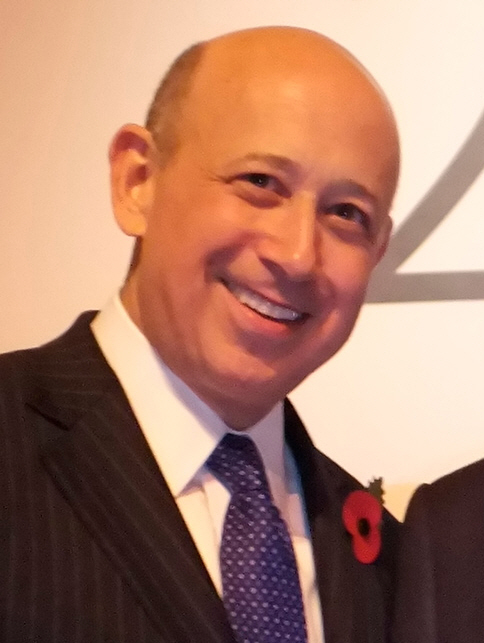
LLOYD BLANKFEIN
Running Goldman Sachs through the 2008 financial crisis and coining the phrase 'doing God's work' with a straight face.
Lloyd Blankfein grew up in a South Bronx housing project and ended up running the most powerful investment bank on the planet. He joined Goldman Sachs as a gold salesman in 1982, worked his way to CEO by 2006, and then steered the firm through the worst financial crisis since the Great Depression — while making a $523 million bonus the year before everything collapsed. Goldman got a $10 billion government bailout in 2008 and paid it back with interest. When asked what Goldman does, Blankfein said they were 'doing God's work.' He wasn't joking. That's either the most tone-deaf quote in Wall Street history or the most honest.
Net Worth
$1.1 billion
Nationality
American
Time Horizon
Medium-Term
Risk Appetite
7 / 10
Net Worth Context
- · Still a billionaire — just the quiet kind at the end of the table.
CAREER & BACKGROUND
Lloyd Blankfein was not supposed to end up at Goldman Sachs. He grew up in the Linden Houses, a public housing project in the South Bronx, New York.
His father sorted mail for the post office. His mother was a receptionist.
He got into Harvard on scholarship, graduated in 1975, went to Harvard Law, and briefly worked as a tax lawyer at Donovan Leisure before deciding law was too slow and too dull.
In 1982, he joined J. Aron & Company, a commodities trading firm, as a gold salesman.
Goldman Sachs had just acquired J. Aron the year before, and Blankfein didn't technically 'join Goldman' — he was absorbed into it.
That distinction mattered to the Goldman old guard. He was not a Goldman man in the traditional sense.
He was a trader from the commodities desk, not an investment banker. He spent years proving that didn't matter.
He climbed fast. By the late 1990s he was running J.
Aron's currency and commodities division. By 2002 he was co-head of Fixed Income, Currency and Commodities.
By 2004 he was president and COO of Goldman Sachs. In 2006, when Hank Paulson left to become Treasury Secretary under George W.
Bush, Blankfein stepped up to Chairman and CEO.
Timing, in finance, is everything. Blankfein took the helm in 2006 — right before everything went wrong.
The housing market was inflating. Goldman's own mortgage desk had loaded up on subprime exposure.
But Goldman also did something most banks didn't: they hedged their bets. While selling mortgage-backed securities to clients, Goldman was quietly shorting the same market.
The 'Big Short' trade made Goldman roughly $4 billion when the market collapsed in 2008.
That trade — and Goldman's role in it — became the defining controversy of Blankfein's tenure. In 2010, Goldman paid $550 million to settle SEC fraud charges related to the Abacus CDO deal, in which Goldman allegedly designed a product to fail and sold it to clients while a hedge fund (John Paulson's) bet against it.
Blankfein testified before the Senate. He kept his job.
Goldman's stock eventually recovered.
He stepped down as CEO in 2018 after 12 years in the role, handing off to David Solomon. By any measure, his run transformed Goldman from a partnership-culture firm into a global financial superpower — and made it one of the most scrutinized institutions in the world in the process.
In 2018, Blankfein was diagnosed with lymphoma. He announced it publicly, went through treatment, and was declared in remission the same year.
He has since remained active as a senior chairman, commentator, and occasional tweet-storm provocateur.
COMPANIES & ROLES
Goldman Sachs is the main event. It is the world's most prestigious investment bank — the firm that advises governments on debt issuance, companies on mergers, and manages money for the ultra-wealthy.
Under Blankfein's leadership from 2006 to 2018, Goldman's revenue peaked at over $45 billion annually, and the firm navigated the 2008 crisis better than virtually any other major bank. It's not a bank you walk into to open a checking account.
It's the firm that countries call when they need to restructure their debt and billionaires call when they want someone to take their company public.
J. Aron & Company, where Blankfein actually started, was a commodities and currency trading operation Goldman acquired in 1981.
Blankfein was a gold trader there before it was fully folded into Goldman. It's where he learned how to price risk, read markets, and move fast — skills that made him a better CEO than many of the investment bankers who looked down on commodities guys.
Since leaving Goldman, Blankfein has been involved in private equity, advisory work, and has been vocal on Twitter and in the media as a commentator on markets, politics, and macro trends. He joined the advisory board of Andreessen Horowitz in 2021, signaling at least some interest in the technology and venture world.
INVESTING STYLE & PHILOSOPHY
Blankfein is not a public markets investor in the traditional sense — he is not managing a hedge fund, picking stocks, or writing annual letters. He is an institutional thinker, a macro reader, and a risk manager.
His style is closer to a chess player than a stock picker: always thinking three moves ahead about what can go wrong.
At Goldman, his philosophy was built around stress-testing everything. Goldman under Blankfein was famous for asking 'what happens if we're wrong?' before any major position.
The firm's traders were encouraged to think asymmetrically — not just 'how much can we make?' but 'what's the worst case, and can we survive it?' That's how Goldman ended up shorting the housing market while selling it to clients. It's also what made Goldman deeply controversial.
Being right and being ethical are not always the same thing.
Blankfein believes in running toward complexity, not away from it. Goldman made money in mortgage derivatives, in commodity swaps, in currencies most banks couldn't price.
His instinct was always: if something is complicated and other people don't understand it, that's where the edge is. That edge comes with responsibility — and Goldman didn't always live up to it.
He's also a macro thinker. He watches interest rates, geopolitics, and credit cycles more than individual companies.
His public commentary since leaving Goldman has been consistently focused on systemic risks — inflation, Federal Reserve policy, sovereign debt levels. He thinks in terms of ecosystems, not individual bets.
THE PLAYBOOK
Risk Approach
Blankfein's risk philosophy is not 'avoid risk.' It's 'understand your risk, price it correctly, and make sure you can survive if you're wrong.' That distinction matters enormously. Goldman under his watch did not play it safe — they took enormous positions in complex instruments.
What they did differently was hedge. Almost everything had an offsetting position somewhere.
He has talked publicly about the concept of 'tail risk' — the idea that once-in-a-lifetime events happen more often than models predict. Goldman's response to that wasn't to avoid big bets; it was to make sure no single bet could kill the firm.
'You can take risks as long as you're not betting your existence on any single outcome' is essentially the Goldman Blankfein doctrine.
Personally, Blankfein is reportedly conservative with his own wealth relative to what you'd expect. He's not known as a wild speculator in private markets or a crypto true believer.
His risk tolerance in his own portfolio appears to skew toward capital preservation and diversification — which is somewhat ironic for a man who ran a firm that invented some of the most aggressive financial products in history.
Money Habits
Blankfein earned a $68.5 million compensation package in 2007 — the year before the financial crisis — which remains one of the most scrutinized executive pay packages in American history. He also reportedly received about $73.7 million in 2006.
Over his tenure at Goldman, his total compensation is estimated in the hundreds of millions of dollars.
Despite growing up in public housing, Blankfein has lived well as an adult. He owns a $27 million apartment in the Sherry-Netherland on Fifth Avenue in Manhattan — one of New York's most prestigious addresses.
He also has a home in the Hamptons. He's not known for conspicuous spending or extravagant public displays of wealth — there are no famous superyachts, no collections of private jets in his name.
His lifestyle is wealthy-New-Yorker standard: expensive and private, not flashy.
He's also been a significant philanthropist. He and his wife Laura have donated to Harvard, to healthcare initiatives, and to organizations focused on economic opportunity and social mobility — the kind of causes that make sense coming from someone who grew up poor and made it through education.
Since his lymphoma diagnosis and recovery in 2018, he has been notably active on Twitter and in the media — and notably not rushing to take a new full-time corporate role. He appears to be doing the billionaire semi-retirement thing: advisory boards, speaking, opining on markets, the occasional investment.
BIGGEST WIN
Goldman's mortgage short during the 2008 financial crisis is the defining trade of Blankfein's era. While the rest of Wall Street was underwater in subprime mortgage exposure, Goldman had quietly hedged its own positions — and in some cases actively shorted the market.
The result: Goldman made approximately $4 billion on the crisis that nearly destroyed its competitors. Bear Stearns collapsed.
Lehman Brothers went bankrupt. Merrill Lynch sold itself in desperation.
Goldman, after taking a $10 billion TARP bailout for systemic stability reasons, paid it back with interest in 2009 and posted a $13.4 billion profit that year. In 2009.
The year after the financial crisis. That is a remarkable outcome.
It came with enormous reputational cost and regulatory scrutiny that lasted years. But from a pure financial performance standpoint, steering the firm through 2008 and emerging stronger is the win of his career.
BIGGEST MISTAKE
The Abacus CDO deal is the mistake — or the thing that, fairly or not, defined the moral critique of Goldman under Blankfein. In 2007, Goldman helped design a collateralized debt obligation (basically a bundle of mortgage securities) called Abacus 2007-AC1.
What the SEC later alleged was that Goldman allowed hedge fund manager John Paulson — who was betting against the housing market — to help select the mortgages that went into the CDO, and then sold that CDO to other clients without disclosing Paulson's involvement or his bet against it. Goldman's clients on the other side of the trade lost over $1 billion.
Goldman settled with the SEC in 2010 for $550 million — the largest settlement ever against a Wall Street firm at that time. Goldman neither admitted nor denied wrongdoing.
Blankfein testified before the Senate Permanent Subcommittee on Investigations and was asked, in essence, whether Goldman was betting against the products it was selling to clients. His answer — technical, lawyerly, and widely seen as evasive — became a symbol of Wall Street's accountability problem.
He kept his job. Goldman kept most of its profits.
The reputational damage lasted years.
FINANCIAL PHILOSOPHY
Blankfein's financial philosophy starts with an insight about complexity: the more complicated something is, the fewer people can properly evaluate it, and the more important it is that someone can. Goldman's edge was always being one of the few institutions that could price complicated risk correctly — or at least better than everyone else.
He believes markets are mostly efficient but that edges exist in the gaps — in the moments when fear or greed or political pressure pushes prices away from reality. Goldman's job, in his framing, was to be the counterparty willing to provide liquidity when others fled.
That's not charity. That's very profitable.
He's also deeply pragmatic about regulation. He doesn't believe in zero regulation — he thinks well-designed rules create stable markets that are actually better for business in the long run.
But he has consistently pushed back against rules he sees as blunt instruments that don't understand how markets actually work. The argument is always the same: 'Let people who understand the plumbing design the plumbing.'
On risk, his philosophy is almost Stoic: identify the worst realistic outcome, decide if you can live with it, and then proceed. If you can't live with the worst case, don't take the position.
If you can, stop worrying about it and execute. That mentality ran through Goldman's culture during his tenure — and it's also what made them controversial when 'can we survive it?' and 'should we do it?' were treated as separate questions.
FAMILY & PERSONAL LIFE
Blankfein has been married to Laura Jacobs Blankfein since 1983. They have three children together.
Laura is reportedly his most important sounding board — he has referenced her counsel in interviews and speeches, and by most accounts theirs is a genuinely close partnership.
He grew up in the Linden Houses in the South Bronx with his sister. His father worked for the US Postal Service.
His mother was a receptionist. Those origins are not incidental to who he became — he has referenced them often as the reason he believes in meritocracy and in public institutions like education.
Getting into Harvard on a scholarship was, in his telling, the pivot point of his life.
In 2018, Blankfein publicly disclosed he had been diagnosed with a 'highly curable' form of lymphoma. He went through treatment while remaining at Goldman and was declared in remission later that year.
The disclosure was handled quietly and professionally — he said he was 'hopeful and encouraged' and didn't make it a public spectacle. He has since talked about the experience as clarifying: it changed how he thought about time and what mattered.
EDUCATION
Blankfein went to Thomas Jefferson High School in Brooklyn — a public school — before earning a scholarship to Harvard College, where he graduated in 1975 with a degree in government. He then went to Harvard Law School, graduating in 1978.
He practiced briefly as a tax attorney at the prestigious Donovan Leisure law firm before deciding that law was not where he wanted to be. The Harvard credentials opened doors, but it was the trading floor at J.
Aron — not the classroom — where Blankfein actually learned to think about money.
BOOKS & RESOURCES
Blankfein has not written a book, which is notable for someone of his profile
He has given enough interviews and congressional testimony that you could piece together a philosophy, but there's no definitive Blankfein text
Essential — it covers the firm's culture and history from the inside. Greg Smith's 'Why I Left Goldman Sachs' is the dissenting view, written by a Goldman executive who quit publicly in a New York Times op-ed in 2012, calling out what he saw as a toxic shift in the firm's culture under Blankfein. Read both
's 'The Shifts and the Shocks' is the macroeconomist's version of the same story
As an Amazon Associate, Netfigo earns from qualifying purchases. Book links above may be affiliate links.
QUOTES (6)
We're very important. We help companies to grow by helping them to raise capital. Companies that grow create wealth. This, in turn, allows people to have jobs that create more growth and more wealth. It's a virtuous cycle. We have a social purpose.
The moment I feel the most vulnerable is when I feel the most comfortable.
We didn't limit what we thought could go wrong to what had gone wrong recently. We tried to think about what could go wrong that hadn't gone wrong recently.
Success is not the key to happiness. Happiness is the key to success. But having said that, I don't know anyone who's happy who doesn't have a level of success.
I grew up in public housing. I believe in the institutions of this country. But I also believe that institutions have to earn trust, and that trust has to be maintained.
NETFIGO SCORE
Proprietary 5-dimension investor rating
Risk Appetite
Contrarian Index
Track Record
Accessibility
Time Horizon
Related Profiles
Investors
George Soros
Both operated at the top of the macro financial world and were vocal on systemic risk, though from very different institutional vantage points.
Jamie Dimon
Jamie Dimon and Blankfein were the two most powerful figures on Wall Street during the 2008 financial crisis, leading the two firms that emerged strongest from the collapse.
John Paulson
John Paulson's fund was the counterparty on the Abacus CDO that led to Goldman's $550M SEC settlement — one of the defining controversies of Blankfein's tenure.
Head-to-Head
Compare Lloyd Blankfein vs another investor.