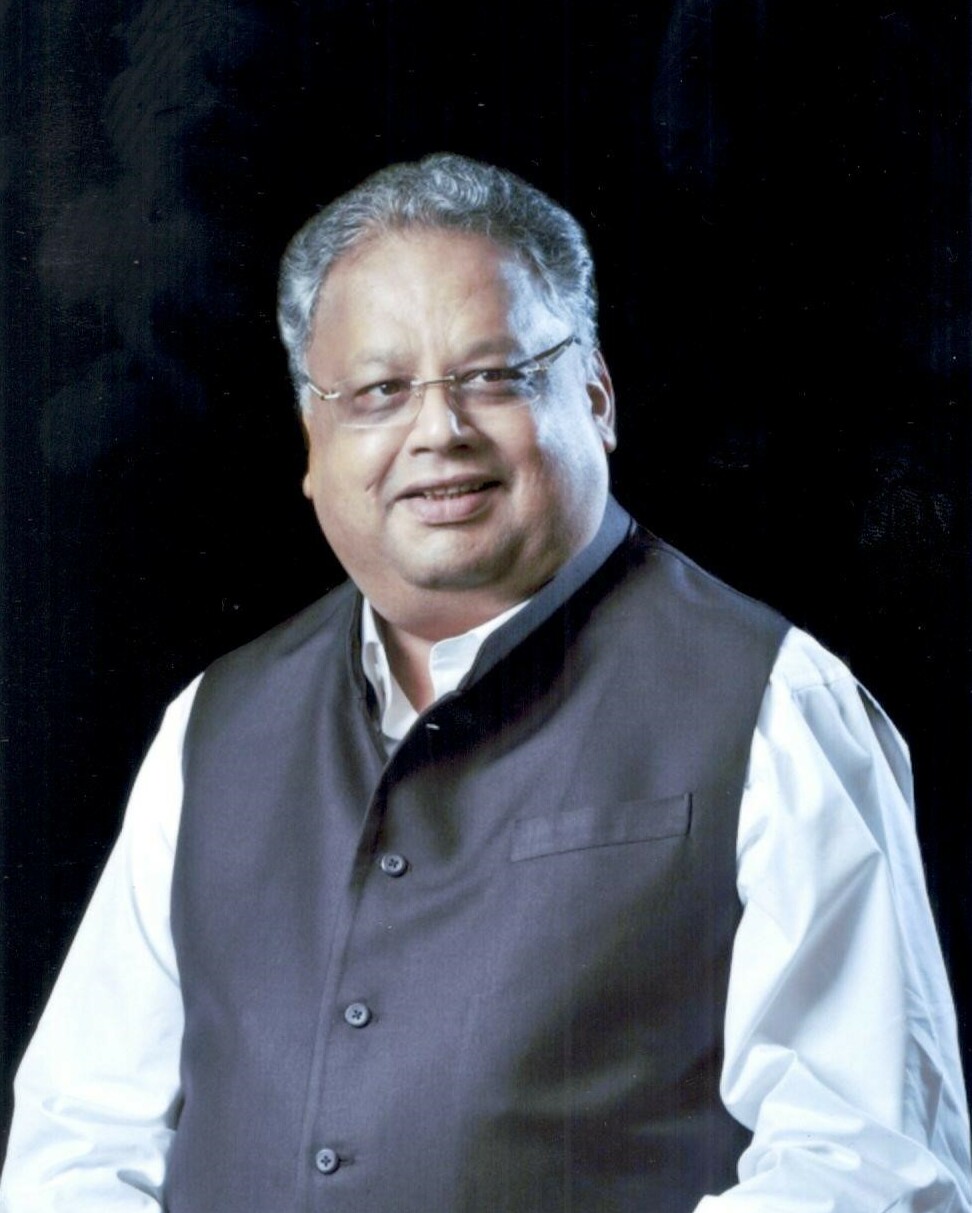
RAKESH JHUNJHUNWALA
India's Warren Buffett — turned $100 into $5.8 billion by betting big on Indian equities
The man who started with 5,000 rupees (about $100) as a college student and turned it into a $5.8 billion fortune by the time he died in 2022. Jhunjhunwala didn't use algorithms, didn't hedge, and didn't diversify internationally — he just believed in India harder than anyone else and backed it with real money. He was loud, opinionated, and almost always right about Indian stocks. The Big Bull earned his nickname.
Net Worth
$5.8 billion (at time of death, 2022)
Nationality
Indian
Time Horizon
Long-Term
Risk Appetite
8 / 10
Net Worth Context
- · Still a billionaire — just the quiet kind at the end of the table.
CAREER & BACKGROUND
Started trading in 1985 while still in college, with just 5,000 rupees ($100). His father refused to fund him — told him to earn it in the market.
Made his first big money in the 1986 Tata Tea rally. By 2000, he was managing a portfolio worth over $50 million.
His bet on Titan Company in 2003 at around ₹3 per share (split-adjusted) turned into one of the greatest Indian stock trades ever — Titan eventually hit ₹2,500+. Founded Rare Enterprises as his investment firm.
Co-founded Akasa Air, a budget airline, in 2022 — just months before his death. At his peak, he held significant stakes in over 30 publicly traded Indian companies.
Passed away in August 2022 at age 62.
COMPANIES & ROLES
Titan Company — his most famous bet. Bought in 2003, held for nearly 20 years.
Also held major positions in Tata Motors, Lupin, Crisil, Escorts, Star Health, NCC, Aptech, and Rallis India. Co-founded Akasa Air.
His firm Rare Enterprises managed his personal portfolio and select client money.
INVESTING STYLE & PHILOSOPHY
Jhunjhunwala was a momentum-aware value investor — which sounds contradictory until you see his track record. He'd buy companies he believed were fundamentally undervalued, but he wanted to see the price already turning upward before he committed big.
He called this "letting the market confirm the thesis." He concentrated heavily — when he was right, he went all in. He rarely shorted stocks.
He loved consumer-facing businesses, especially ones riding India's growing middle class. He held Titan for nearly two decades, adding on every dip.
THE PLAYBOOK
Risk Approach
Extremely high risk tolerance but not reckless. Jhunjhunwala took concentrated bets that would make most fund managers physically ill.
He once had over 30% of his portfolio in a single stock. But his risk was always calculated — he spent months researching before committing.
He said the key was "not risking money you can't afford to lose" early on, and "not being afraid to risk big when you know you're right" once you have a cushion. He also wasn't afraid to take losses quickly when a thesis broke.
Money Habits
Jhunjhunwala lived large. Unlike Buffett, he didn't pretend to be frugal.
He had a sea-facing apartment in Mumbai worth over $60 million. He drove luxury cars, traveled first class, and threw lavish parties.
He said the whole point of making money was to enjoy it. But he was also incredibly disciplined about his investing routine — he'd wake up early, read everything about his holdings, and spend hours on the phone with company management teams.
He tracked his portfolio obsessively, even on vacation. He donated tens of millions to education and healthcare in India.
BIGGEST WIN
Titan Company — bought shares around ₹3 (split-adjusted) starting in 2003. By 2022, the stock was trading above ₹2,500.
That single bet generated returns of over 80,000%. His stake in Titan alone was worth over $1.5 billion at its peak.
He saw that Tata's jewelry brand Tanishq was about to transform how Indians bought gold — from unbranded local shops to modern retail. He was right about a cultural shift, not just a stock.
BIGGEST MISTAKE
He was publicly bullish on Suzlon Energy, an Indian wind power company. The stock collapsed from over ₹400 to under ₹10 between 2008 and 2013.
Jhunjhunwala held on for too long, losing hundreds of millions. He later admitted he let his emotional attachment to the green energy thesis override the deteriorating fundamentals.
He also lost money on A2Z Infra and some real estate plays that didn't pan out.
FINANCIAL PHILOSOPHY
Jhunjhunwala believed India was the greatest investment opportunity on Earth and he never wavered from that view. His philosophy was simple: India's demographics, democracy, and entrepreneurial energy meant the country would grow faster than anywhere else for decades.
He said "I will always be bullish on India" — and he meant it literally. He never diversified into US or European markets.
His second core belief was that great businesses compound over decades, so the best thing you can do after buying a great stock is absolutely nothing.
FAMILY & PERSONAL LIFE
Married Rekha Jhunjhunwala in 1987. They had three children — Aryaman, Aryavir, and Nishtha.
Rekha continues to manage the family's investment portfolio through Rare Enterprises after his death. Jhunjhunwala was known for being intensely private about his family despite being very public about everything else.
EDUCATION
Graduated from Sydenham College of Commerce and Economics in Mumbai. Then completed his Chartered Accountancy (India's equivalent of CPA, but significantly harder — pass rates are typically under 10%).
Started trading during college, which his professors reportedly weren't thrilled about.
BOOKS & RESOURCES
He was a voracious reader but didnt publicly recommend specific investing books
He preferred annual reports and financial statements to investing bestsellers. He did recommend studying the history of Indian business families — the Tatas, Birlas, Ambanis — to understand how wealth compounds across generations in India. He admired Warren Buffett but said Buffett's methods needed adaptation for Indian market conditions
QUOTES (6)
I have always believed that India is the best country to invest in. Not because I'm patriotic, but because 1.4 billion people waking up every morning wanting a better life is the most powerful economic force on Earth.
The stock market is not a place to get rich quickly. It is a place to get rich slowly, and then one day you wake up and realize you're rich.
My father told me — don't ask me for money. Whatever you make, make it from the market. That was the best advice I ever got.
When you buy a stock, you should be willing to hold it even if the stock market shuts down for five years. If you can't do that, you have no business being in equities.
I have made more money sitting on my behind than by actively trading. The art is not in buying — it's in holding.
NETFIGO SCORE
Proprietary 5-dimension investor rating
Risk Appetite
Contrarian Index
Track Record
Accessibility
Time Horizon
Head-to-Head
Compare Rakesh Jhunjhunwala vs another investor.