
NETFIGO SCORE BATTLE
ORIGINAL DATARisk Appetite
Contrarian Index
Track Record
Accessibility
Time Horizon
AT A GLANCE
INVESTING STYLE
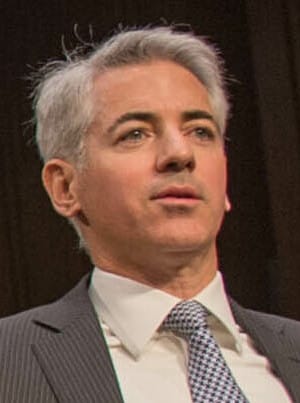
Bill Ackman
Ackman is a concentrated, long-hold, activist investor. He typically owns 5–10 positions at a time — sometimes fewer.
Each one involves exhaustive research. If he's buying, he has usually already built a 100-slide deck explaining exactly what's wrong with the company and exactly what needs to change to fix it.
His style is the opposite of index investing. He wants a controlling voice at the table.
He wants to talk to the CEO. He wants the board to change.
That's the "activist" part — he's not just buying a stock and hoping it goes up. He's buying it with a plan to force the thing that will make it go up.
The strategy works until it doesn't. When the thesis is right, he wins massively.
When the thesis is wrong and he's also very public about it, the losses are spectacular.
Farnoosh Torabi
Torabi is a practical, diversified, automation-focused investor. She believes in maxing out tax-advantaged accounts first (401k, Roth IRA), investing in low-cost index funds, and automating everything so investing isn't a decision you make each month.
She's not a stock picker and doesn't pretend to be. Her approach: the market will go up over time, so get in early, stay in, keep costs low, and don't try to time anything.
She's in the Bogle camp philosophically.
What makes her perspective different is her focus on the earning side. Most personal finance advice is about spending less and saving more.
Torabi argues that growing your income — through negotiation, side hustles, career moves — is a more powerful lever than cutting expenses. You can only cut so much.
There's no ceiling on what you can earn.
FINANCIAL PHILOSOPHY
Bill Ackman
Ackman's core belief is that markets frequently misprice assets when the story around them is either too negative or too complicated. He looks for businesses he can understand deeply, with a gap between what the market thinks they're worth and what he thinks they're worth.
He's talked extensively about asymmetric bets — situations where you can be wrong and lose a small amount, but right and make a lot. He believes activist investing works because most company boards are too comfortable and most CEOs have too little accountability.
He thinks public pressure, when backed by real analysis, is a legitimate tool for creating value. Whether that makes him a hero or a villain depends on which company you ask.
Farnoosh Torabi
Torabi's philosophy has three pillars. First: earn more.
She believes income growth is the most underrated financial strategy. Cutting lattes saves you $5 a day.
A salary negotiation can be worth $10,000 a year — compounding forever.
Second: automate and simplify. She doesn't want people thinking about money every day.
Set up the systems — automatic savings, automatic investing, automatic bill pay — and then spend your mental energy on earning more and living well.
Third: talk about money openly. She thinks financial secrecy — between partners, between friends, between parents and kids — is the biggest barrier to financial health.
Her podcast is built on this idea: hearing how real people handle money normalizes the conversation and makes everyone smarter.
Her most resonant principle: financial independence isn't about being rich. It's about having enough that no person, no job, and no situation has power over you.
RISK TOLERANCE
Bill Ackman
Ackman runs highly concentrated books and uses leverage. That's the opposite of conservative.
He'll put 20–30% of the fund in a single position if he believes in it. He also uses options and credit derivatives — his March 2020 COVID hedge was built using credit default swaps, instruments most retail investors have never heard of.
He famously described his risk approach as: "I only invest when the downside is zero and the upside is unlimited" — which sounds great until you lose $4 billion on one trade. The honest version is: he's a high-conviction investor with a high tolerance for pain on the way to being right.
Farnoosh Torabi
Moderate. She believes in taking appropriate risk for your age and goals — more aggressive when young, more conservative as you approach needing the money.
She's not afraid of the stock market but doesn't advocate for concentrated bets or speculative investments.
She stresses the importance of an emergency fund and having "go-to-hell money" — enough cash saved that you can walk away from a bad job, a bad relationship, or a bad situation without financial panic. She frames this as a safety net and a power tool.
THE PLAYBOOK
Bill Ackman
Ackman has a taste for the finer things and doesn't pretend otherwise. He owns a large Manhattan apartment, he's been photographed at high-end charity events, and his social circle overlaps with New York media, finance, and political elite.
He and his second wife, Neri Oxman, have a high public profile — she's a former MIT professor and design pioneer. He is a Harvard alumnus, twice over, and gave to the school for years, though the relationship became famously strained in 2023 when he led a very public campaign against Harvard's president over campus antisemitism, ultimately contributing to her resignation.
He is not a guy who stays quiet about anything.
Farnoosh Torabi
Torabi is thoughtful about spending. She talks about "spending audits" — periodically reviewing every subscription, recurring charge, and discretionary spend to make sure it still aligns with what you actually value.
She and her husband split finances in a way she's been open about: joint accounts for shared expenses (mortgage, kids, household), separate accounts for individual spending. No permission needed for personal purchases under a certain threshold.
She frames this as both financial and relationship advice.
She lives in the New York area with her family. She's not flashy about spending but she's also not a frugality absolutist — she believes in spending on things that bring genuine joy while cutting things that don't.
BIGGEST WIN
Bill Ackman
The COVID hedge in March 2020 is the one. As markets started selling off in late February, Ackman quietly spent $27 million buying credit default swaps — basically insurance on corporate bonds defaulting if the economy collapsed.
He then went on CNBC on March 18, 2020, visibly emotional, and said "hell is coming." The market kept dropping. Three weeks later, he unwound the trade.
The $27 million had turned into $2.6 billion. That's roughly a 100x return in under a month.
He used the proceeds to buy stocks at the market bottom. He then made another fortune as markets recovered.
The whole sequence — hedge, cry on TV, buy the dip, profit — is one of the more remarkable individual trade sequences in recent hedge fund history.
Farnoosh Torabi
The So Money podcast is the biggest professional win. Over 1,500 episodes, consistently in the top personal finance charts, and it's given her a platform that reaches millions.
The podcast opened doors to corporate speaking, books, and media opportunities.
"When She Makes More" was a cultural win — it started a national conversation about breadwinner women and money dynamics in relationships. She was on every major talk show discussing it, and it positioned her as someone willing to tackle the uncomfortable money topics that other advisors avoid.
BIGGEST MISTAKE
Bill Ackman
The Valeant Pharmaceuticals disaster is the one. Ackman built a massive position in Valeant starting in 2015, eventually owning about $4 billion worth of shares.
His thesis was that Valeant's model — aggressively raising drug prices and cutting R&D — was brilliant. Congress, journalists, and eventually the SEC had a different view.
The stock collapsed from $260 to under $10. Ackman spent months publicly defending the position, appearing on CNBC repeatedly to explain why it would recover.
It didn't. He finally sold in 2017 at a loss of approximately $4 billion.
It's the most expensive public loss in hedge fund activism history. The lesson he's cited: don't get emotionally attached to a position, and be faster to recognize when the fundamental thesis has broken.
Farnoosh Torabi
Torabi has been honest about her biggest regret: not negotiating her salary aggressively enough early in her career. As a journalist, she accepted what was offered because she felt grateful to have the job.
She later calculated how much that cost her over a decade of compounding raises and says the number is "depressing."
She uses this story constantly in her teaching — it's her most practical lesson. One conversation about your salary in your 20s can be worth hundreds of thousands of dollars over a career.
She now coaches women specifically on salary negotiation because she knows the cost of not doing it.
CAREER HIGHLIGHTS
Bill Ackman
Bill Ackman grew up in Chappaqua, New York, the son of a real estate finance chairman. He was a history major at Harvard — class of 1988 — then went straight to Harvard Business School.
His first venture was Gotham Partners, a real estate and value investing fund he started in 1992 with a Harvard classmate. It was a disaster.
The fund made concentrated bets on illiquid real estate and had to be wound down by 2003 under serious investor pressure and SEC scrutiny.
He didn't quit. In 2004 he launched Pershing Square Capital Management, this time with a clearer focus: take large stakes in companies, go public with his thesis, and use activist pressure to force management changes.
The approach worked. His reputation was built on detailed, public investment presentations — sometimes running 100+ slides — that became must-reads on Wall Street.
He turned activist investing into something that felt more like journalism than finance: research a company, find what's broken, publish everything, and bet heavily on being right.
Farnoosh Torabi
Farnoosh Torabi was born in Worcester, Massachusetts, to Iranian immigrant parents who came to the US with almost nothing. Her parents worked multiple jobs — her mother cleaned houses, her father worked in tech.
Money was tight but education was non-negotiable. She grew up watching her parents navigate the American financial system without a manual.
She went to Penn State, then got a master's from Columbia University's Graduate School of Journalism. She started her career as a financial journalist, writing for Money Magazine, TheStreet.com, and the New York Times.
She covered personal finance from the journalism side — not as an advisor, but as a reporter who could translate complicated money topics into stories people actually wanted to read.
Her first book, "You're So Money," came out in 2008 — right when the financial crisis was making everyone panic about money. The timing was either terrible or perfect depending on how you look at it.
The book was aimed at twenty-somethings trying to be financially savvy without giving up their lives.
Her breakout book was "When She Makes More" in 2014. It tackled the taboo topic of relationships where the woman is the primary breadwinner — the financial, emotional, and relationship dynamics that nobody in personal finance was talking about.
It got massive press attention because it said the quiet part out loud: traditional gender expectations around money are still wrecking relationships, even among progressive couples.
In 2015, she launched the "So Money" podcast. It's now past 1,500 episodes, featuring interviews with everyone from billionaires to regular people sharing their financial wins and disasters.
It consistently ranks in the top personal finance podcasts. The show's strength is range — one episode might feature a CEO, the next a single mom who paid off $100,000 in debt.
COMPANIES & ROLES
Bill Ackman
Pershing Square Capital Management is his flagship hedge fund, managing around $16 billion. His most famous public positions have included Canadian Pacific Railway, where he pushed successfully for a new CEO and a turnaround that made Pershing Square hundreds of millions.
He held a massive position in Valeant Pharmaceuticals from 2015 to 2017 — which will come up again. He took a huge bet on General Growth Properties during the 2008 financial crisis when no one else would touch it.
That one returned over $1 billion.
He has also done business on the other side: Pershing Square Holdings is his publicly listed vehicle on Euronext Amsterdam, which lets retail investors access his fund — unusual for a hedge fund of this size. He's been a major Burger King and Restaurant Brands International investor, and he backed Fannie Mae and Freddie Mac preferred shares in a long-running legal battle with the government.
Farnoosh Torabi
So Money Media is her primary business — the podcast, newsletter, and associated content. The podcast has featured over 1,500 guests and has a dedicated audience.
She's a contributor to CNET and has written for or appeared on virtually every major financial media outlet — CNBC, CNN, NBC, Forbes, O Magazine, and more. Corporate speaking is a significant revenue stream.
She doesn't manage money or run a fund. Her business model is content, education, and corporate partnerships.
She's done branded content with major financial companies — always disclosed, and she's careful about maintaining editorial independence.
EDUCATION
Bill Ackman
Harvard College, BA in History, 1988. Harvard Business School, MBA, 1992.
He's been a major Harvard donor — and major Harvard critic — throughout his career. The irony of his most public fight being with his own alma mater was not lost on anyone.
Farnoosh Torabi
Torabi has a bachelor's degree from Penn State and a master's in journalism from Columbia University. The journalism background is her edge — she approaches personal finance as a storyteller and investigator, not as a financial advisor.
She can take complex topics and make them compelling, which is why her podcast works where others don't.
BOOKS & RESOURCES
Bill Ackman
Ackman hasnt written a book, but his annual letters and investment presentations are some of the most-read documents in the hedge fund world
His 334-slide Herbalife short presentation from 2012 is a masterclass in short-selling research — and in being publicly, expensively wrong for several years before eventually being right
For understanding his world: read Confidence Game by Christine Richard, which covers his early career and the MBIA short
It's a tight, compelling read about how activist investing actually works, including the messy parts
As an Amazon Associate, Netfigo earns from qualifying purchases. Book links above may be affiliate links.
Farnoosh Torabi
For people who want a practical, no-BS money system
A critical look at the personal finance industry itself
As an Amazon Associate, Netfigo earns from qualifying purchases. Book links above may be affiliate links.