Compare / Chamath Palihapitiya vs Anas Sefrioui
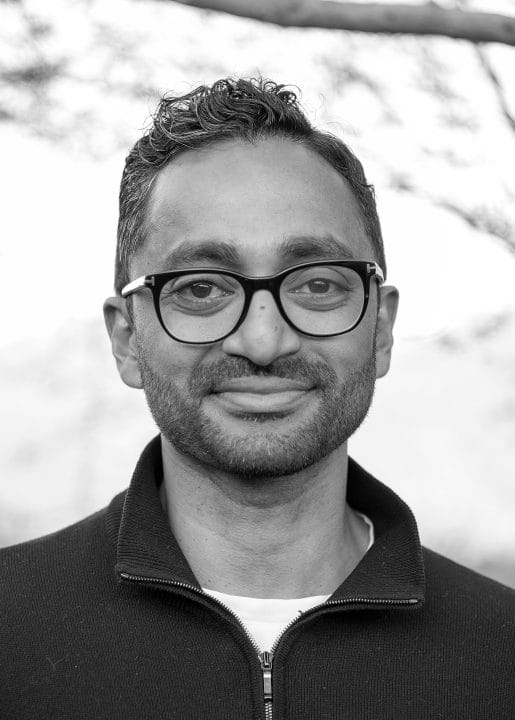
CHAMATH PALIHAPITIYA
Venture capitalist, SPAC pioneer, and outspoken tech investor known as the "SPAC King"

ANAS SEFRIOUI
Building Morocco’s largest real estate empire from scratch and constructing over 300,000 affordable homes acro…
NETFIGO SCORE BATTLE
ORIGINAL DATARisk Appetite
Contrarian Index
Track Record
Accessibility
Time Horizon
AT A GLANCE
INVESTING STYLE
Chamath Palihapitiya
Palihapitiya is a concentrated, long-term, thematic technology investor. He focuses on what he calls "social capital" — investments in companies addressing large, structural problems in healthcare, education, financial services, and climate.
He runs relatively concentrated positions and holds for years. He is also a very public investor — he shares his theses on Twitter, on the All-In Podcast (which he co-hosts), and in interviews, which creates its own dynamic around his picks.
Anas Sefrioui
Sefrioui is a real estate operator first, investor second. He builds companies, not portfolios.
His growth approach has always been organic — acquire land, develop it, sell units, reinvest. No interest in financial markets or passive allocation.
The Africa expansion was the one big strategic bet beyond his home market. Bold in concept.
Mixed in execution.
FINANCIAL PHILOSOPHY
Chamath Palihapitiya
Palihapitiya's stated philosophy is that the most important investments are in businesses that address large, structural failures in society — broken healthcare, broken education, broken financial services. He believes technology is the only force powerful enough to fix these systems at scale, and that venture capital is the right vehicle for funding that change.
He has been vocal about the failures of traditional finance to allocate capital toward genuine societal problems. Whether his actual investments have matched this rhetoric is, charitably, debatable.
Anas Sefrioui
Build where people actually need to live. Volume beats margin.
The goal is not the most impressive building but the most buildings. He has consistently argued that Africa’s housing deficit — running into the hundreds of millions of units — is the biggest real estate opportunity on earth.
RISK TOLERANCE
Chamath Palihapitiya
Palihapitiya has a high tolerance for concentrated, binary bets. SPAC investing is inherently binary: the merger either works or it doesn't.
He has made multiple bets where the downside was essentially total loss for investors who followed him in at the wrong price. He is less disciplined about risk management than the hedge fund managers on this list — his approach is more venture-style, where most bets lose and a few win big.
The problem is that his most public bets have often been the ones that lost.
Anas Sefrioui
High on operational bets, low on financial market speculation. Building in emerging markets involves real currency exposure, regulatory uncertainty, and infrastructure gaps — Sefrioui leaned into all of them.
The 2020 legal troubles showed that close proximity to political capital can also become a liability overnight.
THE PLAYBOOK
Chamath Palihapitiya
Palihapitiya held a roughly 2% stake in the Golden State Warriors and called it his most expensive hobby. He owns significant real estate, travels by private jet, and has not been shy about his wealth.
He is also publicly generous with his opinions, which usually costs him nothing. In January 2022 he said on his podcast that "nobody cares" about the Uyghurs in China.
The Warriors publicly distanced themselves within days, he issued a partial retraction, and he sold his entire stake in the team later that year. He is not someone who stays quiet and stays safe.
Anas Sefrioui
Not known for conspicuous consumption. His wealth has been largely tied up in Addoha shares and land holdings rather than liquid assets.
He is a builder, not a spender.
BIGGEST WIN
Chamath Palihapitiya
The early Facebook bet is the clearest win. Palihapitiya joined Facebook in 2007 when it had 50 million users and received substantial equity.
His four-year tenure as VP of Growth coincided with the company growing to 700 million users. When Facebook went public in 2012, his stake was worth hundreds of millions of dollars.
He also invested in Slack at an early stage — the collaboration tool was acquired by Salesforce in 2021 for $27.7 billion — and Box, which had a successful IPO. The Social Capital vintage-1 and vintage-2 funds performed well by any VC standard.
Anas Sefrioui
The 2006 Casablanca Stock Exchange IPO. Raising 6 billion Moroccan dirhams on the back of a simple affordable housing story, in a market that was not yet sophisticated, was a remarkable capital markets achievement.
It funded the next decade of growth.
BIGGEST MISTAKE
Chamath Palihapitiya
The SPAC era is the obvious answer. His SPACs — particularly Clover Health (which he backed strongly and which dropped from a peak of around $17 to under $3) and Open Door (which fell similarly) — caused significant losses for retail investors who bought in based on his endorsement.
A short-seller report alleged that Clover Health had undisclosed problems, and the stock never recovered. His broader SPAC portfolio has dramatically underperformed.
The criticism is specific: he was paid significant sponsor fees and promote shares at the time of SPAC launch, giving him economic incentives that differed from the retail investors who followed him in.
Anas Sefrioui
Expanding into Sub-Saharan Africa too quickly, without enough local partnerships and local capital structures, created operational strain. The 2020 legal case may also trace back to financial engineering under pressure from the Africa overextension.
Governance did not scale as fast as ambition.
CAREER HIGHLIGHTS
Chamath Palihapitiya
Palihapitiya was born in Sri Lanka in 1976 and moved to Canada with his family when he was six. His father struggled with alcoholism and the family relied on government assistance.
He studied electrical engineering at the University of Waterloo, graduating in 1999. He joined Winamp's parent company, then moved to AOL during the dot-com boom.
When that era collapsed, he joined a small startup called Facebook in 2007 as VP of User Growth.
His work at Facebook was instrumental. He oversaw the team that grew the platform from 50 million to 700 million users, designing the growth loops and viral mechanisms that made Facebook the dominant social network.
He left in 2011, reportedly unhappy with Facebook's direction on privacy and user data — something he has discussed publicly since, including saying on a podcast that he had "tremendous guilt" about what social media had done to society. After Facebook he founded Social Capital in 2011 as a venture firm, then pivoted it dramatically.
Anas Sefrioui
Anas Sefrioui was born in 1956 in Fez, Morocco. He started in real estate in the 1980s with small construction projects in Casablanca.
In 1988 he formally founded Groupe Addoha — later incorporated as Douja Promotion Group. For two decades he focused exclusively on affordable and mid-range housing, staying far from the luxury segment.
The strategy paid off. The 2006 Casablanca Stock Exchange IPO raised around 6 billion dirhams, was heavily oversubscribed, and pushed his personal wealth to an estimated billion, briefly making him one of the richest people in Africa.
Through the 2010s he expanded into Sub-Saharan Africa — Ivory Coast, Senegal, Ghana, and Cameroon — targeting the same underserved affordable housing market. Then came the turbulence.
A restructuring of Morocco’s affordable housing subsidy program hit margins hard. In 2020, Moroccan authorities charged him in connection with a mortgage fraud case linked to Crédit Immobilier.
He denied the charges. The Addoha stock price fell sharply.
The Africa expansion slowed. He remains one of the most significant real estate figures the continent has produced.
COMPANIES & ROLES
Chamath Palihapitiya
Social Capital, founded in 2011, started as a traditional venture capital fund and invested in companies like Slack, Box, and SurveyMonkey. Several of those early bets did well.
But Palihapitiya grew frustrated with the traditional VC model — the fund-of-funds structure, the LP relationships, the consensus decision-making — and in 2018 he converted Social Capital into a family office structure.
He then became the most prominent figure in the SPAC boom of 2020–2021. SPACs — Special Purpose Acquisition Companies — are shell companies that raise money through an IPO and then use those funds to merge with a private company, taking it public.
Palihapitiya launched several, including IPOD, IPOE, and IPOF (yes, those were the actual tickers). His SPACs took public companies including Clover Health and Open Door.
Both suffered steep declines after going public. His basket of SPACs collectively destroyed significant investor capital.
Anas Sefrioui
Groupe Addoha (Douja Promotion Group) is the whole story. Listed on the Casablanca Stock Exchange under the ticker ADH, its market cap peaked near 25 billion dirhams.
The company builds residential properties across four segments: affordable, mid-range, upper mid-range, and a small luxury slice — though the bread and butter has always been the lower two. At its height, Addoha delivered tens of thousands of housing units per year across Morocco and several Sub-Saharan African markets.
Sefrioui also built out logistics and manufacturing businesses tied to construction supply chains.
EDUCATION
Chamath Palihapitiya
University of Waterloo, BASc in Electrical Engineering, 1999. He has spoken about the Canadian university system being accessible regardless of family wealth, crediting it as the mechanism that made his career possible.
He does not come from Harvard or Stanford — something he occasionally references as a point of difference from the VC mainstream.
Anas Sefrioui
Educated in Morocco in real estate and construction. Not known for Western business school credentials.
He built his expertise in the field, not the classroom.
BOOKS & RESOURCES
Chamath Palihapitiya
Palihapitiya does not have a book but the All-In Podcast is one of the most substantive public forums for understanding how he thinks about markets, technology, and policy
The episodes where he discusses healthcare and education reform are particularly revealing about his stated investment thesis
Essential reading for understanding the Facebook growth era he was part of
As an Amazon Associate, Netfigo earns from qualifying purchases. Book links above may be affiliate links.
Anas Sefrioui
Stripped of the politics, it captures the land-banker mindset he has always embodied
Introduced millions to the idea that real estate builds wealth in ways employment never can
The Intelligent Entrepreneur by Bill Murphy Jr. speaks to the relentless, opportunity
Driven building Sefrioui exemplifies
Africa Rising by Vijay Mahajan laid out the case for Africa’s emerging consumer class years before it became consensus — and is the best intellectual framework for understanding his Africa strategy.
As an Amazon Associate, Netfigo earns from qualifying purchases. Book links above may be affiliate links.