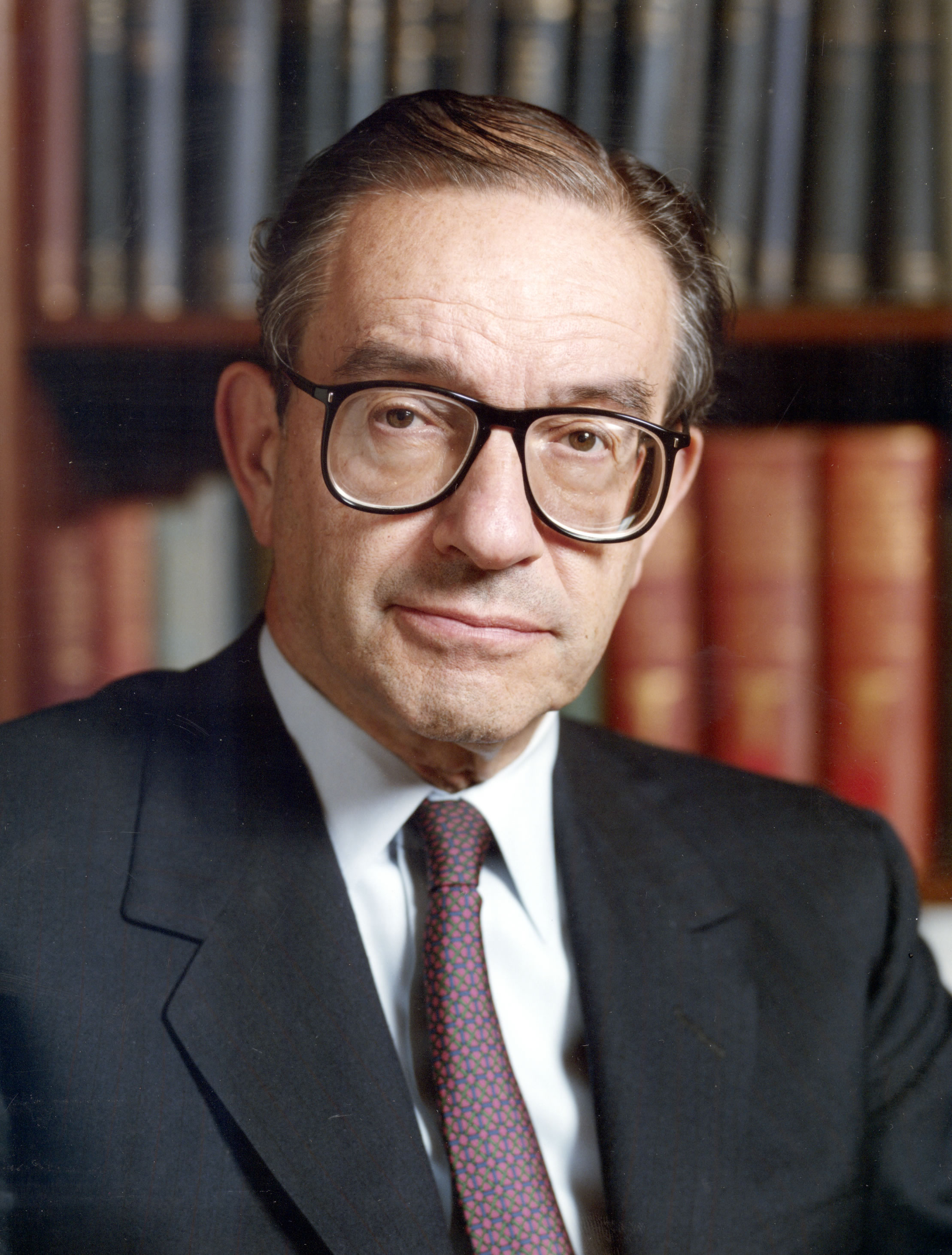
ALAN GREENSPAN
Running the Federal Reserve for 18 years — then admitting before Congress that he got the most important thing wrong
Alan Greenspan ran the most powerful central bank in the world for 18 years, was called The Maestro by everyone who mattered, and then sat before Congress at age 82 and admitted there was a fundamental flaw in his 40-year belief that banks would self-regulate. It is one of the most consequential public admissions of error in economic history — and also a reminder that being right for a very long time does not mean you are right about the thing that matters most.
Net Worth
$25M
Nationality
American
Time Horizon
Long-Term
Risk Appetite
4 / 10
CAREER & BACKGROUND
Alan Greenspan served as Chairman of the Federal Reserve from 1987 to 2006 — 18 years across four presidencies. Wall Street called him "The Maestro." He presided over the longest peacetime expansion in US history, navigated the 1987 Black Monday crash (down 22% in one day), the dot-com bubble, and 9/11.
Then he retired in 2006. Two years later, the financial system collapsed.
In a 2008 Congressional hearing, Greenspan admitted there was a "flaw" in his ideology — specifically, his belief that banks would self-regulate because their rational self-interest would prevent reckless behavior. He was wrong.
He was 82 years old when he said it. It remains one of the most remarkable admissions of error by a major policymaker in modern history.
COMPANIES & ROLES
Federal Reserve — Chairman (1987–2006). Townsend-Greenspan & Co.
— Founder and CEO (private economic consulting, pre-Fed). Various bank boards and advisory roles post-retirement
INVESTING STYLE & PHILOSOPHY
Free market fundamentalist — deeply influenced by Ayn Rand, a personal friend. As Fed chairman, he kept interest rates low for extended periods, opposed derivative regulation, and believed housing prices couldn't fall on a national basis simultaneously.
He was wrong about that last part in a way that cost the global economy trillions.
THE PLAYBOOK
Risk Approach
4
Money Habits
Wrote two books post-retirement. Known for notoriously opaque "Greenspeak" — deliberately vague language that became a Wall Street art form to decode.
The revolving door: made considerably more money consulting for banks after leaving the Fed than he ever made running it.
BIGGEST WIN
The 1987 Black Monday response. He became Fed chairman four days before the largest single-day percentage market drop in history.
His swift communication and liquidity injection stabilized markets within days and established his credibility for the next two decades.
BIGGEST MISTAKE
The housing bubble and the 2008 financial crisis. Extended low rates in the early 2000s contributed to the bubble.
His opposition to regulating credit default swaps and complex derivatives left the financial system structurally exposed. His 2008 Congressional testimony — admitting the "flaw" — is a defining moment of economic humility.
FINANCIAL PHILOSOPHY
Markets self-correct if you let them. Government intervention distorts price signals.
He held this belief for 40 years. It was mostly right — until the part where unregulated financial innovation created systemic risk the market couldn't price correctly.
FAMILY & PERSONAL LIFE
Married to NBC journalist Andrea Mitchell since 1997. Previously married to artist Joan Mitchell (1952–1958).
EDUCATION
Bachelor's, Master's, and PhD in Economics, New York University. Studied saxophone and clarinet at Juilliard School of Music before switching to economics.
BOOKS & RESOURCES
As an Amazon Associate, Netfigo earns from qualifying purchases. Book links above may be affiliate links.
QUOTES (5)
I found a flaw in the model that I perceived is the critical functioning structure that defines how the world works.
The markets have the capacity to do things that regulators cannot anticipate. Sometimes that is a feature. Sometimes it is a catastrophic bug.
Bubbles are only identified in retrospect. While you are in one, it looks like growth.
If I seem unduly clear to you, you must have misunderstood what I said.
The history of economic progress is a history of creative destruction. The question is always: who bears the cost of the disruption?
NETFIGO SCORE
Proprietary 5-dimension investor rating
Risk Appetite
Contrarian Index
Track Record
Accessibility
Time Horizon
Related Profiles
Head-to-Head
Compare Alan Greenspan vs another investor.