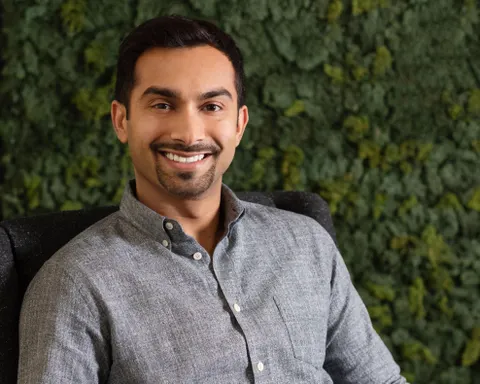
APOORVA MEHTA
Founded Instacart, the grocery delivery app that became a lifeline during COVID-19.
The man who tried and failed at 20 different startups before building the one that made him a billionaire. Instacart was his 21st attempt — and it happened because he was too lazy to go grocery shopping. He built the first version in two hours, ordered himself a case of beer to test it, and Y Combinator accepted his application on the last possible day. Sometimes the best business ideas really are just solving your own laziness.
Net Worth
$1.2 billion
Nationality
Indian-Canadian
Time Horizon
Long-Term
Risk Appetite
9 / 10
CAREER & BACKGROUND
Born in India, grew up in Canada, moved to San Francisco to work as a software engineer. Worked at Qualcomm, BlackBerry (back when it was still called RIM), and Amazon before deciding to start his own thing.
At Amazon, he worked on supply chain and fulfillment systems — which turned out to be the perfect training for reimagining grocery delivery.
Before Instacart, Mehta built and scrapped 20 different startup ideas. A social network for lawyers.
An ad network for games. None of them stuck.
The 21st idea was grocery delivery. He applied to Y Combinator's Summer 2012 batch past the deadline and got a phone interview only after ordering YC partner Garry Tan a six-pack of beer via the Instacart prototype.
It worked.
Instacart grew from a San Francisco-only experiment to 5,500+ cities across the US and Canada. COVID-19 turned it from a convenience into a necessity overnight — order volume grew 500% in a matter of weeks in March 2020.
The company hit a $39 billion valuation in 2021, then IPO'd in September 2023 at $10 billion.
COMPANIES & ROLES
Founded Instacart in 2012. Grew it to 500,000+ shoppers, 80,000+ retail partners, and $1.5 billion in revenue by IPO.
Stepped down as CEO in 2021, replaced by Fidji Simo from Facebook, but remained Executive Chairman. Previously worked at Amazon on fulfillment engineering, Qualcomm, and BlackBerry.
INVESTING STYLE & PHILOSOPHY
As a founder, Mehta's approach is pure product-market-fit obsession. He does not invest in public markets.
His startup philosophy is "build the smallest possible version, test it immediately, kill it fast if it does not work." Twenty dead startups before Instacart prove he practices what he preaches.
THE PLAYBOOK
Risk Approach
Very high. He quit stable engineering jobs at Amazon and BlackBerry to launch 21 startups.
The man failed 20 times and kept going. But within each venture, he is actually quite disciplined — he kills ideas quickly rather than throwing good money after bad.
Money Habits
Lives in San Francisco. Not known for flashy spending.
The famous story is that he used to save money by walking to work and cooking all his meals at home during early Instacart days — while running a company that delivered groceries to people who did not want to shop for themselves. The irony was not lost on him.
BIGGEST WIN
Instacart's explosive growth during COVID-19. When the pandemic hit in March 2020, grocery delivery went from convenience to necessity overnight.
Order volume grew 500% in weeks. The company hired 300,000 new shoppers in a single month.
The timing was pure luck — but having the infrastructure ready to handle it was not.
BIGGEST MISTAKE
The IPO pricing. Instacart went public at $10 billion in September 2023 after being valued at $39 billion in 2021.
That is a 75% haircut. The market had changed, and competition from DoorDash, Amazon Fresh, and Walmart's delivery service compressed what investors were willing to pay.
FINANCIAL PHILOSOPHY
Build, test, fail, repeat. The only real failure is stopping.
Mehta's philosophy is more entrepreneurial than financial. He believes in trying many things fast, keeping overhead low, and scaling only what works.
His wealth comes almost entirely from one company that took 21 tries to find.
FAMILY & PERSONAL LIFE
Born in India, raised in Canada. Keeps personal life relatively private.
Not married publicly as of recent reports.
EDUCATION
University of Waterloo (Engineering). Waterloo is Canada's premier engineering school and a pipeline to Silicon Valley — alumni include the founders of BlackBerry, Kik, and Pebble.
BOOKS & RESOURCES
The startup bible that every YC founder has on their shelf
The build-measure-learn methodology that Mehta lived through 20 failures
The Zappos story about building culture while scaling fast
As an Amazon Associate, Netfigo earns from qualifying purchases. Book links above may be affiliate links.
QUOTES (5)
I failed at 20 startups before Instacart. The only thing that changed was the idea. I was the same person.
The best startup ideas come from solving your own problem. I was too lazy to go grocery shopping. That's it.
COVID didn't make Instacart. It accelerated something that was already happening. People were going to stop going to grocery stores eventually.
Twenty failures taught me more than one success ever could. Each dead startup showed me exactly what not to do next time.
NETFIGO SCORE
Proprietary 5-dimension investor rating
Risk Appetite
Contrarian Index
Track Record
Accessibility
Time Horizon
Related Profiles
Head-to-Head
Compare Apoorva Mehta vs another investor.