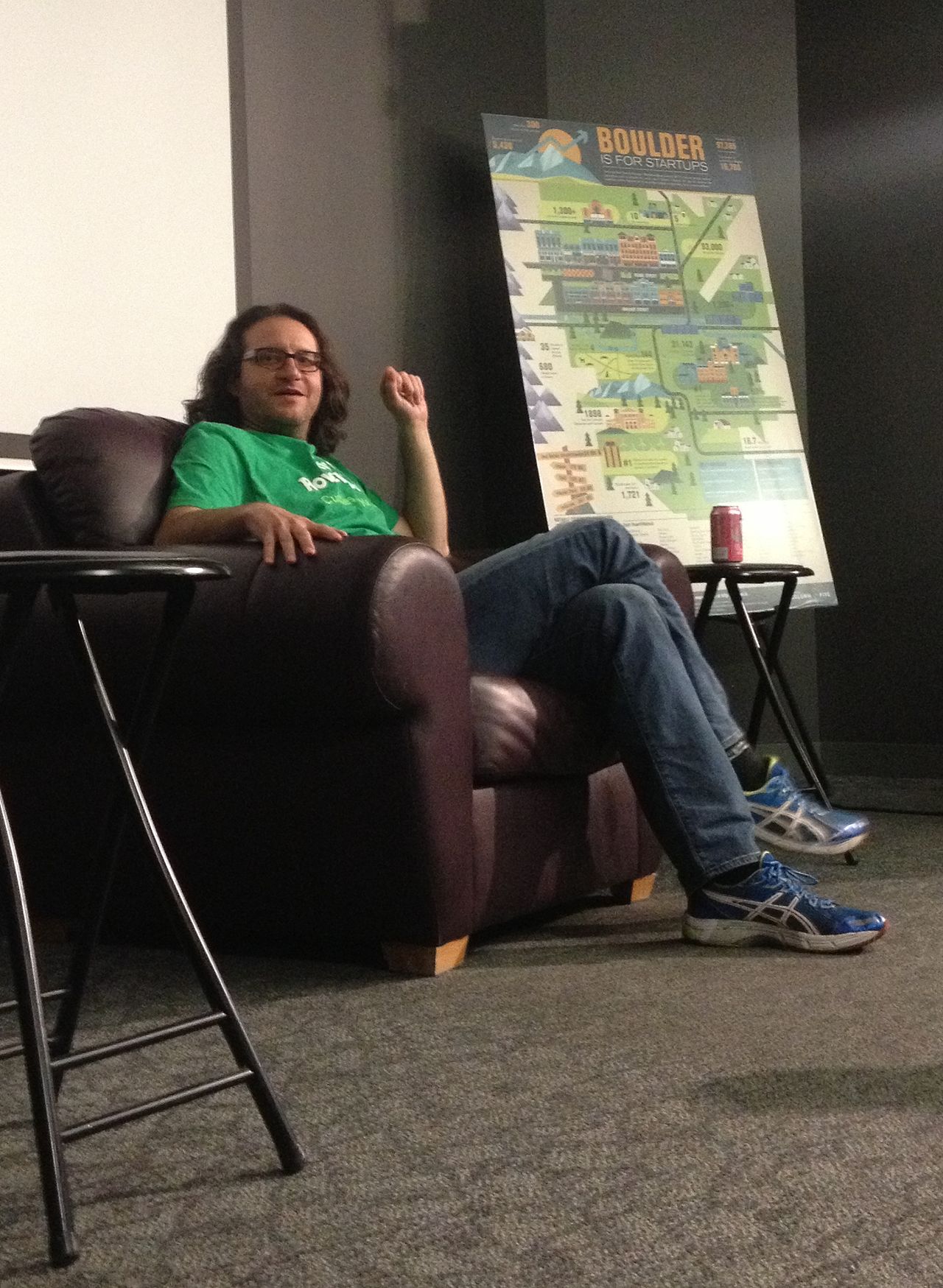
BRAD FELD
Co-founding Foundry Group and Techstars, and writing the book that taught an entire generation how startup boards actually work.
Brad Feld has invested in over 500 startups since the mid-90s and helped build the playbook that modern venture capital runs on. He co-founded Foundry Group in 2007 with $225 million in its first fund, then helped launch Techstars — the accelerator network that has now produced over 3,500 companies worth more than $100 billion combined. He's also one of the rare VCs who will openly admit when he's wrong, burned out, or depressed — which is either refreshing or a liability, depending on who you ask. Either way, he's shaped Boulder, Colorado into a legitimate startup ecosystem almost entirely by force of will.
Net Worth
$500 million
Nationality
American
Time Horizon
Long-Term
Risk Appetite
8 / 10
Net Worth Context
- · 500x the average American's lifetime earnings, stacked and waiting.
CAREER & BACKGROUND
Brad Feld didn't start in Silicon Valley. He started in Boston in the early 1990s, right out of MIT, where he founded Feld Technologies — a software consulting company — at 23 years old.
He ran it for six years before selling it to AmeriQuest Technologies in 1993. That exit was small by modern standards, but it gave him the capital and the credibility to start angel investing.
By the mid-90s he was deep into the Boston tech scene, writing checks into early-stage software companies before anyone called it 'seed investing.' He was doing 20, 30 deals a year. Most didn't work.
Some did. He was learning.
In 2000 he co-founded Mobius Venture Capital (later renamed Mobius), and spent the early 2000s watching much of his portfolio evaporate in the dot-com crash. It was a brutal period for anyone in venture.
Feld didn't quit. He kept writing checks.
The inflection point came in 2006. Feld, along with Jason Mendelson, David Cohen, and David Brown, launched Techstars in Boulder — a three-month accelerator program offering mentorship and a small amount of funding to early-stage startups.
The first cohort had 10 companies. The model spread.
Fast. Today Techstars operates in over 150 cities globally and has invested in startups that include Sendgrid, DigitalOcean, and ParkWhiz.
In 2007, Feld left Mobius and co-founded Foundry Group with Jason Mendelson, Ryan McIntyre, and Seth Levine. They raised their first fund at $225 million.
Their thesis was specific: back entrepreneurs building software and internet businesses, focus on themes they genuinely understood, and never invest outside those themes just because a deal looked good. Foundry went on to back companies including Fitbit, MakerBot, Gnip, and Return Path.
Several became significant exits.
Feld has also been remarkably transparent about the mental health side of the job. He's written publicly about clinical depression, the psychological cost of the venture cycle, and the pressure of managing both a portfolio and a public persona.
For an industry that runs on confidence and projection, that kind of honesty is genuinely unusual.
COMPANIES & ROLES
Foundry Group is the core. It's a Boulder-based venture firm that invests in software and internet companies at the Series A stage.
They've typically raised funds in the $200–225 million range and focused on what Feld calls 'themes' — underlying patterns like human-computer interaction, glue (infrastructure software), or distribution — rather than chasing sectors. It's a deliberate filter.
They pass on a lot of deals that would look attractive to a generalist fund.
Techstars is the other big one. Co-founded with David Cohen in 2006, it's now a global accelerator network that invests $20,000 in exchange for 6% equity in each cohort company.
The program has become one of the most recognized accelerator brands in the world, second only to Y Combinator in terms of reputation. Alumni include Sendgrid (acquired by Twilio for $3 billion), DigitalOcean (IPO'd at $5 billion), and ClassPass.
Earlier in his career, Feld co-founded Feld Technologies (sold 1993), and was a general partner at Mobius Venture Capital during the dot-com era. He also had early involvement as an angel in companies including Harmonix (makers of Guitar Hero — sold to Viacom for $175 million) and Newmerix.
He's also an investor in or advisor to a huge number of companies that never made headlines — the unglamorous middle of a venture portfolio where most of the work actually happens.
INVESTING STYLE & PHILOSOPHY
Feld invests in themes, not sectors. The distinction sounds subtle but it changes everything about how he picks companies.
A sector investor looks at 'enterprise software' and tries to find the best company in that bucket. Feld looks for a pattern — say, the way software is eating the process of buying and selling things — and then finds all the companies where that pattern is the core of what they do.
It's more like being an anthropologist than a stock picker.
He's a Series A investor, which means he wants to see that a startup has real users or real revenue, but he doesn't need a full business model. He's betting on the team and the trajectory, not the spreadsheet.
His view is that if you invest early enough and the team is strong enough, the business model figures itself out.
Feld is deeply involved in his portfolio companies — not in a micromanaging way, but in a 'I will sit on your board and fight for you for ten years' way. His book 'Startup Boards' is basically a manual for how a good board member behaves.
He wrote it partly because he'd seen so many bad board members, including, by his own account, earlier versions of himself.
He's also a long-term investor in the truest sense. He doesn't chase hot rounds.
He doesn't flip positions. He picks a company, joins the board, and rides it out.
That has meant some very long waits — and some very expensive lessons in patience — but it also means the companies that do break through have genuinely had time to build something real.
THE PLAYBOOK
Risk Approach
Feld is high-risk by design. Venture capital only works if you're willing to lose money on the majority of your bets — and Feld has said explicitly that a portfolio where everything returns 2x is a bad portfolio.
He wants the 50x. That means he needs the 0x too.
He's talked about individual investments that went to zero after years of work and real emotional investment. Not just losing capital — losing a relationship, a story he believed in, years of board meetings and hard conversations.
The financial loss is one thing. The psychological cost of watching a company you genuinely cared about collapse is different.
His risk tolerance is high for capital, moderate for personal stress. He's spoken at length about the mental load of being a VC — the way bad news from portfolio companies can ambush you at any time, the way you hold multiple companies' fates in your head simultaneously.
He manages that partly through running (he's run over 25 marathons) and through very deliberate choices about how many boards he sits on.
He doesn't use leverage. He doesn't try to time markets.
He just picks teams he believes in and accepts that most of them will fail. That's a different kind of risk tolerance than most people have.
Money Habits
Feld lives in Boulder, Colorado — which he's described as a deliberate choice. He could be in San Francisco.
He chose not to be. Boulder has cheaper real estate, mountains, and enough tech density to make it genuinely useful as a base.
He runs there. A lot.
He's talked about running as a near-daily practice and has completed over 25 marathons. It's not a hobby — it's how he manages the psychological weight of the job.
He runs long distances the way other people drink or meditate. He documented this in his book 'Running Lean' — the idea that physical discipline and mental discipline are the same thing.
He and his wife Amy Batchelor live what he describes as a deliberately 'un-fancy' life for people of their net worth. No private jets.
No conspicuous spending. They spend heavily on experiences — travel, food, time — rather than possessions.
He's written honestly about going through periods of significant depression, which cost him not just money (in terms of deals he didn't do or relationships he let slip) but presence. He talks about it publicly because he thinks the stigma around mental health in the VC world is damaging and stupid.
He reads obsessively — science fiction, mostly. He credits sci-fi with keeping his imagination engaged in a job that can easily become rote pattern-matching.
BIGGEST WIN
Fitbit. Foundry Group backed Fitbit when it was still a scrappy hardware startup trying to convince people to clip a tiny device to their waistband and obsess over their step count.
The idea sounded niche. Feld and his team believed the underlying theme — quantified self, wearable computing — was real.
They were right. Fitbit went public in 2015 at a valuation north of $4 billion, and Foundry's stake was worth a multiple of what they'd invested.
Google then acquired Fitbit in 2021 for $2.1 billion. The exit was smaller than the IPO peak, but still a very significant return on a Series A check.
Sendgrid is another one worth mentioning — it went through Techstars, Foundry backed it, and Twilio acquired it for $3 billion in 2019. That's the Techstars model working exactly as designed: find scrappy founders early, give them just enough structure and capital to find their footing, and let them build.
The broader win is Foundry Group's track record as a whole. The firm has consistently returned capital to LPs in an industry where that is genuinely hard to do.
That consistency — not one massive hit, but a portfolio that works over time — is arguably his most important professional achievement.
BIGGEST MISTAKE
Feld has been unusually candid about the mistakes. One recurring theme: early in his career at Mobius, he was on too many boards, too spread thin, and not actually useful to the companies he was supposed to be helping.
He describes being a bad board member — showing up, saying smart-sounding things, and leaving without doing the work. The cost wasn't a specific dollar figure.
It was a reputation he had to rebuild and relationships he burned with founders who deserved better.
The dot-com crash hit his Mobius portfolio badly. He's never given a precise number on losses, but the vintage years 1999–2001 were brutal for everyone in venture.
Feld watched companies he'd backed and believed in collapse — not because the people were bad, but because the capital markets evaporated and the window closed. The lesson he took: burn rate matters.
Companies that aren't cash-efficient don't survive market dislocations. He became more focused on capital efficiency in part because of that period.
He's also talked about relationships with founders he managed badly under pressure — being too direct at the wrong moment, or not direct enough when a hard conversation needed to happen. Those aren't financial mistakes with a dollar amount, but they're real costs.
One of the reasons he wrote 'Startup Boards' is that he wanted to codify what good board behavior looks like, partly in response to his own earlier failures.
FINANCIAL PHILOSOPHY
The underlying principle is: back people, not ideas. Ideas change.
Business models pivot. The market shifts.
What doesn't change is whether the founders are smart, honest, and resilient. Feld has backed companies that went through three complete pivots before finding their product.
The idea he backed on day one no longer exists. The people do.
He also believes strongly in 'doing things that don't scale' in the early days of a company — a philosophy he picked up from the Paul Graham school of thought and reinforced through Techstars. The best founders are obsessively involved with their early customers in ways that can never be automated.
The scaling comes later.
On returns: Feld has been explicit that venture math requires power-law thinking. In a fund of 30 companies, one or two will return the whole fund.
Most will be flat or negative. The mistake is treating each investment like it should be a moderate success.
Moderate successes don't pay for the failures. You need moonshots.
He's also openly skeptical of the 'growth at all costs' mentality that dominated VC in the 2010s. He's talked about portfolio companies that raised enormous rounds, grew fast, burned cash, and never found a sustainable business underneath the growth.
He's not a capital efficiency zealot, but he believes growth that has no path to sustainability is just a liability with good PR.
FAMILY & PERSONAL LIFE
Feld has been married to Amy Batchelor for over three decades. Amy is an author and adventurer in her own right — she's written about their relationship and their shared experiences traveling the world.
They've made a deliberate effort to keep parts of their life genuinely private despite Feld's public presence in the startup world.
They don't have children, which Feld has mentioned occasionally as something they made a conscious decision about. They've talked about how the absence of kids changed how they structure their time and their priorities.
Amy has been publicly supportive and vocal about the mental health struggles Feld has gone through — his episodes of depression, the burnout cycles, the cost of managing a high-pressure career over many decades. Their relationship appears to be a genuine partnership rather than a background detail.
Feld grew up in Dallas, Texas. His father is a doctor — an OB-GYN — which Feld has occasionally cited as early exposure to someone who was professional, disciplined, and deeply committed to their work.
He's described his upbringing as intellectually stimulating and supportive of his interests in math and computing.
EDUCATION
Feld went to MIT for both his undergraduate degree in Management Science and his MBA, graduating in 1987. MIT gave him the technical grounding and the network — he describes the culture there as intensely focused on building things, which suited him.
He started Feld Technologies while still in school, essentially treating the degree as parallel infrastructure while he ran the real experiment. MIT mattered, but the company he built in parallel to it mattered more.
BOOKS & RESOURCES
Feld has written more useful books about venture capital and startup mechanics than almost anyone else in the industry
They're not motivational. They're operational
For reading recommendations beyond his own work, Feld is an evangelist for science fiction
He's cited Kim Stanley Robinson's Mars trilogy as formative, and William Gibson's work as a constant influence on how he thinks about the future. If you want to understand how Feld sees technology, read more science fiction
As an Amazon Associate, Netfigo earns from qualifying purchases. Book links above may be affiliate links.
QUOTES (6)
The best thing you can do for an entrepreneur is tell them the truth.
A startup community must be led by entrepreneurs. Not government. Not universities. Not VCs. Entrepreneurs.
If you are not getting better, you are getting worse. There is no steady state.
The moment you stop learning is the moment your relevance starts to decay.
Depression is the thing no one in venture talks about, which is insane given how many people it affects.
Venture math is power-law math. If your best outcome is a 3x, something has gone wrong with your portfolio construction.
NETFIGO SCORE
Proprietary 5-dimension investor rating
Risk Appetite
Contrarian Index
Track Record
Accessibility
Time Horizon
Related Profiles
Investors
Fred Wilson
Fred Wilson of Union Square Ventures is Feld's closest philosophical peer in venture — both are long-term, founder-first Series A investors who built their reputations by being genuinely helpful board members rather than check-writers.
Jason Calacanis
Both are prominent early-stage tech investors who have built significant media presence around startup investing and have backed overlapping ecosystems of founders.
Marc Andreessen
Marc Andreessen represents the scale-and-brand approach to venture that Feld has deliberately avoided — useful contrast for understanding different models of what a VC firm can be.
Head-to-Head
Compare Brad Feld vs another investor.