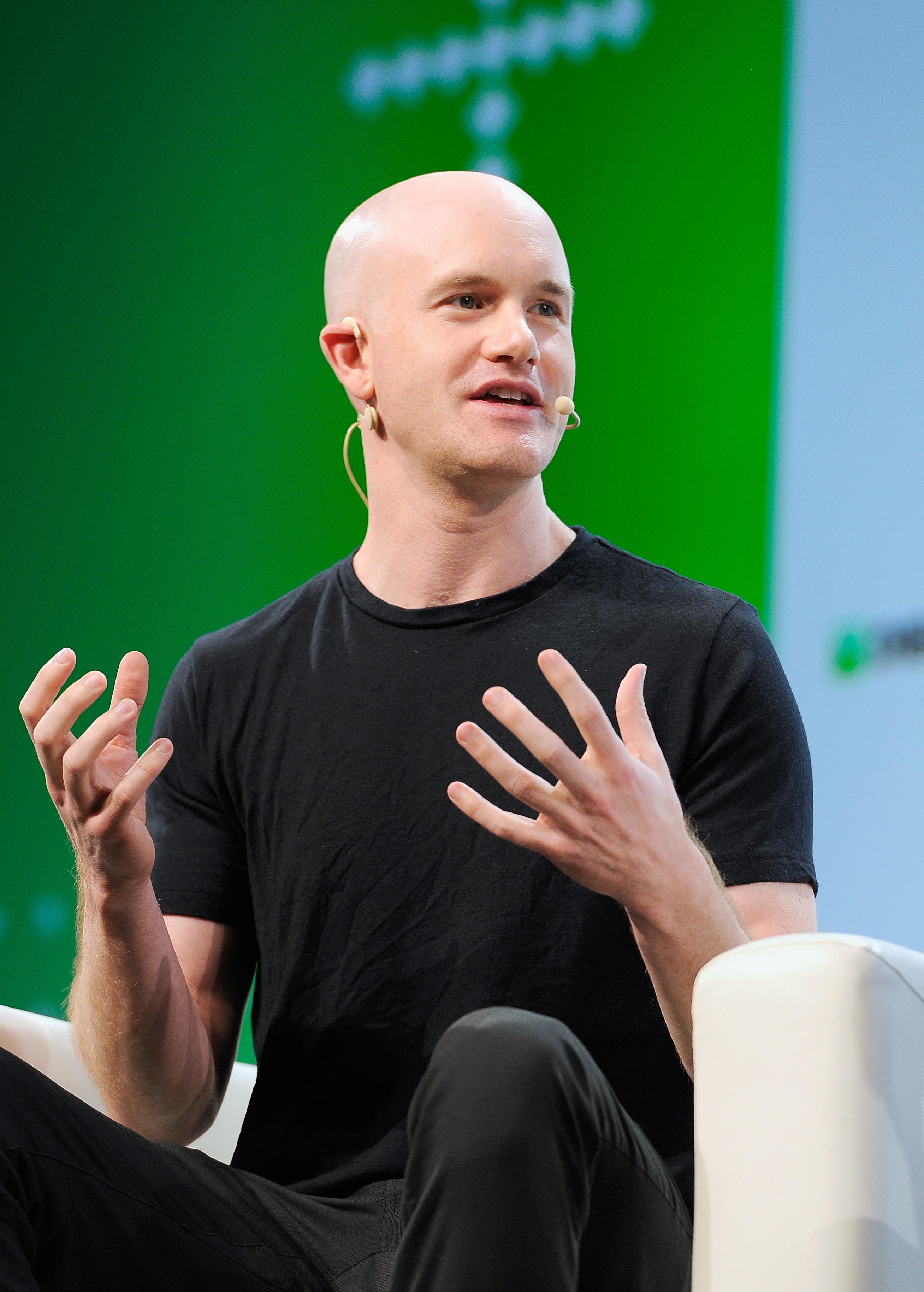
BRIAN ARMSTRONG
Co-founding Coinbase, the company that turned crypto from a nerd experiment into something your grandma can buy on her phone.
Brian Armstrong took a concept most Wall Street banks dismissed as a scam and built it into a $100 billion public company. He founded Coinbase in 2012 with $150,000 in seed money from Y Combinator — at a time when Bitcoin was trading at around $7. The company went public in April 2021 via direct listing at a $86 billion valuation, which was the largest tech debut in history at that point. He's been sued by the SEC, called a criminal by regulators, and had his stock drop 90% from its peak. Still standing. Still building.
Net Worth
$11 billion
Nationality
American
Time Horizon
Long-Term
Risk Appetite
8 / 10
Net Worth Context
- · That's the GDP of a small country — around the size of Greenland.
- · Enough to buy an NBA team and keep $7B for snacks.
CAREER & BACKGROUND
Brian Armstrong grew up in San Jose, California, in a family that pushed education hard. He showed an early aptitude for coding and started freelancing as a software developer when he was still a teenager — tutoring kids in math on the side for extra cash.
That combination of tech skills and hustle would define everything that came after.
He studied economics and computer science at Rice University in Houston, graduating in 2005. After college he did the expected thing: took a corporate job, first at IBM and then at Deloitte as a consultant.
He was good at it. He was also bored out of his mind.
The work felt slow and disconnected from anything that mattered.
The pivot came when he joined Airbnb as a software engineer in 2011. This was early Airbnb — when the whole company fit around one table.
Armstrong got a front-row seat to what it looked like when a small team built something that genuinely changed behavior at scale. It sharpened his hunger.
He'd already been reading about Bitcoin since 2010. The more he read, the more convinced he became that the financial system was unnecessarily complicated, exclusionary, and expensive.
He wrote a business plan for a Bitcoin wallet and exchange on the side while still at Airbnb. That plan became the application he submitted to Y Combinator in 2012.
YC accepted it. Armstrong quit Airbnb and moved into a small apartment in San Francisco with $150,000 in seed funding and a co-founder he found through the YC network: Fred Ehrsam, a former Goldman Sachs trader.
The two made an unlikely but effective pair — Armstrong was the idealistic engineer, Ehrsam was the finance guy who understood markets.
Coinbase launched publicly in 2012. The early days were rough.
The product was clunky. Regulators didn't know what to do with it.
Banks refused to work with them. Armstrong spent months calling banks trying to get a business account opened and was rejected almost every time.
He later described it as one of the most demoralizing periods of his life.
But the product worked. It was the first time ordinary people could buy Bitcoin without using sketchy peer-to-peer forums or setting up a technical wallet themselves.
That ease-of-use was the whole product. And as Bitcoin's price went up — and then crashed, and then went up again — Coinbase traded right alongside it, collecting fees on every transaction.
By 2014, Coinbase had processed over $1 billion in transactions. By 2021, it was handling $335 billion per quarter.
The company went public on April 14, 2021, via direct listing on the Nasdaq. On day one, shares briefly hit $429, valuing the company at over $100 billion.
Armstrong's stake was worth roughly $14 billion at the open. It was one of the most anticipated tech IPOs in years.
The crash came fast. Crypto winter hit in 2022.
Coinbase's stock fell from its peak by over 90%. The company laid off 18% of its workforce in June 2022 and another round later that year.
Armstrong published a blog post about the layoffs that was widely read — frank, direct, no corporate spin. That post became something of a template for how tech founders communicate bad news.
Through all of it, Armstrong kept building. He launched Coinbase's Layer 2 blockchain, Base, in 2023 — a bet that crypto's future is in cheaper, faster transactions rather than speculation on Bitcoin price swings.
He's been vocal about wanting to move Coinbase's headquarters out of the US if regulatory pressure doesn't ease, and has lobbied aggressively in Washington for clear crypto legislation.
Love him or hate him on crypto, Armstrong has done something genuinely rare: he built a durable, regulated, publicly traded company in one of the most hostile regulatory environments in tech history. That's not nothing.
COMPANIES & ROLES
Coinbase is the main event — and it's hard to overstate how central it is to the entire crypto industry. It's essentially the on-ramp.
When someone decides they want to buy Ethereum or Bitcoin or any of the hundreds of tokens listed on the platform, they usually come to Coinbase. The company makes money by charging fees on those trades, which means its revenue is almost perfectly correlated to how excited (or panicked) people are about crypto at any given moment.
That's a feature of the business that Armstrong has tried — with mixed success — to diversify away from.
Beyond trading, Coinbase runs a custody business (storing crypto for institutional clients who don't trust themselves with their own private keys), a staking business (earning yield on proof-of-stake coins on behalf of customers), and Coinbase One (a subscription product for high-frequency traders who want zero-fee trading). The company also issues the USDC stablecoin in partnership with Circle — that's a dollar-pegged token that makes it easier to move money around the crypto ecosystem without converting back to actual dollars.
Base is the newer, arguably bigger bet. It's a Layer 2 blockchain built on top of Ethereum that launched in 2023.
The idea: Ethereum transactions are slow and expensive. Base makes them fast and cheap, while inheriting Ethereum's security.
Armstrong wants Base to become the financial infrastructure layer for a new generation of apps. Whether that happens depends on whether crypto actually delivers on the 'decentralized finance' promise — still very much an open question.
Armstrong also runs Coinbase Ventures, the company's investment arm, which has backed dozens of crypto startups. They've been early in projects like Compound, Maker, Uniswap, and Dapper Labs (the CryptoKitties and NBA Top Shot people).
It's strategic as much as financial — keeping Coinbase connected to whatever's happening at the frontier of the ecosystem.
He personally invested in OpenAI in its early days, which turned out to be a very good call. He's also backed a handful of biotech companies, reflecting an interest in longevity science that goes well beyond the typical tech founder hobby.
INVESTING STYLE & PHILOSOPHY
Armstrong thinks about investing the way you might think about infrastructure — he wants to own the picks-and-shovels of whatever the next big thing is, not bet on which specific miner strikes gold. Coinbase itself is this philosophy made literal: he didn't bet on Bitcoin going to $100,000 or crashing to $10,000.
He bet that people would want to buy and sell it either way, and that charging a small fee on every transaction would compound into something massive. He was right.
For his personal investing, he leans heavily into early-stage bets where he has domain knowledge. Crypto obviously, but also AI and biotech — areas he finds intellectually compelling and where he thinks the next 20 years of value creation will happen.
He doesn't pretend to have an edge in public markets or traditional equities. His edge is being early to things most people think are insane.
He's said publicly that he thinks about investing in terms of expected value — a decision-making framework borrowed from probability theory. If something has a small chance of being enormous and a large chance of being zero, he's interested as long as the math works out.
This makes him naturally comfortable with volatile assets. Bitcoin dropping 70% doesn't change his view on whether the underlying technology has value — it just means the price was wrong for a while.
The risk is that this framework can justify almost anything. 'Expected value' is only as good as your probability estimates, and in crypto those estimates have historically been all over the place.
Armstrong has been right enough times that the approach looks smart in retrospect. But the honest version of his track record includes being one of the most visible evangelists for an asset class that has repeatedly destroyed ordinary retail investors who got in at the wrong moment.
THE PLAYBOOK
Risk Approach
Armstrong's risk tolerance is high — probably higher than he consciously acknowledges. He left a stable job at Airbnb in 2012 to build a Bitcoin exchange when Bitcoin was worth $7 and most people thought it was either a Ponzi scheme or money for drug dealers.
That's not a careful risk-adjusted decision. That's conviction bordering on stubbornness.
He describes himself as someone who thinks about downside through the lens of 'what's the worst realistic scenario, and can I survive that?' For Coinbase, the worst realistic scenario in the early days was that regulators shut them down before they got started. He managed that risk by being almost pathologically compliance-focused from day one — hiring lawyers early, registering as a money transmitter in every state that required it, working with regulators rather than ignoring them.
That caution bought Coinbase a legitimacy that its shadier competitors never had.
Personally, Armstrong is reported to hold a significant portion of his net worth in crypto — which means his wealth goes up and down with the market by hundreds of millions of dollars at a time. He's said that doesn't bother him, which is either a genuinely zen attitude toward money or the kind of thing you can only say when you have enough of it that the swings don't touch your actual life.
The thing that actually makes him nervous is regulatory risk — the possibility that US lawmakers decide crypto is too dangerous and effectively ban meaningful parts of the industry. That's not irrational paranoia.
The SEC sued Coinbase in 2023, alleging the company was operating as an unregistered securities exchange. That case dragged on for years and was a real existential threat.
He responded by spending tens of millions on political lobbying and threatening to move the company overseas. Whether that was risk management or defiance is in the eye of the beholder.
Money Habits
Armstrong lives in Miami Beach, which he moved to partly for lifestyle reasons and partly because Florida has no state income tax — a not-irrelevant consideration when your net worth is in the billions. He sold his San Francisco house after relocating, which tracks with his broader frustration with California's regulatory environment.
He's not a conspicuous spender in the tech-bro-yacht sense. The most expensive things he's known to spend on are science and health.
He reportedly invests heavily in personal health optimization — longevity medicine, advanced diagnostics, the whole biohacking extended-life playbook that's become fashionable among a certain tier of Silicon Valley founders. He's openly interested in living significantly longer than the average human lifespan and puts money behind that interest.
He funds ResearchHub, a startup he personally backs that's trying to create an open-source version of academic publishing — basically GitHub for science papers. He's put significant personal capital into this, not because it's obviously going to make money but because he thinks the current academic incentive structure is holding back scientific progress.
He gave away $1 billion worth of cryptocurrency in 2021 to causes focused on scientific research, pandemic preparedness, and global economic freedom. For context, that was when Coinbase stock was near its peak and his net worth was temporarily much higher than it is today.
He's continued donating through the market downturn, which is easier said than done when your assets have lost 80% of their value on paper.
He doesn't own flashy cars or private jets that he's publicly shown off. His social media presence is almost entirely professional — crypto policy, Coinbase updates, the occasional book recommendation.
He seems genuinely uninterested in the personal brand performance that consumes so many founders of his stature.
BIGGEST WIN
The direct listing in April 2021 was the moment everything Armstrong had built since 2012 was validated in the most public and financially spectacular way possible. Coinbase shares opened at $381 on April 14, 2021 — implying a fully diluted valuation of roughly $100 billion on day one.
Armstrong's personal stake was worth approximately $14 billion at the open. For a company that started with $150,000 in seed money and spent its first years convincing banks to even open a business account, this was extraordinary.
The timing was also almost perfect. The direct listing came at the peak of the crypto bull market — Bitcoin was flirting with $65,000 at the time.
Retail investor enthusiasm was at an all-time high. The Robinhood crowd was piling into everything.
Coinbase was suddenly the stock you bought to get exposure to crypto without actually holding crypto, and institutional investors who'd been sitting on the sidelines of the asset class entirely found it an easier pill to swallow.
What made it a win beyond just the IPO valuation was that it proved the underlying business model worked. Coinbase had posted $1.8 billion in revenue in Q1 2021 alone — more than it had generated in its entire existence up to that point.
The business wasn't theoretical. It was making absurd amounts of money.
The direct listing put all of that on public record and dared anyone to argue that crypto was just a fad.
He'd also been right about the regulatory strategy. Competitors like BitMEX and Binance had operated in legal gray areas, moved fast, and broken laws.
Armstrong had moved slower and played it straight. By 2021, BitMEX's founders were facing criminal charges, Binance was under investigation everywhere, and Coinbase was ringing the opening bell at Nasdaq.
Slow and legal won that round.
BIGGEST MISTAKE
The 2021 peak is also where the biggest mistake lives. Coinbase went public at $86 billion valuation in April 2021.
By January 2023, the stock was trading below $35 — down more than 90% from its post-listing high. The company's revenue collapsed as crypto volumes dried up in 2022, and a business that had looked like a money machine turned out to be almost perfectly correlated to speculative mania.
That's a hard thing to defend to public market shareholders who didn't sign up for a crypto index fund.
The specific mistake was not diversifying revenue fast enough. Armstrong knew — and said publicly — that Coinbase was too dependent on trading fees from retail crypto speculation.
But during the bull market, the money was coming in so fast that there was little urgency to fix it. When the crash came, the company was still 80%+ dependent on transaction revenue.
Headcount had ballooned during the good times. The layoffs that followed — 18% of staff in June 2022, then more later — were painful and avoidable.
He's also been transparent about a cultural mistake: hiring too fast without being disciplined about what the company actually needed. Coinbase grew from about 1,200 employees at its IPO to nearly 6,000 by mid-2022.
Then it shrunk back down to under 3,000. That whiplash cost real people their jobs and cost the company hundreds of millions in severance and reorganization.
Armstrong published a detailed blog post owning the mistake — which is more accountability than most CEOs show — but the damage was done.
Estimated cost of the hiring-and-shrinking cycle: at least $400-500 million in excess compensation, severance, and lost productivity. The stock hasn't recovered to its IPO price as of 2024.
FINANCIAL PHILOSOPHY
Armstrong's financial philosophy starts with a conviction that the existing financial system is broken in ways most people don't notice because they've never seen anything different. It's slow.
It's expensive. It's exclusionary — billions of people around the world don't have access to basic banking.
He built Coinbase on the premise that a financial system that runs on open, programmable infrastructure could fix all of that. That's the mission, and it's genuinely held, not marketing copy.
On money personally, he's talked about thinking of wealth as a tool for impact rather than an end in itself. He's signed the Giving Pledge — committing to donate the majority of his wealth over his lifetime.
He's specifically interested in funding scientific research that moves too slowly under the traditional grant system, including work on aging, infectious disease, and education.
He believes in taking concentrated bets rather than spreading risk thin. Diversification, in his view, is what you do when you don't know what you're doing.
If you genuinely believe in something, own a lot of it. This is the Buffett-ish logic — don't hedge your best ideas with bad ones.
The obvious tension is that this philosophy works brilliantly when you're right and catastrophically when you're wrong, and crypto has given him plenty of experience with both.
He's also a believer in long time horizons as the key competitive advantage most people don't use. He's said he thinks about Coinbase on a 10-to-20-year timeline, which means short-term price crashes, regulatory setbacks, and bad quarters don't change his fundamental view.
In a world where most public company CEOs are managing to quarterly earnings, this is genuinely rare — and genuinely difficult to maintain when your stock is down 90% and your investors are calling.
FAMILY & PERSONAL LIFE
Armstrong is relatively private about his personal life for a person of his public stature. He has a daughter, born around 2019.
The mother's identity has never been publicly confirmed and Armstrong has not discussed the relationship, which suggests it either ended or was always private.
He's not publicly married. For a billionaire CEO, he keeps an unusually low profile on anything personal — no Instagram of the yacht, no girlfriend in the tabloids, no divorce drama.
The stuff that ends up in the press is mostly work: regulatory battles, Coinbase updates, his views on crypto policy.
His parents were engineers, which explains a few things about how he thinks and communicates. There's a certain directness and systems-thinking to his public communication that feels like it came from a household that valued precision over emotion.
He has a close working relationship with his brother, John Armstrong, who has been involved in some of his philanthropic initiatives. Beyond that, his family details are kept away from public view — which, given the amount of money involved, is probably wise.
EDUCATION
Armstrong studied economics and computer science at Rice University in Houston, graduating in 2005. The double major matters — economics gave him a framework for thinking about markets and incentives, computer science gave him the tools to build.
That combination is basically the cheat code for founding a fintech company.
He's talked about being a mediocre student in some respects — more interested in building things on the side than in academic performance for its own sake. He started freelancing as a developer while still in school, which was more formative than most of his coursework.
Rice is a respected school, but Armstrong is not someone who leads with his résumé. The work speaks louder.
BOOKS & RESOURCES
Armstrong doesnt have a book of his own — hes been too busy building and fighting regulators to sit down and write one
But his blog on Medium and his Twitter/X posts function as a running record of how he thinks, and they're worth reading if you want to understand the crypto true-believer worldview from someone who's actually accountable for executing on it
As essential reading for understanding the monetary philosophy underpinning Bitcoin. It's a polemical book — Ammous is not a neutral observer — but it's the clearest articulation of why Bitcoin maximalists believe what they believe. Armstrong doesn't identify as a Bitcoin maximalist (he's built a whole company on other tokens), but he finds the theoretical framework useful
Which is the canonical text for the kind of contrarian technology optimism that Armstrong embodies. The core idea — that the most valuable companies create new categories rather than competing in existing ones — maps directly onto how Coinbase positioned itself in the early years
Comes up when Armstrong talks about the realities of running a company through difficult periods. The layoffs of 2022 and the SEC lawsuit are exactly the kind of situations Horowitz writes about — no good options, just better and worse ways to make hard calls
As an Amazon Associate, Netfigo earns from qualifying purchases. Book links above may be affiliate links.
QUOTES (6)
We want to create an open financial system for the world. That's a pretty audacious goal but I think it's achievable.
If you're not embarrassed by the first version of your product, you've launched too late.
Crypto is the most important financial innovation in a generation. I want Coinbase to be at the center of it.
I think about expected value constantly. If something has a small chance of being world-changing and a large chance of failing, the math can still work out.
The biggest risk isn't volatility. It's that the US falls behind because we can't get a clear regulatory framework. That would be a tragedy.
We hired too fast. I own that. When money is coming in fast, discipline is harder to maintain. That's on me.
NETFIGO SCORE
Proprietary 5-dimension investor rating
Risk Appetite
Contrarian Index
Track Record
Accessibility
Time Horizon
Related Profiles
Investors
Balaji Srinivasan
Balaji Srinivasan served as Coinbase's CTO from 2014 to 2019 and was one of Armstrong's closest intellectual allies during the company's critical growth years.
Changpeng Zhao
Both built the two largest centralized crypto exchanges in the world and have been locked in a decades-long battle for market share, regulatory legitimacy, and the title of crypto's most powerful CEO.
Michael Saylor
Both are among the most prominent institutional champions of Bitcoin as a legitimate asset class, though Armstrong's approach is broader — he's bet on the entire crypto ecosystem, not just BTC.
Head-to-Head
Compare Brian Armstrong vs another investor.