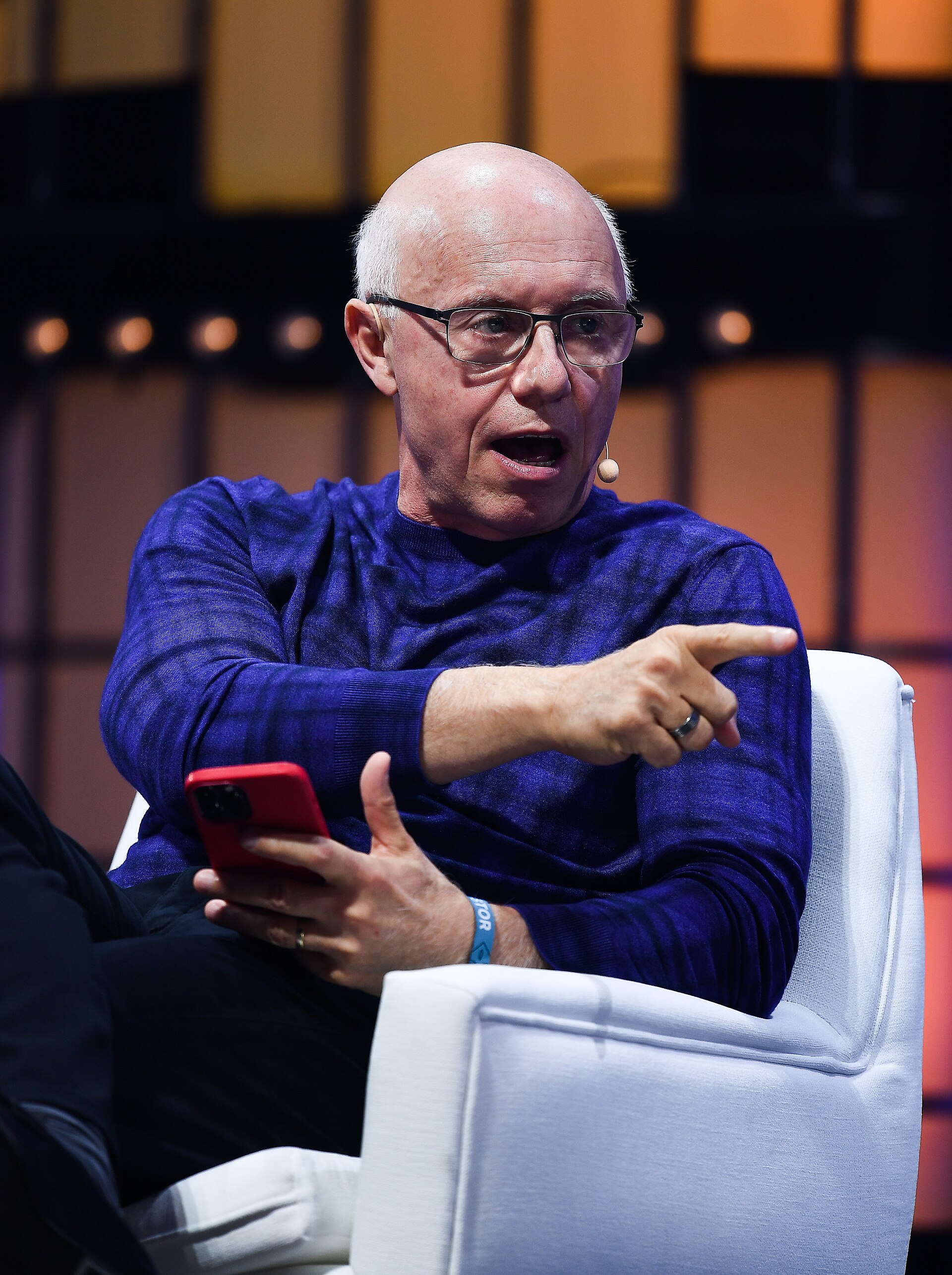
DOUG LEONE
The scrappy immigrant who turned Sequoia Capital into the most dominant venture firm on earth.
Doug Leone grew up in Genoa, Italy, moved to America with almost nothing, and eventually ran the firm that backed Google, Apple, WhatsApp, and Airbnb. He spent years cold-calling companies out of a phone book before anyone would give him a meeting. That persistence — borderline obsessive, slightly terrifying — became the defining trait of his investing career. Sequoia under his watch didn't just find great companies; it hunted them with a ferocity that made other VCs look like they were waiting for the bus. The immigrant kid from Genoa out-competed everyone born with every advantage. That's the whole story.
Net Worth
$5 billion
Nationality
Italian-American
Time Horizon
Long-Term
Risk Appetite
7 / 10
Net Worth Context
- · Still a billionaire — just the quiet kind at the end of the table.
CAREER & BACKGROUND
Doug Leone was born in Genoa, Italy, and came to the United States for college with no connections and no money. He studied mechanical engineering at Cornell, then got a master's in engineering at MIT, then another master's at Carnegie Mellon.
Three degrees before most people figure out what they want for breakfast. That academic grind wasn't about passion for engineering — it was a survival strategy.
In an unfamiliar country, credentials were the closest thing to a ladder.
His first job out of school was in sales at Sun Microsystems in the mid-1980s, which turned out to be the best possible training ground for what came next. He was good at it — frighteningly good — because he treated every sales call like his rent depended on it.
Which, early on, it did. By the time he left Sun, he had a reputation as someone who could sell anything to anyone, and more importantly, as someone who understood enterprise technology at a level most salespeople never bother to reach.
In 1988, Michael Moritz recruited him to Sequoia Capital. It was not an obvious hire.
Leone had no investing background. What he had was a sales instinct that could smell a real business from a fake one, and a relentlessness that Moritz recognized as something you can't teach.
The two became one of the most effective partnerships in the history of venture capital — Moritz the storyteller and visionary, Leone the operator and closer.
For the next three decades, Leone helped build Sequoia into something that operates less like a fund and more like a dynasty. He made partner, then managing partner, then global managing partner.
He brought Sequoia into India and Southeast Asia before most Western VCs had even acknowledged those markets existed. He scaled the firm from a single Sand Hill Road partnership into a global institution with offices on multiple continents and assets under management in the tens of billions.
In 2022, he stepped back from the day-to-day management role, handing the reins to Roelof Botha. But his fingerprints are on every major deal Sequoia has done since the early 1990s.
When Sequoia backed Google in 1999 — writing a $12.5 million check alongside Kleiner Perkins for a combined stake that would eventually be worth over $4 billion — Leone was in the room. When Sequoia backed WhatsApp in 2011 for $8 million and watched that stake become worth $3 billion when Facebook acquired the company for $19 billion in 2014, Leone was part of that decision.
His career is basically a highlight reel of the most important bets in Silicon Valley history.
COMPANIES & ROLES
Sequoia Capital is the main event, and calling it just a venture firm undersells it considerably. Sequoia has backed companies that now account for more than $1 trillion in combined public market value.
Apple. Google.
Oracle. Cisco.
LinkedIn. WhatsApp.
Airbnb. Stripe.
Zoom. The list reads like a roll call of the companies that built the modern internet and the devices we use to access it.
Leone personally led or co-led investments in dozens of major companies across his tenure. He was on the board of ServiceNow, the enterprise software company that went public in 2012 and now has a market cap north of $150 billion.
He backed Palo Alto Networks, the cybersecurity firm that became one of the most valuable security companies in the world. He was deeply involved in Nubank, the Brazilian fintech that became the largest digital bank in Latin America and went public in 2021 at a valuation over $40 billion.
Beyond specific companies, Leone's biggest contribution to Sequoia was arguably organizational. He pushed the firm to build a proper presence in India and Southeast Asia through Sequoia India (now Peak XV Partners), which became one of the most important VC operations outside the United States.
He also helped architect the Sequoia Scout program — a network of founders and operators who feed deal flow back to Sequoia — which gave the firm an intelligence advantage that no amount of cold-calling could replicate.
At Sun Microsystems, before all of this, he was a sales leader who helped push the company's workstations into enterprise accounts across the country. It's not a glamorous origin story, but it taught him exactly how enterprise technology sales works — which turned out to be enormously useful when evaluating whether a startup had a real go-to-market strategy or just a pitch deck.
INVESTING STYLE & PHILOSOPHY
Leone invests like a predator, not a curator. Most VCs wait for warm introductions, review pitch decks, and attend demo days.
Leone spent years literally calling companies out of a phone book trying to get meetings. That hunting instinct never left him.
When he identifies a sector he believes in, he goes after every significant company in that space, backs the best one, and helps them build distribution from day one.
He's famously operator-focused. He doesn't get particularly excited about technology for its own sake.
What he wants to know is: can this company sell? Does the team know how to build a real business, or do they just know how to build a product?
He grew up in sales, and he has a finely tuned detector for whether a founding team understands the difference between a product and a company. Many great engineers with great ideas have failed to get Leone's backing because they couldn't answer basic questions about how they were going to get customers.
His framework, such as it is, prioritizes market size above almost everything else. He wants enormous markets — not $1 billion markets, but markets where the addressable opportunity is in the hundreds of billions.
His logic is simple: in a big market, even a mediocre team can build something meaningful. In a small market, even a brilliant team hits a ceiling.
So the first question is always: how big can this actually get?
He also looks for what he calls 'missionary founders' — people who are building because they're obsessed with a problem, not because they spotted a market opportunity. The distinction sounds abstract until you spend time with both types.
Missionary founders work through problems that would cause a mercenary founder to pivot or quit. Leone has seen enough companies fail at the exact moment they needed to push through to know the difference matters enormously.
He is not a spreadsheet investor. He doesn't spend weeks building financial models before making a decision.
He makes fast, conviction-based calls and uses the board relationship to course-correct. He's been wrong — sometimes expensively — but the speed of his decision-making is part of what lets Sequoia win competitive deals that other firms lose while still deliberating.
THE PLAYBOOK
Risk Approach
Leone's risk tolerance is high, but it's not reckless. The key distinction he draws is between risks you understand and risks you don't.
He's comfortable backing companies with no revenue, no customers, and only a vision — if he understands the market and believes in the founders. What he's not comfortable with is backing companies in sectors he doesn't understand, or founders whose motivations he can't read.
He talks about the importance of what he calls 'pattern recognition' — and he's been doing this long enough that his pattern library is enormous. He can sit with a founding team for an hour and come away with a strong read on whether this is the kind of person who figures things out under pressure.
That read is essentially his risk management tool. He's not trying to eliminate risk; he's trying to ensure that when things go wrong — and they always go wrong — the founder is the kind of person who adapts rather than freezes.
On portfolio risk, he runs a concentrated-by-conviction model. Sequoia doesn't spray money across 200 companies and hope a few hit.
The fund makes fewer bets but goes bigger on each one, including follow-on investments as companies prove themselves. This means individual failures hit harder, but it also means the wins compound much more dramatically.
The WhatsApp return — a $3 billion payoff on an $8 million check — is the extreme version of this model working perfectly.
He also believes strongly in time as a risk management tool. He has said repeatedly that the best companies take longer than anyone expects to become great.
Impatience kills more venture investments than bad judgment. His willingness to hold positions for a decade or more, supporting founders through multiple pivots and dark periods, is a genuine competitive advantage.
Money Habits
Leone is notably private about his personal finances, which is itself revealing. He has not become the kind of public figure who posts about philanthropy on LinkedIn or announces donations to name buildings after himself.
His giving has been substantial — he and his wife Patricia have donated tens of millions to Cornell University, including a gift that funded the Leone Lab at Cornell Engineering — but it's been done without the self-promotional apparatus that accompanies most billionaire philanthropy.
He doesn't maintain a high public profile in terms of visible consumption. No superyacht stories.
No residential real estate portfolio splashed across architecture magazines. He splits his time between the Bay Area and a ranch in Montana, which says something about his priorities — wide-open land, privacy, distance from the Valley's social circuit.
He drives himself to meetings. He's known for being reachable and direct, not for operating behind a wall of assistants and gatekeepers.
Founders who have worked with him describe a guy who picks up the phone when they call, not someone who manages access as a signal of importance.
At the office, the work ethic is legendary. He's talked about arriving early and staying late for his entire career — not as a performance of hustle, but because he genuinely can't sit still.
The immigrant survival instinct, maybe. The sense that every opportunity has to be earned multiple times before you can trust it's real.
He doesn't treat his success as proof that he can relax. He treats it as proof that the approach works, which means doing more of it.
BIGGEST WIN
The single most spectacular number is WhatsApp. Sequoia invested $8 million in WhatsApp in 2011, when the messaging app had a tiny team, no meaningful revenue, and a business model that basically consisted of charging users $1 per year.
When Facebook acquired WhatsApp in February 2014 for $19 billion — at the time the largest acquisition of a venture-backed company in history — Sequoia's stake was worth approximately $3 billion. That's a return of roughly 375x on the original investment in under three years.
Which is, by any measure, one of the greatest individual venture capital returns ever recorded.
Leone was closely involved in the WhatsApp investment. Jan Koum, WhatsApp's founder, is a fellow immigrant who came to the US from Ukraine with very little.
The personal connection and shared experience were part of what made the relationship work. Leone understood what Koum was building and why the user obsession — no ads, no data harvesting, just a clean fast messaging product — was actually a business strategy, not a liability.
The Google investment also deserves mention. In 1999, Sequoia and Kleiner Perkins co-invested $25 million combined into Google when it was a Stanford project with no revenue model.
That investment became worth billions. It is now studied in business schools as the canonical example of a venture bet that changed the world.
Leone was part of the Sequoia team that made that call.
BIGGEST MISTAKE
Leone is characteristically tight-lipped about specific failures, which means the full list of misses will probably never be public. But the misses are real.
Sequoia famously passed on several investments that became enormous — the most well-documented being an early pass on Airbnb, which Sequoia eventually did invest in, but later than they should have at a much higher valuation. The cost of that delay was real, though it's hard to quantify exactly.
Leone has also spoken candidly in various interviews about the broader category of his mistakes: being too slow to recognize when a company needed to change direction, staying loyal to a founding team longer than the evidence warranted, and occasionally letting the relationship with a founder cloud his judgment about whether the business was actually working. The last one is particularly honest — he's building long-term relationships with founders, which is an asset, but it creates a bias toward optimism that has cost him and the fund money.
There's also the category of deals he simply missed. Every great investor of his era passed on companies that became generational businesses.
The question is whether the process was right even when the outcome was wrong. Leone seems to accept that missing deals is part of the job and is more interested in understanding why than in cataloguing the pain.
FINANCIAL PHILOSOPHY
Leone's first principle is that markets matter more than people give them credit for. He's seen too many brilliant founders fail in small markets and too many average founders succeed in massive ones to believe talent alone determines outcomes.
This doesn't mean talent is irrelevant — it means talent is the multiplier on top of market size. Get the market wrong and talent doesn't save you.
His second principle is about velocity. He believes decisions made slowly are usually worse than decisions made quickly, because the analysis process in venture is fundamentally limited by what you can know at the time.
You never have enough information to be certain. The question is whether you have enough conviction to act.
He'd rather make a fast call with 70% confidence than spend three months getting to 80% confidence and miss the deal anyway.
He has a deep belief in founder-market fit — the idea that the right founder for a company is often someone who has personally experienced the problem they're solving. Not just studied it, but lived it.
He looks for that personal connection because it predicts persistence better than anything else. When things get hard, people who are personally invested in solving the problem keep going.
Everyone else starts exploring pivots.
On the relationship between investors and founders, Leone is notably direct about the investor's role. He thinks VCs who position themselves as partners or coaches are often doing founders a disservice.
A VC's job is to help the company win. Sometimes that means being supportive.
Sometimes it means telling the CEO they're wrong about something important. The VCs who are too worried about maintaining the relationship to deliver hard feedback aren't actually helping.
He also has a strong view on focus. He's seen too many startups die trying to do everything.
His advice to founders is almost always to narrow the focus to the point where it feels uncomfortable — and then narrow it again. The instinct to expand is almost always premature.
FAMILY & PERSONAL LIFE
Leone married Patricia, and the two have been together throughout his career at Sequoia. They have children together and have been based primarily in the Bay Area, though the Montana ranch plays a significant role in their lives outside work.
Patricia has been his partner in their philanthropic activities — the Cornell donation was made jointly, and they've been deliberate about giving in areas connected to education and opportunity, which tracks with Leone's own experience as an immigrant who got his footing through academic credentials.
His father was an engineer in Italy, which explains the engineering degrees. Leone has talked about the way his upbringing shaped his relationship with work — the sense that nothing is guaranteed, that status is not inherited, and that the only real security is competence and effort.
He came to the US essentially alone as a young man, and that experience of building a life from zero in an unfamiliar place never entirely leaves a person.
He's described himself as a difficult personality — intense, demanding, not always easy to work with. The people who've worked closely with him at Sequoia tend to describe him with a mix of respect and wariness.
He expects a lot and doesn't soften feedback. That's a reasonable thing to know about someone before you invite them onto your board.
EDUCATION
Leone has three graduate degrees, which is unusual for a venture capitalist and makes perfect sense given his background. He did mechanical engineering at Cornell as an undergraduate — practical, respected, the kind of degree an Italian immigrant with ambitions in American industry would pursue.
Then an MS in engineering at MIT. Then another MS at Carnegie Mellon.
By his late twenties he had more engineering credentials than most people accumulate in a lifetime.
None of those degrees directly prepared him for venture capital. What they gave him was credibility, a technical vocabulary, and the discipline of engineering thinking — breaking problems down, testing hypotheses, being honest about what the data says.
Those skills translate surprisingly well to evaluating technology companies. The formal education ended in the mid-1980s.
Everything after that was learned on the job at Sun Microsystems and then Sequoia.
BOOKS & RESOURCES
Leone has not written a book, which is consistent with his generally low public profile
He gives interviews occasionally but doesn't maintain a newsletter, podcast, or public presence beyond occasional conference appearances
The Intel CEO who wrote the definitive manual for how to run a technology company — is frequently cited by people in Leone's orbit as essential reading, and it aligns closely with his operator-first investing philosophy. The book treats management as an engineering discipline, which is exactly the frame Leone brings to evaluating companies
Another text that resonates with his view of what building a real company actually feels like — not the sanitized highlight reel, but the grinding decisions made under pressure with incomplete information
Rounds out the essential reading for anyone trying to understand how the best venture investors think about markets and monopolies
As an Amazon Associate, Netfigo earns from qualifying purchases. Book links above may be affiliate links.
QUOTES (6)
The most important thing in venture is market size. If the market is big enough, even a B team can win. If the market is small, even the A team hits a ceiling.
I came to this country with nothing. That experience never leaves you. It makes you paranoid in a useful way — you never fully believe the success is permanent.
The best founders are missionaries, not mercenaries. Missionaries are obsessed with the problem. Mercenaries are obsessed with the exit. You can tell the difference in about ten minutes.
Speed matters in venture. Not recklessness — speed. The analysis never gets you to certainty. At some point you have to decide whether you have enough conviction to act.
Board members who are too worried about the relationship to tell a founder they're wrong are not helping that founder. They're helping themselves feel comfortable.
Focus is the hardest discipline in startups. Every founder wants to expand. My job is to keep asking: what's the one thing you do better than anyone else in the world?
NETFIGO SCORE
Proprietary 5-dimension investor rating
Risk Appetite
Contrarian Index
Track Record
Accessibility
Time Horizon
Related Profiles
Investors
John Doerr
Doerr at Kleiner Perkins co-invested alongside Sequoia in the landmark 1999 Google deal, one of the most consequential venture bets in history
Mike Moritz
Moritz and Leone were co-managing partners at Sequoia Capital for over two decades, together building the firm into the dominant global venture franchise
Head-to-Head
Compare Doug Leone vs another investor.