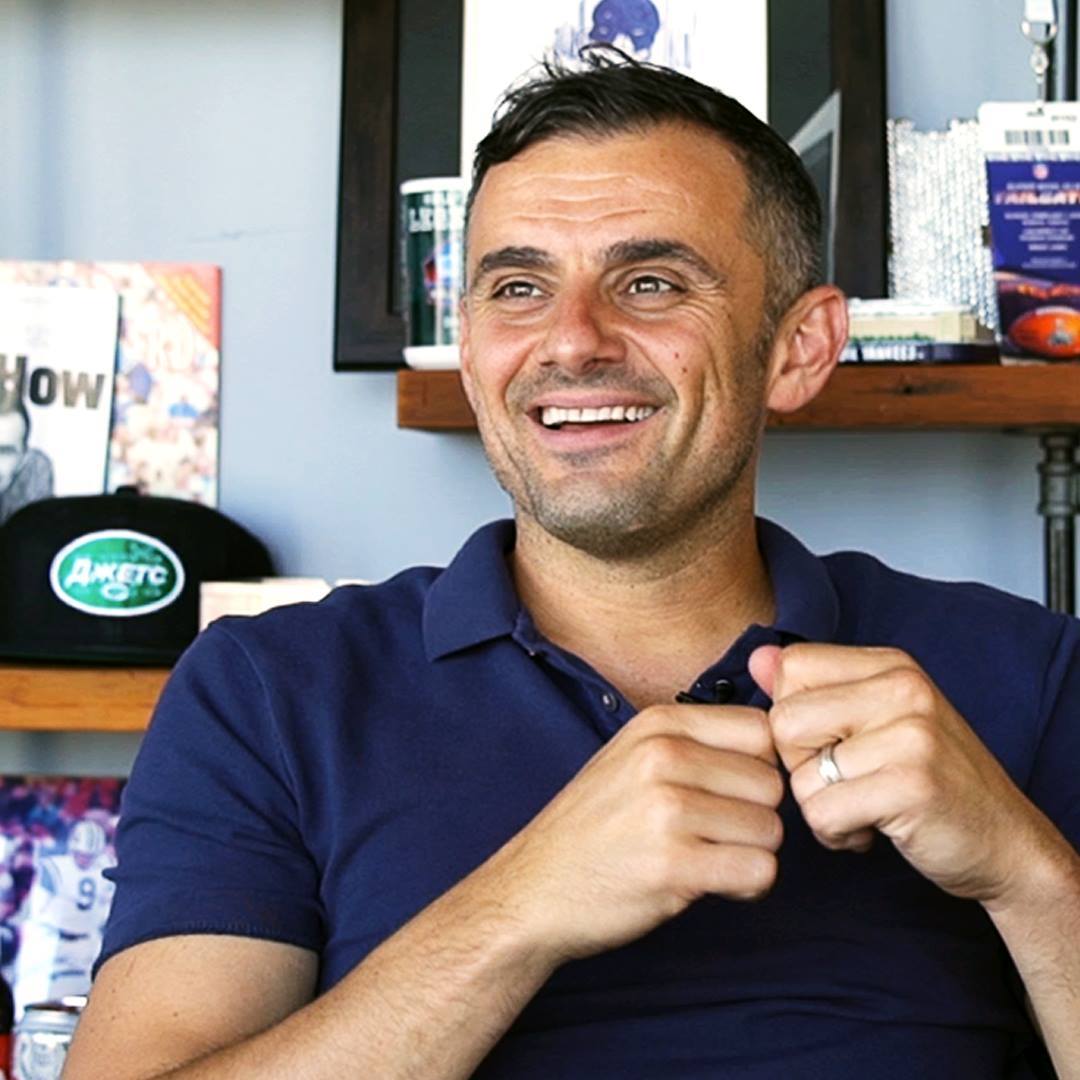
GARY VAYNERCHUK
Turned his family's wine shop into a $60 million business using YouTube, then built VaynerMedia into a 1,000-person agency while preaching hustle louder than anyone on the internet.
Gary Vaynerchuk grew up sharing a bedroom with eight family members in a one-bedroom New Jersey apartment after his family immigrated from Belarus with nothing. He took his dad's $3 million liquor store and grew it to $60 million in sales in five years using email newsletters and one of the earliest YouTube channels anyone had heard of. Then he bet early on Twitter, Facebook, Tumblr, and Uber — turning a few hundred thousand dollars into hundreds of millions in paper gains before most people knew what a startup was. He talks a lot. But the receipts are real.
Net Worth
$200 million
Nationality
American
Time Horizon
Long-Term
Risk Appetite
8 / 10
Net Worth Context
- · 200x the average American's lifetime earnings, stacked and waiting.
CAREER & BACKGROUND
Gary Vaynerchuk — or GaryVee, as the internet knows him — was born in Babruysk, Belarus in 1975. His family immigrated to the United States when he was three.
They landed in Queens, New York, and eventually settled in Edison, New Jersey. Eight family members.
One bedroom. His dad, Sasha, worked at a liquor store and eventually bought it.
Gary spent his childhood hustling. He ran lemonade stands.
He sold baseball cards at flea markets in middle school and was reportedly clearing $1,000 a weekend by the time he was in high school. He was never a great student.
He went to Mount Ida College in Massachusetts and graduated with a degree in business. He has said many times that college did almost nothing for him.
In 1997, fresh out of college, he joined his father's liquor store — Wine Library — in Springfield, New Jersey. He immediately started changing things.
He expanded the wine selection, focused on customer service, and launched one of the first e-commerce wine sites on the internet. Then he started a daily video show on YouTube called Wine Library TV.
Starting in 2006, he filmed himself tasting wines, spitting into a New York Jets bucket, and talking like nobody else in the wine industry talked. No pretension.
No suits. Just raw takes and hustle energy.
The show ran for 1,000 episodes. It built a massive audience.
It earned him appearances on Conan, Late Night with Conan O'Brien, and The Ellen DeGeneres Show. More importantly, it grew Wine Library's annual revenue from roughly $3 million to over $60 million in five years.
He didn't spend a dollar on traditional advertising. He did it entirely through content and community.
In 2009, he co-founded VaynerMedia with his brother AJ Vaynerchuk. The pitch was simple: social media is the new television, and brands have no idea how to use it.
VaynerMedia would do it for them. The agency grew to over 1,000 employees across New York, Los Angeles, London, Singapore, and other offices.
Clients have included PepsiCo, NFL, JPMorgan Chase, Anheuser-Busch, and dozens of Fortune 500 companies. Revenue is estimated north of $250 million annually.
He also started investing early — very early. He put money into Twitter, Facebook, Tumblr, Snapchat, Coinbase, and Uber when they were still tiny.
His early-stage angel checks, made mostly between 2009 and 2013, have appreciated enormously. His Uber investment alone is reported to have returned somewhere between 50x and 100x.
In 2021, he launched VeeFriends — an NFT project built around a hand-drawn character universe. He sold NFTs that granted holders access to him personally: meetings, events, appearances.
The project raised tens of millions of dollars in its first week. It remains one of the few celebrity NFT projects with a genuine ongoing community and utility model.
He also runs VaynerX, the holding company that sits above VaynerMedia and his other ventures, and VaynerSports, a sports talent management agency. The empire has grown well beyond social media consulting.
COMPANIES & ROLES
Wine Library was the starting point — his dad's liquor store in New Jersey that Gary turned into a $60 million e-commerce operation using YouTube videos and pure hustle before most businesses had a social strategy. He effectively ran one of the first influencer businesses in history without anyone calling it that.
VaynerMedia is his flagship agency. Founded in 2009 with his brother AJ, it manages social media and creative content for major brands.
Think of it as an advertising agency that was born inside social platforms instead of adapting to them. It has grown to over 1,000 employees and reportedly generates $250 million or more in annual revenue.
VaynerX is the parent holding company that organizes all of this.
On the investment side, Gary got early access to startups through relationships he built by being loudly useful on the internet before most VCs were paying attention. He invested in Twitter in 2009, Facebook early, Tumblr (which sold to Yahoo for $1.1 billion in 2013 — he was in), Snapchat in its early days, and Uber before it was a household name.
He has said his Uber investment produced returns somewhere between 50x and 100x. He invested in Coinbase, too, before crypto was a mainstream conversation.
VaynerSports manages professional athletes across the NFL, NBA, MLB, and MLS — handling contracts, endorsements, and brand deals. It's essentially applying the VaynerMedia brand-building approach to individual human beings.
VeeFriends is his NFT venture — launched in 2021 around hand-drawn characters representing positive traits like empathy, accountability, and patience. Each character was also a token that granted holders real-world access and experiences.
He has described it as a long-term brand play, not a quick flip. Whether it endures beyond the NFT cycle remains to be seen, but in 2021 and 2022 it generated significant revenue and genuine community engagement at a time when most celebrity NFT projects were purely cash grabs.
He also launched an e-commerce and AI media company, and has invested in dozens of early-stage startups through his personal angel portfolio.
INVESTING STYLE & PHILOSOPHY
Gary invests on attention arbitrage. That's the whole thesis.
Find the platform or medium where attention is cheap and undervalued, get in before advertisers and institutions arrive, and extract enormous value before the price reflects reality.
He did it with YouTube in 2006 when nobody in business was taking video content seriously. He did it with Twitter and Facebook in 2009 when most VCs still thought social media was a fad.
He did it with Snapchat when the prevailing wisdom was that teenagers don't have money. He did it with NFTs in 2021 when most of the business world was still reading explainer articles about what a blockchain was.
His angel investing is gut-driven and relationship-based. He doesn't run a fund with a formal thesis.
He doesn't have an investment committee. He backs founders he believes in and bets on platforms he uses obsessively.
He describes his process as meeting a lot of people, watching a lot of behavior, and placing small-to-medium bets on the ones that feel right. He has publicly said he looks at the founder's character and self-awareness more than the business model, because businesses pivot but people don't change.
He's also a long-term holder. He talks a lot about patience in a way that surprises people who associate him with the hustle-hustle-hustle content.
He held Uber through multiple cycles. He held Coinbase.
He's not flipping. He believes deeply in his own pattern recognition and doesn't sell just because the market disagrees with him temporarily.
His consumer brand investing — things like wine, NFTs, and media products — is an extension of the same logic. He wants to own assets in categories where he understands attention and distribution better than most other investors.
He's not competing with Sequoia on enterprise SaaS. He's competing in spaces where knowing how to build an audience is worth more than knowing how to build a spreadsheet.
THE PLAYBOOK
Risk Approach
Gary has a genuinely high risk tolerance — but it's not reckless. It's conviction-based.
He takes big swings on things he understands through direct experience, and he's extremely reluctant to bet big on things outside that lens.
His famous line is that he'd rather lose trying than regret not trying. He's put money into projects and platforms that most sophisticated investors laughed at — and been right enough times that the laughers have gone quiet.
He went deep on social media when social was considered a toy. He went deep on NFTs when NFTs were considered a scam.
His accuracy rate isn't 100%. But his conviction when he's right is so high that the wins dwarf the losses.
He has also said repeatedly that he doesn't lose sleep over losing money. He says it's because he genuinely believes he can always make it back.
That's either extreme confidence or extreme denial — and for someone with his track record, it's probably the former. He grew up with nothing.
He knows what nothing feels like. A down round or a failed startup doesn't rattle him the way it rattles someone who has never been truly broke.
He doesn't use leverage. He doesn't borrow to invest.
His risk is always equity risk — he's putting his own capital or his own time in, never financing it. That keeps the downside survivable even when individual bets go wrong.
Money Habits
Gary has talked openly about the fact that he doesn't own a lot of flashy things. He wears sneakers that cost less than most people's dress shirts — New Balance is his brand of choice, and he's worn them for years, long before he had a deal with them.
He drives a relatively normal car. He doesn't have a yacht.
What he does spend on is experiences and relationships. He takes his family on trips.
He buys front-row seats to New York Jets games — he's a lifelong Jets fan and makes no apologies for it despite decades of disappointment. He has said spending money on experiences with people he loves is the only category of spending that genuinely makes him happy.
He owns real estate in New York, which he has called his main hard asset outside of business equity. He's talked about real estate as the place where he parks wealth preservation capital — not a growth vehicle, but a store of value in a market he understands geographically.
He doesn't obsess over daily expenses or track spending with apps or spreadsheets. He has said his financial system is simple: don't spend more than you make, own equity in things you believe in, and don't let your lifestyle expand faster than your wealth.
He practices what he preaches on the lifestyle inflation point — his personal overhead is reportedly modest relative to his income.
He also gives away a lot of time for free. He famously replies to DMs, spends hours at meet-and-greets, and gives away content at a rate that most paid consultants would find absurd.
He treats his attention as a resource that generates returns through goodwill, network effects, and brand equity — not through being hoarded.
BIGGEST WIN
Uber. He invested early — somewhere in the 2009 to 2011 window, when Uber was still called UberCab and had launched only in San Francisco.
The exact check size has never been confirmed, but he has referenced returning somewhere between 50x and 100x on that position. If he put in $500,000, that's a $25 to $50 million return on a single check.
But the Uber investment is almost inseparable from the broader angel portfolio wins of that era. His Twitter stake, his Facebook position, his Tumblr shares that sold to Yahoo for $1.1 billion in 2013, his early Snapchat check, his Coinbase position — all of these came from the same playbook: get on these platforms before brands understand them, become a known name in the ecosystem, and parlay that access into early equity.
The total value of that angel portfolio has been estimated at somewhere between $100 million and $200 million. The cost basis was probably a few million dollars spread across those checks.
That's a return profile that most institutional investors would sell their GP interests to replicate.
The meta-win is that he built the access — the ability to get into those deals — through content. He didn't get Uber because he had a fund or because he went to Stanford.
He got it because he was one of the most recognizable voices on the internet and people wanted him around. That's a playbook nobody had written before him.
BIGGEST MISTAKE
He has said publicly that his biggest financial regret is not investing more when he had early conviction. He passed on putting more money into companies he believed in because he second-guessed himself or because the check he could write felt too small to matter.
In hindsight, the return on those incremental dollars would have been enormous.
He has also spoken about the early days of VaynerMedia when he underinvested in infrastructure and operations. He was great at landing clients and terrible at building the internal systems to service them properly.
The agency went through growing pains — high churn, delivery problems, culture issues — that he has acknowledged were his fault as a leader. He's said this cost the business years of compounding and probably tens of millions in revenue that walked out the door.
On the NFT side, VeeFriends launched in a hot market in 2021 and the floor prices on secondary markets dropped significantly through 2022 and 2023 as the broader NFT market collapsed. People who bought in at peak prices paid $50,000 to $100,000 for tokens that were worth far less a year later.
Gary has acknowledged the timing hurt holders and has repeatedly committed to building long-term value — but the short-term loss for buyers who entered at the top was real and significant.
He has also admitted to spreading himself too thin across too many projects simultaneously. His attention is the core asset, and he's diffused it across an agency, a sports management company, an NFT project, multiple media projects, a book series, and constant content creation.
He's said that if he had focused more narrowly at key moments, the compounding would have been more powerful.
FINANCIAL PHILOSOPHY
His core belief is that patience is the most underrated asset in business. He says this constantly and people often tune it out because he also talks about working at 4am and grinding on weekends — but the two ideas aren't in conflict.
Work hard now, hold for a long time. Don't cash out early just because someone offers you a number that sounds big.
He is deeply anti-short-termism. He thinks most people fail because they optimize for the next quarter when they should be thinking about the next decade.
He passed on selling VaynerMedia multiple times for offers reportedly in the hundreds of millions because he believes the business will be worth significantly more in ten years than it is today. He might be right.
He might be overconfident. But the philosophy is consistent.
He also believes that self-awareness is the most valuable financial skill most people don't talk about. Knowing what you're actually good at — and being honest about where you're not — determines which opportunities you should chase and which ones will destroy you.
He says he's bad at detail, bad at operations, bad at sitting still. So he hired people for those things and focused entirely on sales, vision, and content.
His view on money itself is interesting. He says he doesn't care about money for the things it buys.
He cares about money for the options it creates. Owning his business outright, having no boss, being able to say no to deals he doesn't believe in — those are the things that matter to him.
He drives that point home when he talks about why he didn't take venture money for VaynerMedia. He didn't want investors telling him what to do.
He also preaches buying things that appreciate rather than things that depreciate. Real estate over cars.
Equity over expenses. He talks about this particularly when addressing young people who spend money on lifestyle before building any assets.
FAMILY & PERSONAL LIFE
Gary is married to Lizzie Vaynerchuk — they met in college and have been together since. They have two children, Misha and Xander.
He talks about his family in public, but keeps the specifics relatively private, which is notable for someone who shares almost everything else online.
His mother, Tamara, and father, Sasha, are central characters in his story. His dad built the liquor store that Gary turned into an empire.
He credits his mother for his emotional intelligence and his father for his work ethic. He talks about his immigrant upbringing constantly — not as a sob story, but as the origin point of everything he is.
His brother AJ Vaynerchuk is his business partner and co-founded VaynerMedia with him. AJ runs the operational side of the business.
Gary has described their working relationship as complementary — he sells and builds culture, AJ executes and keeps the lights on. It's a family business in the best sense of the phrase.
He's a die-hard New York Jets fan — the kind of loyalty that comes from growing up in New Jersey with no rational reason to keep believing. He once said the Jets are the one thing in his life that makes him feel completely powerless, which he finds both maddening and somehow useful for perspective.
EDUCATION
He went to Mount Ida College in Massachusetts and graduated with a degree in business. He has said with complete honesty that college didn't teach him much that mattered.
He learned to sell at flea markets as a kid. He learned to hustle at his dad's liquor store.
The degree was more of a formality than a foundation. He's not anti-education, but he is loudly pro-real-world-experience, and his own trajectory makes it hard to argue with him.
BOOKS & RESOURCES
He's cited Naval as one of the thinkers he respects most
As a study in founder perseverance and brand-building under pressure
As an Amazon Associate, Netfigo earns from qualifying purchases. Book links above may be affiliate links.
QUOTES (6)
Patience is the most underrated attribute of a successful entrepreneur.
NETFIGO SCORE
Proprietary 5-dimension investor rating
Risk Appetite
Contrarian Index
Track Record
Accessibility
Time Horizon
Related Profiles
Investors
Grant Cardone
Both Vaynerchuk and Cardone are polarizing entrepreneur-influencers who preach hustle culture and have built eight-figure businesses off their personal brands — though their investment philosophies diverge sharply, with Cardone obsessing over real estate and Vaynerchuk focused on equity and attention.
Jason Calacanis
Both angel investors made early bets on Uber and Twitter, and both built their deal flow through media presence and community rather than traditional VC networks. Calacanis and Vaynerchuk run in the same early-stage circles.
Naval Ravikant
Both are early-stage angel investors who built their investment access through public intellectual influence rather than institutional pedigree. Vaynerchuk and Ravikant represent the new archetype of investor-as-content-creator.
Head-to-Head
Compare Gary Vaynerchuk vs another investor.