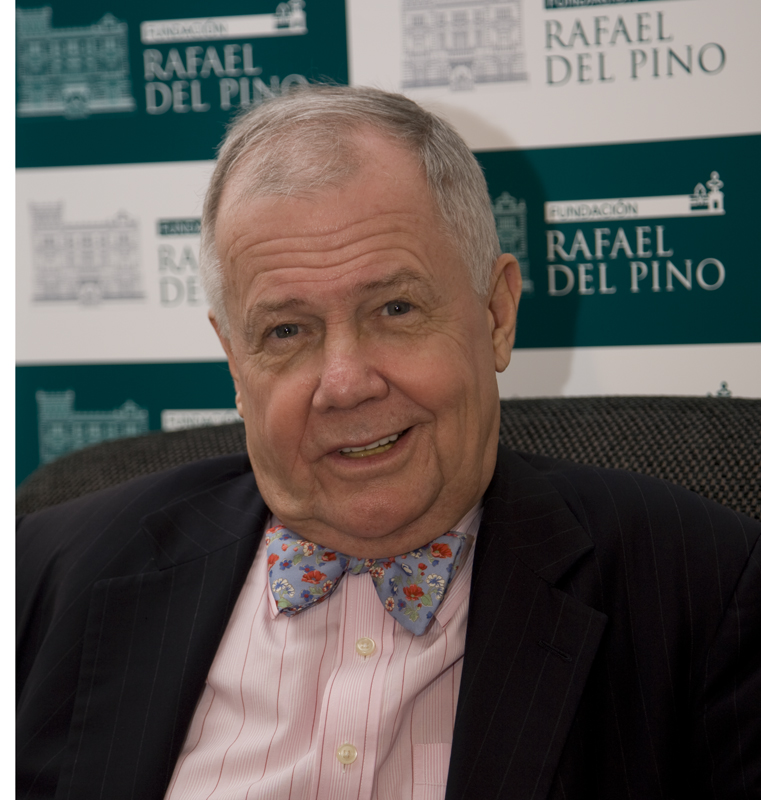
JIM ROGERS
Co-founding the Quantum Fund with George Soros, riding a motorcycle around the world twice, and calling the commodity supercycle before anyone else was paying attention.
Jim Rogers co-founded the Quantum Fund with George Soros in 1973, and over the next decade they returned 4,200% while the S&P 500 managed around 47%. He retired at 37, then spent the next few decades riding motorcycles across six continents and writing books about what he saw. His big call — that commodities were entering a multi-decade supercycle — turned out to be right for about fifteen years. He also moved his family to Singapore because he was convinced China would define the 21st century. Whether that last bet pays off is still TBD.
Net Worth
$300 million
Nationality
American
Time Horizon
Generational
Risk Appetite
7 / 10
Net Worth Context
- · 300x the average American's lifetime earnings, stacked and waiting.
CAREER & BACKGROUND
Jim Rogers grew up in Demopolis, Alabama, the son of a factory worker. He was sharp, driven, and got himself to Yale on scholarships, which was not a small thing for a kid from rural Alabama in the early 1960s.
After Yale he went to Oxford, then got drafted, then landed a job at a small brokerage house in New York. He hated it.
The work was boring and the analysis was shallow.
In 1973, Rogers teamed up with George Soros to launch the Quantum Fund with around $12 million. Rogers did the research — deep, fundamental, hours-in-the-library research — while Soros made the trades.
The combination worked. Over the next ten years, the fund returned approximately 4,200%.
By comparison, the S&P 500 returned about 47% over the same period. When Rogers left in 1980, he was 37 years old and rich enough to never work again.
He did not stop working, exactly. He retired from the fund but started doing something more interesting to him: traveling.
In 1990, he set off on a motorcycle with his girlfriend (later wife) Paige Parker and rode across six continents over two years — covering more than 100,000 miles through 52 countries. He wrote a book about it.
Then he did it again from 1999 to 2002, this time covering 116 countries and 152,000 miles, which earned him a Guinness World Record.
The travel wasn't just adventure tourism. Rogers was doing research.
He was looking at which countries were developing, which commodities were undersupplied, which currencies were mispriced. Out of that came his major macro call of the 2000s: commodities were entering a supercycle.
He launched the Rogers International Commodity Index in 1998. The index tracked agricultural goods, metals, and energy — things he thought the world was structurally underinvesting in.
He was right. The commodity boom ran from roughly 2000 to 2014.
In 2007, he made another contrarian bet on his own life: he moved his family from New York to Singapore. His stated reason was that China was going to be the dominant economic power of the 21st century, and he wanted his daughters to grow up fluent in Mandarin.
He still lives there.
COMPANIES & ROLES
The Quantum Fund is the big one. Rogers and Soros launched it in 1973 with $12 million from outside investors.
Rogers was the analyst — he'd spend weeks researching a single position, reading government reports, visiting factories, talking to farmers. Soros took that research and sized the trades.
By 1980, the fund had grown to around $381 million. Rogers left in 1980 and Soros kept going — but the foundational years of Quantum were as much Rogers as Soros.
After leaving Quantum, Rogers launched the Rogers International Commodity Index (RICI) in 1998. It's a broad commodity index — covering 38 commodities across energy, metals, and agriculture — weighted by global consumption rather than just US or Western markets.
That weighting was the insight: if you're tracking what the world actually uses, you need to include rice, rubber, and azuki beans, not just oil and gold. The index became a vehicle for investors who agreed with his commodity supercycle thesis.
He's also been a vocal investor in frontier markets — Myanmar before it opened, Russia in the early 1990s when everyone thought it was uninvestable, Chinese agriculture, and African farmland. These are not stocks most people have heard of.
Rogers tends to buy things that are so beaten down or so ignored that other investors have literally stopped covering them.
He's appeared on television regularly — CNBC, Bloomberg, Fox Business — mostly to make macro calls, some of which have been spectacularly right and some of which have been spectacularly wrong. He predicted a major US financial crisis well before 2008.
He also turned bearish on the US dollar so early that being right almost didn't matter by the time the trade played out.
INVESTING STYLE & PHILOSOPHY
Rogers is a top-down macro investor. That means he starts with the big picture — geopolitics, demographics, supply and demand at the global level — and works his way down to specific trades.
He is not interested in quarterly earnings. He does not model discounted cash flows.
He wants to know: is this country opening up or closing down? Is this commodity being underproduced relative to what the world needs?
Is this currency mispriced by twenty years of bad policy?
His research method is old-fashioned and intensive. He actually goes places.
When he was managing money at Quantum, he would spend months in the field — visiting farms, talking to local officials, reading regional newspapers in the original language where he could manage it. He has said that most investors never leave their offices, and that's why they miss things.
He sees travel as competitive advantage.
He thinks in very long cycles. Not quarters.
Not years. Decades.
His commodity supercycle thesis was based on the idea that from roughly 1980 to 2000, the world had underinvested in raw material production. No new mines, no new farms, no new oil fields.
Eventually demand catches up and prices explode. He called that cycle in the late 1990s when oil was around $10 a barrel.
Oil hit $147 in 2008.
His core investing analogy is simple: find the thing that's so hated nobody wants to own it, make sure the fundamentals are sound, and wait. He bought Russian shares in 1998 right after the ruble collapsed and everyone was fleeing.
He bought Chinese agriculture in the early 2000s before China became a mainstream investment. He loves being early.
He is also comfortable being early by years — which is a polite way of saying he's been wrong for extended periods on several calls.
He is deeply skeptical of central banks, paper money, government intervention, and anything that looks like a financial bubble inflated by cheap credit. These views have made him a reliable commentator but have also led him to be bearish on the US stock market for long stretches during which it kept going up.
THE PLAYBOOK
Risk Approach
Rogers has a genuinely unusual relationship with risk. He is not reckless — he does extensive research before making major calls — but he is completely comfortable with positions that feel uncomfortable to everyone around him.
He bought shares in countries where his broker wasn't sure trades would settle. He went long commodities when the whole asset class had been written off for two decades.
His framework for managing risk is roughly: know more than the market, wait for extreme pessimism, and size positions you can hold for years without panicking. He is not a stop-loss trader.
He doesn't bail out when a position moves against him in the short term. What he does do is try to ensure he's right on the fundamentals before he gets in — so that when the price drops, he's adding rather than selling.
He has said that he never uses leverage he can't afford to lose and that his biggest risk management tool is simply doing the homework. If you understand why something is cheap, you don't panic when it gets cheaper.
If you're just following a trend, you sell at the worst possible time.
That said, he has been wrong on big calls — US dollar collapse, imminent stock market crashes — for extended periods. His risk tolerance includes tolerating being publicly wrong.
Most investors can't do that. Rogers seems to enjoy it a little, or at least has made peace with it.
Money Habits
Rogers retired at 37 with enough money to live comfortably for the rest of his life. By his own account, he has not been extravagant with that freedom.
His big spending decisions have been his adventures — two circumnavigations of the globe by motorcycle, which cost real money in logistics, support, and time but were fundamentally about experience rather than status.
He moved his family from a townhouse on Riverside Drive in Manhattan — which he sold for about $16 million — to Singapore, a decision he frames as an investment in his daughters' futures rather than a lifestyle upgrade. Singapore is expensive, but the move was ideological, not hedonistic.
He drives modest cars. He doesn't own a yacht.
His version of luxury is time — time to read, research, travel, and spend with his daughters. He has said in interviews that he wants his daughters to understand that money is a tool and that the most important thing he can give them is the intellectual framework to understand the world, not a trust fund that removes the need to think.
He teaches his daughters Mandarin. He takes them to factories and markets when he travels.
His personal spending philosophy mirrors his investing philosophy: buy things that are undervalued, avoid things that are fashionable and overpriced, and optimize for the long term.
BIGGEST WIN
The Quantum Fund. Full stop.
Between 1973 and 1980, Rogers and Soros turned roughly $12 million in investor capital into $381 million — a return of approximately 4,200%. The S&P 500 returned about 47% over the same period.
In terms of raw outperformance, this is one of the greatest track records in the history of investing.
Rogers contributed the research engine. He was famously obsessive — reading everything, going everywhere, building investment theses from the ground up.
One of the fund's famous trades was shorting the UK pound and betting on the collapse of British financial markets in the mid-1970s, when Britain was genuinely in economic crisis. The trade worked enormously.
Another was going long certain commodities and international markets before those trades were popular on Wall Street.
The commodity supercycle call also deserves mention. Rogers started beating the drum about commodities in the late 1990s when oil was around $10 a barrel, copper was near historical lows, and agricultural prices had been depressed for years.
He launched the Rogers International Commodity Index in 1998. Over the following decade, commodities staged one of their greatest bull markets in history.
Oil went from $10 to $147. Copper tripled.
Agricultural commodities surged. People who followed his thesis when he was making it — when it was easy to ignore — made extraordinary returns.
BIGGEST MISTAKE
Rogers has been publicly, stubbornly wrong on the US dollar for a very long time. He has been predicting a dollar collapse driven by unsustainable deficits and Federal Reserve money printing since at least the late 1990s.
He has told investors to get out of the dollar, buy hard assets, and position for the end of dollar dominance — essentially continuously since he left Quantum. The dollar has not collapsed.
It is still the world's reserve currency. Investors who followed his dollar thesis and shorted the greenback aggressively have had a mixed-to-painful experience.
He has also been bearish on US stocks for extended periods during which US stocks went up a lot. Being consistently negative on American equities from, say, 2012 to 2020 was an extremely expensive position to hold.
He wasn't completely wrong — valuations were stretched and the 2020 crash briefly validated some concerns — but the duration of the bull market made the call a costly one.
He has acknowledged timing as his weak spot. His reads on fundamentals are often correct.
His reads on when things will play out are often wrong. He's said this himself: being early by years is functionally the same as being wrong if you can't hold the position.
The lesson is that macro investing requires not just being right on the analysis but being right on the timing — and Rogers has conceded the second part is genuinely hard.
FINANCIAL PHILOSOPHY
Rogers's rules are simpler than most finance professionals would like. First: only invest in things you understand better than the person on the other side of the trade.
He spent years becoming an expert in agricultural markets, commodity cycles, and emerging economy dynamics before betting big on them. He thinks most investors lose money because they're trading on opinions, not knowledge.
Second: buy things that are cheap. Not just kind of cheap — historically, embarrassingly cheap.
He uses phrases like 'panics and hysteria' to describe the entry points he looks for. When a market has collapsed so badly that no one will defend it on television, Rogers starts getting interested.
Third: do your own research. He is dismissive of Wall Street research, financial media, and consensus views.
His view is that by the time something is widely recommended, the opportunity is gone. He reads government statistics directly.
He visits the places he invests in. He talks to farmers, factory workers, shopkeepers — not just CEOs and CFOs.
Fourth: be patient. His commodity supercycle thesis took years to play out.
His China thesis is still playing out. He has explicitly said he would rather be early by two years than late by a month.
Being early means suffering mark-to-market losses while you wait, but it also means getting the real return rather than the tail end of someone else's trade.
Fifth: stay solvent during the wait. He doesn't use dangerous amounts of leverage precisely because he knows his timing is often off.
He needs to be able to hold positions through the pain without getting wiped out.
FAMILY & PERSONAL LIFE
Rogers has been married twice. His second wife, Paige Parker, was his companion on both motorcycle adventures around the world.
They married in 2000. Together they have two daughters, Happy (born 2003) and Hilton (born 2008), both of whom have grown up in Singapore and are being raised bilingual in English and Mandarin.
Rogers has talked extensively about wanting his daughters to understand China and Asia because he believes that's where the center of the world economy is moving. He has said, somewhat bluntly, that speaking Mandarin will be more valuable to a child born today than speaking any other language.
He takes them along on research trips and has said he tries to teach them to think about the world as investors — not in a Wall Street way, but in the sense of understanding how economies and societies actually work.
His late father was a factory worker in Alabama. Rogers has cited his working-class background as formative — it gave him a healthy skepticism of financial orthodoxy and a respect for the real economy (factories, farms, mines) that shapes how he invests.
EDUCATION
Rogers attended Yale University on scholarship, graduating in 1964. He then went to Balliol College, Oxford, studying PPE (Philosophy, Politics, and Economics).
He has said Oxford was transformative — it taught him to think rigorously about systems, institutions, and how the world is organized. He then served in the US Army before landing in New York's financial world.
The Oxford background is evident in how he talks about macro — he thinks about history, politics, and economics as one interconnected thing, not separate disciplines.
BOOKS & RESOURCES
Rogers has written several books, all of which are worth reading because theyre genuinely readable — he writes the way he talks, which is direct and opinionated.
For broader reading, Rogers recommends studying economic history directly — hes cited Charles Kindlebergers Manias, Panics, and Crashes as essential, along with reading government statistics and commodity market data rather than sell-side research.
As an Amazon Associate, Netfigo earns from qualifying purchases. Book links above may be affiliate links.
QUOTES (6)
I just wait until there is money lying in the corner, and all I have to do is go over there and pick it up.
Bottoms in the investment world don't end with four-year lows; they end with 10- or 15-year lows.
The way to get rich is to find what you love to do and then find someone to pay you to do it.
History shows that people who save and invest grow and prosper, and the others deteriorate and collapse.
In my experience, the key to making money is knowing when not to do anything.
NETFIGO SCORE
Proprietary 5-dimension investor rating
Risk Appetite
Contrarian Index
Track Record
Accessibility
Time Horizon
Related Profiles
Investors
George Soros
Co-founded the Quantum Fund with Soros in 1973, delivering 4,200% returns over a decade before Rogers retired at 37
Jim Simons
Contemporaries who both retired from active fund management after extraordinary track records, though their methods could not be more different
Ray Dalio
Both are global macro investors who think in decades, study economic history obsessively, and built reputations on commodity and currency calls
Stanley Druckenmiller
Druckenmiller succeeded Rogers as Soros's chief strategist at Quantum; both are global macro legends who built their reputations in the same fund's orbit
Head-to-Head
Compare Jim Rogers vs another investor.