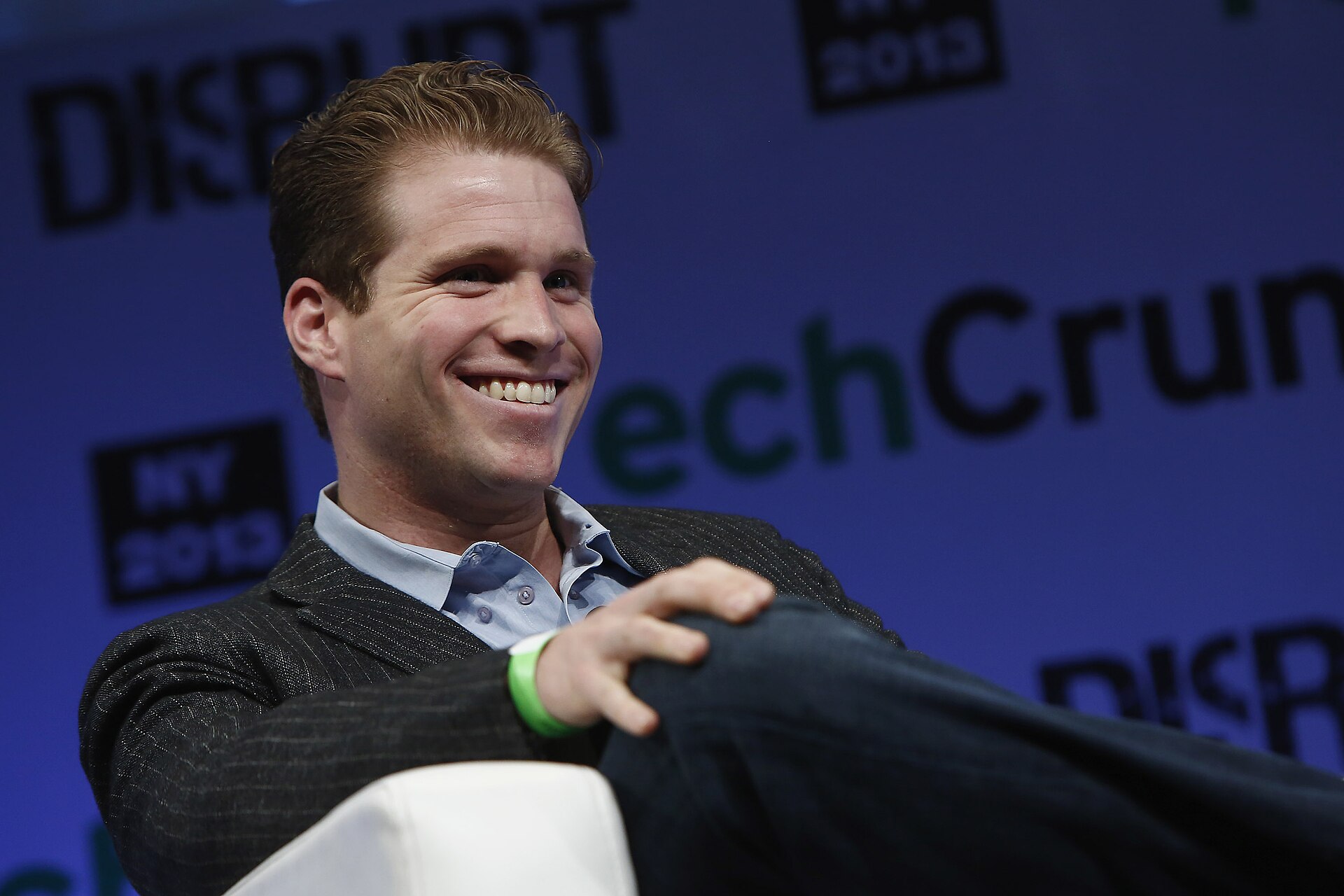
JOE LONSDALE
Co-founding Palantir at 21 and building 8VC into one of Silicon Valley's most politically outspoken venture firms.
Joe Lonsdale co-founded Palantir at 21, helped build a company now worth over $100 billion, and then decided that wasn't enough — so he started a venture firm, founded half a dozen more companies, and became one of tech's loudest voices on government dysfunction. He's the rare VC who actually ships products instead of just writing checks. Critics call him abrasive. Supporters call him a builder. Both are correct. He moved his entire operation from San Francisco to Austin in 2021, which at this point is less a political statement and more a personality trait for his class of tech founder.
Net Worth
$5 billion
Nationality
American
Time Horizon
Long-Term
Risk Appetite
7 / 10
Net Worth Context
- · Still a billionaire — just the quiet kind at the end of the table.
CAREER & BACKGROUND
Lonsdale grew up in Menlo Park, California, the kind of place where the dinner table conversation was already about startups before startups were cool. He was obsessed with math and tech from an early age, and by the time he got to Stanford, he was already orbiting Peter Thiel's world.
At Stanford, he worked with Thiel directly — first as an intern at Thiel's hedge fund Clarium Capital, then as a co-founder of Palantir Technologies, which he helped launch in 2003 alongside Thiel, Alex Karp, Nathan Gettings, and Stephen Cohen. Palantir was built to do one thing: help intelligence agencies and large institutions make sense of massive, messy data.
The CIA's venture arm In-Q-Tel was an early backer. Lonsdale was 21 years old.
He stayed at Palantir through its formative years, helping build out the product and culture before departing around 2009 to pursue other ventures. He was never the CEO — that was always Alex Karp — but his fingerprints are all over the company's early architecture and sales strategy.
After Palantir, he co-founded Addepar in 2009, a wealth management platform for high-net-worth individuals and financial advisors. The idea was elegant: rich families and family offices had massive, sprawling portfolios spread across dozens of custodians, and nobody had clean data on all of it.
Addepar would fix that. It eventually grew to manage reporting on over $6 trillion in assets.
In 2012, he launched Formation 8, a venture fund focused on enterprise technology and defense, before eventually spinning that into what became 8VC in 2015. 8VC is Lonsdale's primary vehicle today — a firm with over $6 billion in assets under management that bets heavily on hard tech, healthcare, defense, and enterprise software.
Along the way he also co-founded OpenGov, a government financial transparency platform; Epona Health; and has been involved in more than a dozen other companies as a founder or early investor. The man does not appear to sit still.
COMPANIES & ROLES
Palantir is the big one. Co-founded in 2003 with Peter Thiel and Alex Karp to help governments and large institutions analyze massive datasets — think counter-terrorism intelligence, fraud detection, supply chain tracking.
It went public in 2020 via a direct listing and is now worth north of $100 billion. Lonsdale left before the IPO, but the Palantir stake alone would have made most people retire.
He didn't.
Addepar is his other major build. Launched in 2009, it's essentially the financial operating system for family offices and wealth managers — aggregating all their holdings into one clean dashboard.
By 2024 it was tracking over $6 trillion in assets across thousands of clients. Not a flashy consumer app, but deeply embedded infrastructure for the people managing serious money.
OpenGov is the government tech play. It provides budgeting, reporting, and procurement software to local and state governments — the kind of mundane-sounding product that's actually critical because most government finance still runs on spreadsheets and legacy systems from the 1990s.
Over 1,500 government entities use it.
8VC is his venture firm, managing over $6 billion across multiple funds. Its portfolio includes companies like Joby Aviation (electric air taxis), Samsara (fleet operations), Blend (mortgage software), and dozens more.
The firm has a particular focus on what Lonsdale calls 'frontier tech' — defense, biotech, infrastructure, and government services.
He also co-founded Epona Health and has been a founding investor or co-founder in companies spanning healthcare IT, defense technology, and financial infrastructure. His model is less 'write a check and give advice' and more 'get in early, help build the thing, hire the team, then step back.'
INVESTING STYLE & PHILOSOPHY
Lonsdale is a builder-investor. Most VCs find interesting companies and wire money.
Lonsdale finds interesting problems and tries to build companies around them. It's a subtle but important distinction — it means he's usually coming from the product side, not the financial side, of any deal.
He focuses almost exclusively on what gets called 'frontier tech' or 'hard tech' — defense, government, healthcare infrastructure, enterprise software. These are the sectors that most Silicon Valley investors avoided for years because the sales cycles are long, the customers are difficult, and the regulatory environments are brutal.
Lonsdale sees that as a feature, not a bug. High barriers to entry mean less competition from people who just want a quick flip.
His typical investment looks like this: a domain where legacy incumbents are entrenched but bad, a team with unusual technical depth, and a go-to-market strategy that involves deep relationships rather than viral growth. He's not chasing consumer apps or crypto tokens.
He's betting on picks-and-shovels infrastructure that will be boring and essential for decades.
He also thinks a lot about geopolitics and national security. 8VC is one of the more active defense-tech investors in Silicon Valley — Lonsdale has been vocal about the need for American tech companies to work with the U.S.
military, at a time when many of his peers were distancing themselves from anything government-adjacent. He's been outspoken that this is both a moral and a business thesis.
The time horizon is long. He'll wait years — sometimes a decade — for a thesis to play out.
Addepar took years to hit product-market fit. Palantir took almost a decade to become the company it is now.
He has the patience that most early-stage investors claim to have but don't actually possess.
THE PLAYBOOK
Risk Approach
Lonsdale takes on a lot of company-building risk but is disciplined about portfolio construction. He's not a spray-and-pray VC who writes 100 tiny checks hoping one becomes a unicorn.
He makes concentrated bets in sectors he genuinely knows — government, defense, financial services — and gets operationally involved enough that he can affect the outcome.
He's comfortable with the kind of risk most people avoid: long sales cycles, regulated industries, government contracts, geopolitical exposure. He's said publicly that some of the best opportunities are in the sectors everyone else finds boring or scary.
That's a contrarian stance that requires real conviction, because you have to be willing to sit with an investment for years before seeing traction.
He's also willing to be politically controversial, which is its own kind of risk in tech. He's been openly critical of California's regulatory environment, openly pro-defense-tech, and openly skeptical of progressive governance.
In a world where many tech investors stay carefully neutral to avoid alienating LPs or portfolio founders, Lonsdale says what he thinks. That's cost him relationships.
He seems to view that as acceptable collateral damage.
Money Habits
Lonsdale relocated from San Francisco to Austin, Texas in 2021 — partly for taxes (no state income tax), partly for ideology, and partly because he genuinely believes the Bay Area's governance model is broken. He's been vocal enough about this that it became national news.
He's married with children and does not appear to have the flashy lifestyle profile of some of his contemporaries. No superyacht stories.
No profile pieces about his art collection. His public persona is almost entirely about ideas and work — what's wrong with government, what's right about hard tech, why Silicon Valley lost its nerve.
He funds and co-founded the Cicero Institute, a policy think tank focused on criminal justice reform, healthcare, and government efficiency. It's his attempt to put money and effort into changing the policy environment, not just complaining about it on social media.
He's also a donor to Republican and libertarian causes, which puts him in a distinct minority among his Stanford-educated, tech-venture peers. He backed Ron DeSantis's presidential campaign in 2023 and has been a consistent voice for limited government in a world where most of his colleagues publicly say nothing and privately think the same things.
He teaches at Stanford — or has lectured there — and has a reputation among students as demanding and intellectually serious. Not the kind of guest speaker who tells everyone to follow their passion.
BIGGEST WIN
Palantir. Full stop.
He helped found it at 21 with essentially nothing except a Thiel connection and a conviction that governments were drowning in data they couldn't use. The company spent years being almost-profitable, largely misunderstood, and dependent on classified government contracts that it couldn't even talk about publicly.
When Palantir went public in September 2020 via direct listing, it opened at around $10 per share with a market cap of approximately $22 billion. By late 2021 it had hit nearly $45 billion.
By 2024, with the AI tailwind behind it, Palantir's market cap had exceeded $100 billion. Lonsdale left the company years before the IPO, but his founding equity stake — even heavily diluted — represented an extraordinary outcome.
The broader win is what Palantir proved: that you could build a serious enterprise software business selling to intelligence agencies and the military, that Silicon Valley and national security didn't have to be enemies, and that patience in company-building pays off in ways that the quarterly-obsessed venture world rarely accounts for. That thesis has since become the foundation of an entire generation of defense-tech startups.
BIGGEST MISTAKE
Lonsdale has been involved in enough companies that not all of them worked. He's spoken about the difficulty of getting government-focused technology to scale — the sales cycles are long, the procurement processes are Byzantine, and even a great product can die waiting for a contract to clear.
The more publicly documented difficult episode in his career was a lawsuit filed against him in 2015 by a former Stanford student, which was eventually dismissed. It was an ugly, contested, public situation that he pushed back on vigorously.
Whatever actually happened, it dominated press coverage of him for a period and likely cost him deals and relationships at a time when #MeToo was reshaping how the tech industry handled these situations. The legal outcome vindicated his position, but reputational damage from that kind of coverage doesn't just disappear.
On the business side, Formation 8 — his pre-8VC fund — had a mixed track record. It made some good bets but also had notable misses.
The decision to restructure it into 8VC was partly a reset. The lesson he seems to have drawn: tighter focus, fewer themes, deeper involvement.
8VC is more concentrated than Formation 8 was.
FINANCIAL PHILOSOPHY
Lonsdale's philosophy is built around one idea: technology can fix things that seem broken at an institutional level, but you have to be willing to actually try to fix them instead of just commenting on them from the sidelines.
He believes most VCs are too passive — they pick companies like they're picking stocks, instead of treating company-building as a craft. His rule is: if you can't contribute meaningfully to making the company better, you shouldn't be leading the round.
Writing a check and then showing up at board meetings to ask about CAC and LTV is not value-add.
On wealth: he's written and spoken about the idea that capital should be deployed toward solving hard problems, not sat on. He's skeptical of wealth preservation as a primary goal.
In his framework, the best use of financial resources is building the systems and companies that make civilization actually function — which is why 8VC keeps investing in things like government software and healthcare infrastructure that most people find unglamorous.
He's also a believer in American dynamism — a term he and others in his orbit have popularized to describe the thesis that the U.S. can and should be building more ambitious things: better infrastructure, stronger defense, more competitive biotech.
The investment strategy flows from that worldview. He's not betting on the U.S.
in decline. He's betting on it rebuilding.
FAMILY & PERSONAL LIFE
Lonsdale met his wife Tayler through their shared Stanford circles. They married and have children together — he's spoken about fatherhood in the context of thinking about long-term institutional problems, the kind of 'what kind of country are we leaving behind' framing that colors a lot of his policy work.
His family moved with him to Austin in 2021, which given the cultural and climatic difference from Palo Alto was either a bold statement or a very expensive political opinion. Probably both.
He's close to the broader Thiel network — not just professionally but in terms of shared intellectual outlook on government, technology, and what's gone wrong with American institutions. That network — which includes Keith Rabois, Blake Masters, and others — has become increasingly influential in Republican politics, which puts Lonsdale at the intersection of tech and political power in an unusual way.
EDUCATION
Stanford University, BA in Mathematics and Computational Sciences. This is where everything started — the Thiel connection, the Palantir co-founding, the network that underpins everything he's built since.
He's spoken about Stanford as formative but also increasingly critical of what elite universities have become. Classic case of someone who benefited enormously from an institution and then spent decades critiquing it.
BOOKS & RESOURCES
Lonsdale hasnt published a book, which is honestly surprising given how much he writes and talks about ideas
He's prolific on X (formerly Twitter) and through the Cicero Institute, and has given enough interviews and lectures to fill one — but no book yet
A prescient (and occasionally wild) 1997 book about how technology would decentralize power away from nation-states. It's become something of a sacred text in the Thiel-adjacent tech world
For the political economy lens he applies to his government-reform work, and 'The Innovator's Dilemma' by Clayton Christensen for the framework he applies to incumbents in regulated industries
As an Amazon Associate, Netfigo earns from qualifying purchases. Book links above may be affiliate links.
QUOTES (6)
The best opportunities are in the places everyone else finds too hard, too regulated, or too boring. That's where you find real moats.
Silicon Valley has an obligation to work on national security. Pretending otherwise is naive and irresponsible.
Most VCs think their job is to pick the right horses. The best ones help build the horse.
California isn't ungovernable. It's just governed by people who've decided dysfunction is acceptable.
If you want to change how the government works, you have to build the software it runs on. Complaining doesn't scale.
The founders who build things that matter are the ones willing to work in unsexy, difficult, slow-moving domains for a decade.
NETFIGO SCORE
Proprietary 5-dimension investor rating
Risk Appetite
Contrarian Index
Track Record
Accessibility
Time Horizon
Related Profiles
Investors
Head-to-Head
Compare Joe Lonsdale vs another investor.