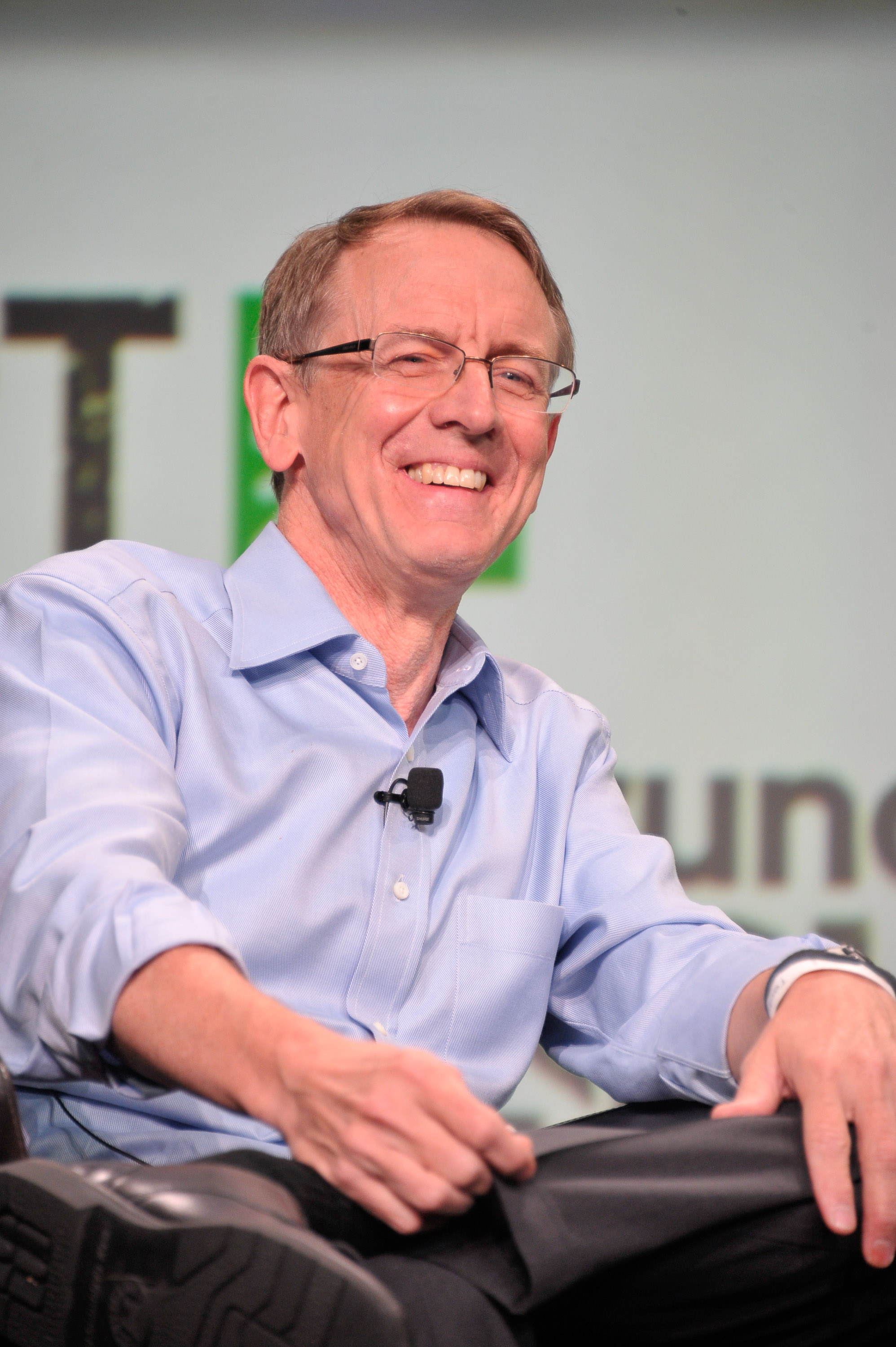
JOHN DOERR
The venture capitalist who backed Google and Amazon early and invented the goal-setting system half of Silicon Valley runs on.
John Doerr put $12.5 million into Google in 1999 when it was two guys in a garage who'd already turned down a $1 million acquisition offer from Excite. That bet is now worth tens of billions. He also backed Amazon, Netscape, Intuit, and Compaq before anyone knew what a venture capitalist was. He didn't just pick winners — he handed them OKRs, the goal-setting framework he learned at Intel, and told them to run faster. In a world full of VCs who write checks and go to conferences, Doerr actually showed up with a system.
Net Worth
$12.7 billion
Nationality
American
Time Horizon
Long-Term
Risk Appetite
7 / 10
Net Worth Context
- · That's the GDP of a small country — around the size of Greenland.
- · Enough to buy an NBA team and keep $9B for snacks.
CAREER & BACKGROUND
John Doerr grew up in St. Louis and went on to study electrical engineering at Rice University, then got his MBA from Harvard Business School.
Before he ever wrote a venture check, he spent years at Intel in the late 1970s selling chips. That's important.
He didn't come from money or banking — he came from the floor of a semiconductor company, which is why he understood what engineers were actually building better than most of the people writing checks at the time.
In 1980, he joined Kleiner Perkins, then a small but respected venture firm in Menlo Park. Over the next two decades, he turned it into the most powerful firm in Silicon Valley.
He backed Compaq, which became one of the fastest companies to reach $1 billion in revenue. He backed Netscape, which basically invented the commercial internet browser and went public in 1995 in one of the most watched IPOs of the decade.
He backed Amazon in 1996, when Jeff Bezos was selling books out of a garage in Seattle and most people thought it was a bookstore. He backed Google in 1999, when Sequoia's Mike Moritz also came in — one of the rare deals where two top firms co-invested at the same round.
By the time the dot-com bubble burst in 2000, Doerr was famous for the wrong reasons too. He'd made the 'greatest legal creation of wealth in the history of the planet' speech on a TED stage in 1999, which has aged somewhat awkwardly given the crash that followed.
But his core bets — Amazon and Google — turned out to be generational. They didn't just survive the crash.
They became two of the most valuable companies in human history.
Doerr also introduced OKRs — Objectives and Key Results — to Silicon Valley. He'd learned the system from Andy Grove at Intel and presented it to Larry Page and Sergey Brin in a conference room in 1999.
Google still uses it. So does LinkedIn, Twitter, Uber, and thousands of other companies.
That's a legacy most investors don't have: you changed how companies actually operate.
In his later career, Doerr became one of the loudest voices on climate change, committing hundreds of millions to clean energy and authoring a book on the subject. He's given $1.1 billion to Stanford's School of Sustainability, which now bears his name.
He's also on the board of Amazon and has been one of the most connected operators in technology for over four decades.
COMPANIES & ROLES
Kleiner Perkins is where Doerr spent his entire investing career. He joined in 1980 and became the firm's most famous general partner.
Kleiner Perkins backed some of the biggest companies in technology history, and Doerr was lead investor or board member on most of the landmark deals.
Google is the one everyone knows. Doerr invested $12.5 million in 1999 as part of a $25 million round alongside Sequoia.
The company was worth about $75 million at the time. It went public in 2004 and is now worth $2 trillion.
Doerr sat on the board for years and was instrumental in convincing Page and Brin to hire Eric Schmidt as CEO — a decision that arguably saved the company from itself in its early years.
Amazon is arguably the better bet in terms of risk-adjusted insight. Doerr invested in 1996 when it was a two-year-old online bookstore.
Jeff Bezos was planning to expand beyond books — but nobody knew into what. Doerr joined the board and stayed for over two decades.
Amazon is now worth $1.8 trillion.
Netscape was Kleiner's defining deal of the mid-1990s. The browser company went public in August 1995 and its first-day trading — the stock doubled on day one — kicked off the dot-com era.
Doerr was involved early and the return was massive before the eventual collapse.
Compaq was Doerr's first major win. Kleiner backed Compaq in 1982.
It became the fastest company to reach $1 billion in revenue at the time. It was eventually acquired by HP for $25 billion in 2002, though by that point its best days were behind it.
Intuit, Sun Microsystems, Macromedia, and dozens of other enterprise and consumer software companies round out the portfolio. Kleiner under Doerr was also an early backer of Genentech, which is how the firm developed its healthcare investing practice.
INVESTING STYLE & PHILOSOPHY
Doerr is what you'd call a conviction investor who shows up. Most VCs write a check and wait.
Doerr writes a check, takes a board seat, brings a management framework, makes introductions, and helps recruit the CEO. He's less 'I'll fund you' and more 'I'll co-build this with you.' Whether that's always welcome is a different question — but the returns suggest it works.
His framework is straightforward: find a huge market, find a team that can own it, and back them before anyone else figures out what's happening. He's said repeatedly that he bets on people first and markets second.
With Google, he met Page and Brin and decided within days that they were something different. The technology was secondary to his read on the founders.
He's also obsessed with metrics. The OKR thing isn't just a consulting trick — it reflects how he actually thinks.
He wants companies to set ambitious, measurable goals and hold themselves accountable. Not 'grow the business.' More like 'reach 100 million users in 18 months and here's exactly how we'll know if we're on track.' That kind of specificity is rare in VC, where the default is vague optimism.
In terms of sectors, he's concentrated in technology and — more recently — climate. He doesn't scatter capital across dozens of themes.
He picks a wave and surfs it hard. In the 1980s it was semiconductors and PC hardware.
In the 1990s it was the internet. In the 2000s it was consumer internet.
In the 2010s it was mobile and enterprise SaaS. Now it's clean energy and AI.
He's also unusually patient by VC standards. Amazon took years to look like a great investment.
Google looked like a great investment almost immediately, but his broader thesis — that the internet would transform everything — took a decade to fully play out. He held through the crash and stayed on boards through the hard years.
That's the difference between a tourist and an operator.
THE PLAYBOOK
Risk Approach
Doerr operates in venture capital, which is structurally a high-risk game — most bets fail, a few bets return everything, and one or two bets define a career. He's comfortable with that math.
He doesn't try to reduce uncertainty by only backing proven companies. He bets on things that haven't happened yet.
But he manages risk through selection, not diversification. He doesn't spread a fund thin across fifty companies hoping something works.
He concentrates on the deals he believes in most, takes board seats, and gets operationally involved. His logic is: if you're going to lose money, lose it because the market was wrong, not because you weren't paying attention.
He's also willing to take reputational risk. Backing Google when Excite had already passed on it, backing Amazon when conventional wisdom said physical retail would never die, putting climate change on Kleiner's agenda when most Silicon Valley firms thought it wasn't a venture opportunity — all of these were positions that made him look wrong before they made him look right.
The dot-com crash was a real test. Kleiner had backed plenty of companies that went to zero between 2000 and 2002.
Doerr was publicly associated with the bubble, having made optimistic speeches right before it burst. His response was to double down on the underlying thesis — the internet was still going to change everything — rather than pivot away from tech investing.
That turned out to be the right call, even if the timing was painful.
Money Habits
Doerr lives in Woodside, California, the ultra-wealthy enclave in the hills above Palo Alto where tech billionaires go when they want privacy and land. He's not the flashiest figure in Silicon Valley — you're not reading about him at Art Basel or buying a superyacht.
But he's not exactly ascetic either.
He and his wife Ann have given away extraordinary amounts of money. The $1.1 billion gift to Stanford for the Doerr School of Sustainability in 2022 was the largest in the university's history.
He's also committed hundreds of millions to climate-related causes and organizations through the years. The giving isn't recent — they've been philanthropically active since the early 2000s.
Doerr is known for being intensely focused and not particularly interested in conspicuous consumption. No famous art collection.
No side hustle in the media. He's written a book, but it's a business book, not a memoir designed to build a personal brand.
His brand is the portfolio. He'd rather be known for what he backed than for what he drives.
He's been involved with charitable education initiatives for decades, including KippLA and various STEM programs. The pattern is consistent: when he's not in the office, he's usually putting money into something he thinks will matter in twenty years.
Which is more or less the same thing he does in the office.
BIGGEST WIN
Google. Full stop.
Doerr invested $12.5 million in September 1999 as part of a $25 million Series A alongside Sequoia Capital. At the time, Google was valued at roughly $75 million — not bad for a search engine nobody had heard of that was already technically superior to everything else in the market, but still speculative.
When Google went public in August 2004, Kleiner's stake was worth over $1 billion. By the time Alphabet's market cap crossed $1 trillion in 2020, the original $12.5 million investment had grown by a factor of thousands.
The exact current value of Kleiner's total position has never been fully disclosed, but estimates put it in the tens of billions across the full history of distributions and holdings.
What makes this remarkable isn't just the number. It's the context.
Excite had the chance to buy Google for $1 million in 1999 and passed. Ask Jeeves passed.
Yahoo passed. Doerr and Moritz at Sequoia are the ones who showed up with serious money when it mattered.
And critically, Doerr didn't just write a check — he helped hire Eric Schmidt as CEO in 2001, which gave Page and Brin the adult supervision they needed to scale without chaos. The investment and the operational support compounded together.
BIGGEST MISTAKE
Kleiner Perkins' clean-tech push in the late 2000s and early 2010s is the most discussed stumble of Doerr's career. The firm committed over $1 billion to cleantech investments between roughly 2006 and 2012, backing solar, biofuel, electric vehicle, and battery companies with the same conviction Doerr had applied to internet investments.
The thesis was right. The timing and execution were not.
The fund lost a significant portion of that capital. Some companies went bankrupt.
Others were acquired at fractions of their invested value. Battery and solar costs didn't fall as fast as the models predicted.
The subsidies and policy environment didn't materialize the way Kleiner hoped. And frankly, some of the bets were on technology that simply wasn't ready — not unlike backing broadband infrastructure in 1999, except that internet infrastructure eventually worked.
The clean-tech losses are estimated to have cost Kleiner somewhere between $400 million and $900 million depending on how you count the positions. More damaging to the firm was the reputational cost: Kleiner went from the most respected firm in Silicon Valley to a firm that had missed several major social and mobile deals (Twitter, Facebook, Uber) while pouring capital into solar companies.
The partners who made the call on some of those missed consumer deals eventually left.
Doerr has been fairly candid about this. His response was to double down on climate — his 2021 book 'Speed and Scale' is essentially an action plan for decarbonization — rather than retreat.
Whether that represents conviction or doubling down on a sunk-cost thesis is something the next decade will answer.
FINANCIAL PHILOSOPHY
Doerr's investing philosophy is almost inseparable from Andy Grove's influence. Grove ran Intel like a machine — clear objectives, measurable results, brutal accountability.
Doerr absorbed that and carried it into every company he touched. His philosophy is: set a direction, measure progress ruthlessly, and don't confuse activity with achievement.
He also believes, genuinely, that great companies are built around ideas that matter. Not just financially, but socially.
His climate work isn't marketing — he's been talking about it since the early 2000s when it was deeply unfashionable in technology circles. He thinks investors have an obligation to direct capital toward problems that are worth solving, not just toward problems that are easy to monetize.
On founders, he's been consistent for decades: back missionaries, not mercenaries. Founders who are building because they're obsessed with a problem will outlast founders who are building for the exit.
This is a widely repeated VC cliché now, but Doerr was saying it before it became a cliché.
He's also honest about luck. In 'Measure What Matters,' he writes about the Google investment and is fairly candid that some of it was timing, some was judgment, and some was being in the right place.
That honesty is rarer in VC than it should be. Most investors in his position would just claim omniscience.
FAMILY & PERSONAL LIFE
Doerr has been married to Ann Howland Doerr since 1978 — they met at Harvard Business School. Ann has been an equal partner in their philanthropy and is deeply involved in education initiatives.
Their marriage predates the Google check, the Amazon check, and basically all of it, which is either romantic or statistically improbable, take your pick.
They have two daughters, Mary and Esther. Their daughter Mary died in 2005 at age 16 from a drug overdose, a loss Doerr has spoken about publicly and that has visibly shaped his engagement with addiction and youth education issues.
He's referenced her in speeches and interviews over the years — it's clearly not a topic he avoids.
The Doerr family is based in Woodside, California. They're known as serious philanthropists rather than social figures.
The $1.1 billion gift to Stanford was made in both their names.
EDUCATION
Doerr studied electrical engineering at Rice University in Houston, graduating in 1973. The engineering background matters — he could actually read a spec sheet, which put him ahead of most investors when everyone was trying to figure out what a microprocessor was.
He then got his MBA from Harvard Business School in 1976, where he met his wife Ann. Harvard gave him the business vocabulary to go with the engineering foundation.
Then Intel gave him everything else.
BOOKS & RESOURCES
It's the book Doerr has recommended more than any other, and it's the direct source of the OKR framework. Grove wrote it in 1983 and it holds up completely
Which influenced Grove, which influenced Doerr. The whole lineage is there
As an Amazon Associate, Netfigo earns from qualifying purchases. Book links above may be affiliate links.
QUOTES (6)
OKRs are not a silver bullet. They cannot substitute for sound judgment, strong leadership, or a creative workplace culture.
NETFIGO SCORE
Proprietary 5-dimension investor rating
Risk Appetite
Contrarian Index
Track Record
Accessibility
Time Horizon
Related Profiles
Investors
Jeff Bezos
Doerr backed Amazon in 1996 and sat on its board for over two decades — one of the most consequential investor-founder relationships in tech history.
Marc Andreessen
Both defining figures in Silicon Valley venture capital, backing overlapping generations of tech companies from rival top-tier firms.
Vinod Khosla
Khosla was a Kleiner Perkins partner alongside Doerr for years before founding his own firm, sharing roots in the same foundational era of Silicon Valley VC.
Head-to-Head
Compare John Doerr vs another investor.