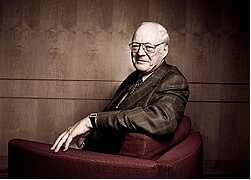
JOHN NEFF
Running Vanguard Windsor Fund for 31 years, 13.7% annualized returns, deep value contrarian investing
John Neff ran the Windsor Fund for 31 years — longer than most marriages. He averaged 13.7% annually against the S&P's 10.6% and never once cared what Wall Street thought. He bought stocks nobody wanted and waited. The style was almost boring. The boring made him one of the best mutual fund managers of the 20th century. He passed away in 2019, but Windsor investors who held from day one turned $10,000 into over $560,000.
Net Worth
$50 million
Nationality
American
Time Horizon
Long-Term
Risk Appetite
3 / 10
CAREER & BACKGROUND
Joined Windsor Fund at Vanguard in 1964 as portfolio manager. Ran the fund for 31 consecutive years until retirement in 1995.
Averaged 13.7% annualized returns versus the S&P 500's 10.6% over that span. Windsor became the largest actively managed mutual fund in the US for much of his tenure.
Invested $1 of his own money for every dollar he earned in management fees. Published John Neff on Investing in 1999, sharing his full methodology.
COMPANIES & ROLES
Vanguard, Wellington Management
INVESTING STYLE & PHILOSOPHY
Deep value, low P/E, high dividend yield. Neff focused on unloved, out-of-favor companies with low price-to-earnings ratios and solid dividends.
He had a disciplined sell process — when a stock hit his price target, he exited regardless of how the story had improved.
THE PLAYBOOK
Risk Approach
Low. Neff avoided speculative names entirely.
He bought fundamentally sound companies at steep discounts and held through volatility rather than panic-selling. His diversification across beaten-down sectors reduced concentration risk.
Money Habits
Frugal and methodical. He co-invested his own money alongside fund investors and kept his personal portfolio consistent with his fund strategy.
He was known for driving modest cars and living well below his means.
BIGGEST WIN
Buying Citicorp in 1990 during the banking crisis when shares had collapsed to roughly $10. By 1993 the stock had recovered to over $50.
The position generated enormous gains for Windsor investors who might have fled banks entirely during the panic.
BIGGEST MISTAKE
In his own book, Neff acknowledged being too rigid on P/E thresholds. Some companies with higher earnings multiples genuinely deserved them — Neff sometimes missed great businesses because the valuation looked expensive by his metrics.
FINANCIAL PHILOSOPHY
Buy what nobody else wants. Patience is the edge.
A low P/E with a good dividend means you are paid to wait. Neff thought most investors wasted energy chasing popular stocks with rich valuations and then wondered why they underperformed.
FAMILY & PERSONAL LIFE
Married to Lillian Neff. Had three children.
Born January 19, 1931 in Wauseon, Ohio. Passed away June 4, 2019.
EDUCATION
University of Toledo, BA Business Administration (1955). Case Western Reserve University, MBA (1958).
BOOKS & RESOURCES
As an Amazon Associate, Netfigo earns from qualifying purchases. Book links above may be affiliate links.
QUOTES (5)
It's not always easy to do what's not popular, but that's where you make your money.
We were not contrarians for its own sake. We were contrarians because the numbers said so.
If you buy stocks with high growth rates, you are buying hope. Hope is expensive.
I've always liked low P/E stocks. They have a limited downside.
Sell when the fundamental reasons you bought no longer exist, or when the price target is reached. Not before, not after.
NETFIGO SCORE
Proprietary 5-dimension investor rating
Risk Appetite
Contrarian Index
Track Record
Accessibility
Time Horizon
Related Profiles
Investors
Benjamin Graham
Graham's deep value philosophy — buying stocks at steep discounts to intrinsic value — was the intellectual foundation for Neff's entire Windsor Fund approach.
Warren Buffett
Both are disciples of Benjamin Graham's value investing school. Neff and Buffett dominated their respective eras with contrarian, fundamentals-driven approaches and outperformed the S&P 500 over decades.
Head-to-Head
Compare John Neff vs another investor.