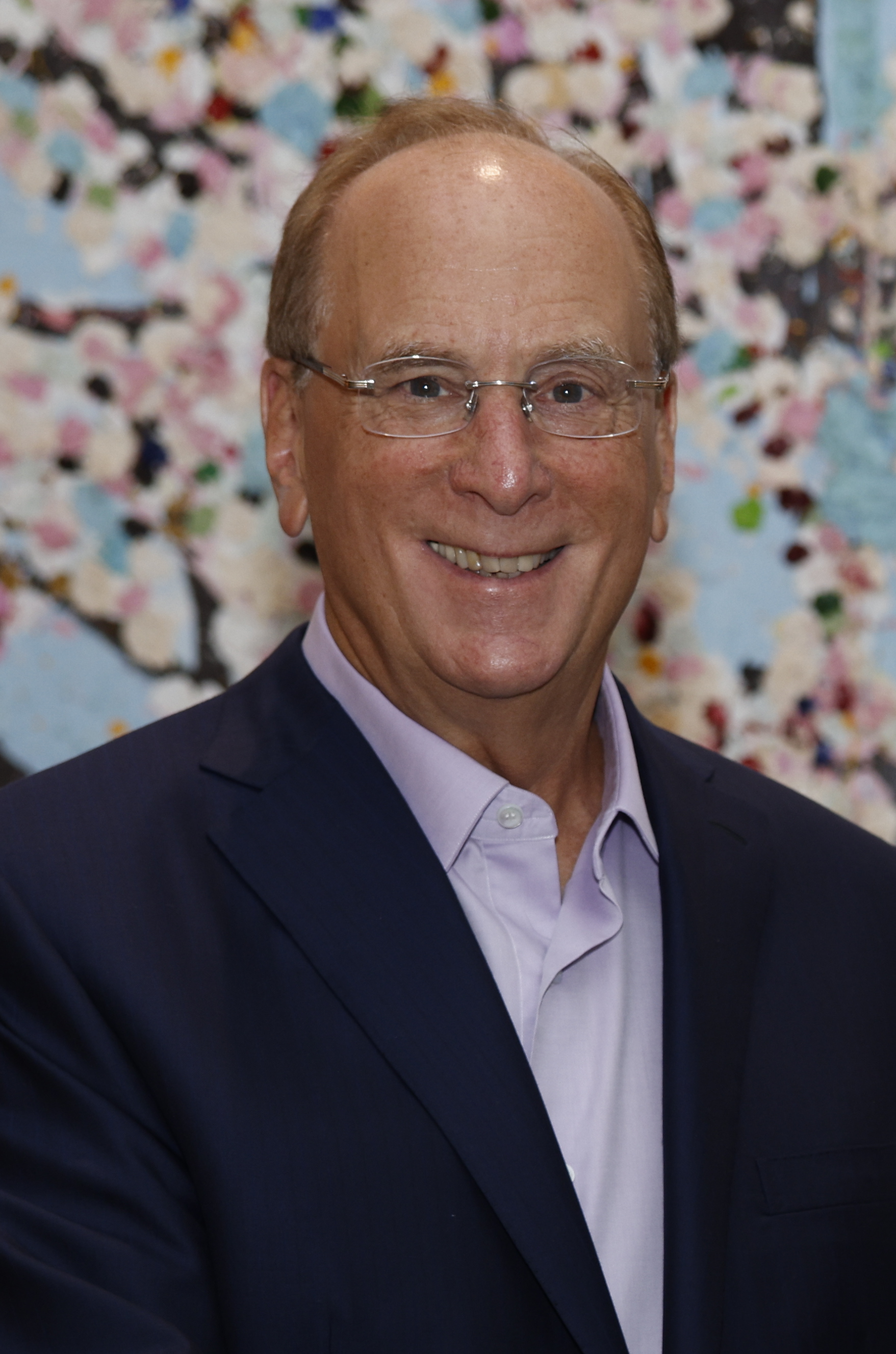
LARRY FINK
Building BlackRock into the world's largest asset manager, controlling $10 trillion in assets and rewriting how institutional money moves.
Larry Fink doesn't manage money — he manages the people who manage money. BlackRock oversees more than $10 trillion in assets, which is more than the GDP of every country on earth except the US and China. He built it from scratch after getting fired in spectacular fashion from First Boston in 1988. His annual letters to CEOs have become so influential that Fortune 500 boards actually change strategy based on what Larry thinks. The most powerful man in finance that most people have never heard of.
Net Worth
$1.1 billion
Nationality
American
Time Horizon
Generational
Risk Appetite
5 / 10
Fund
BlackRock Inc.
Net Worth Context
- · Still a billionaire — just the quiet kind at the end of the table.
CAREER & BACKGROUND
Larry Fink grew up in Van Nuys, a working-class neighborhood in the San Fernando Valley. His father owned a shoe store.
His mother taught English at the local college. Nobody in his circle was headed for Wall Street — but Fink had a knack for seeing how money worked, and he followed that instinct all the way to UCLA, where he studied political science and then picked up an MBA from the Anderson School of Management.
He landed at First Boston in 1976 and immediately started doing something nobody was really doing yet: securitizing mortgages. Taking pools of home loans, slicing them into bonds, and selling them to investors.
He was one of the architects of the modern mortgage-backed securities market. By his early thirties he was running a $1 billion trading desk and was widely considered one of the smartest people in fixed income on all of Wall Street.
Then he blew it. In 1986, his desk lost $100 million in a single quarter on a bad interest rate bet.
The exact cause was a systems failure — his team didn't have the right tools to model the risk properly. First Boston forced him out in 1988.
It was humiliating, and it was the best thing that ever happened to him.
He took the lesson seriously. If the right risk management technology had existed, he might have avoided the loss.
So he decided to build it. In 1988, with seven colleagues and $5 million from Blackstone as seed capital, he co-founded what would become BlackRock.
The company's entire DNA, from day one, was built around risk analytics — specifically a proprietary risk platform called Aladdin.
BlackRock started as a fixed income shop, which suited Fink's background perfectly. But it grew through a series of acquisitions that were timed almost perfectly.
The 2009 acquisition of Barclays Global Investors — including its iShares ETF business — for $13.5 billion was the move that turned BlackRock from a large asset manager into something with no real precedent. iShares became the dominant ETF platform on the planet, and passive investing exploded in the decade that followed.
BlackRock was perfectly positioned.
By 2024, BlackRock managed over $10 trillion in assets. Not a typo.
Ten trillion dollars. That's enough to buy Apple, Microsoft, Saudi Aramco, Alphabet, and Amazon and still have money left over.
Fink didn't just build a company — he built the infrastructure of global institutional finance.
COMPANIES & ROLES
BlackRock is the main event — and it's almost hard to overstate what it is. It's the world's largest asset manager, running over $10 trillion across equity funds, bond funds, ETFs, alternatives, and institutional mandates.
It manages money for pension funds, sovereign wealth funds, central banks, endowments, insurance companies, and retail investors. If you have a 401(k), there's a reasonable chance some of your money is in a BlackRock fund.
The crown jewel within BlackRock is iShares — the ETF platform acquired when BlackRock bought Barclays Global Investors in 2009. iShares is the largest ETF provider in the world, with over $3.5 trillion in assets.
When the passive investing revolution took off in the 2010s, iShares was basically the plumbing.
Then there's Aladdin — BlackRock's proprietary risk management operating system. It monitors risk across roughly $21 trillion in assets globally, not just BlackRock's own.
Banks, insurers, pension funds, and even governments pay to use it. Aladdin is why BlackRock is more than an asset manager — it's a financial infrastructure company.
Critics have pointed out that this creates a somewhat strange situation where BlackRock is simultaneously managing assets and running the risk systems that competing firms use to manage theirs.
Fink also served on various boards, including advising the US Federal Reserve during the 2008 financial crisis and the COVID-19 crisis — both times the Fed turned to BlackRock to help manage emergency bond-buying programs. That's how central to the financial system he became.
INVESTING STYLE & PHILOSOPHY
Fink is not a stock picker. He's not a macro trader.
He's something different — a systems thinker who built a machine that makes money by being everywhere at once.
The core of his philosophy is passive investing at scale. BlackRock's iShares business is built on the idea that most active managers can't beat the market after fees, so the smarter play is to own the market cheaply and efficiently.
This isn't contrarian thinking — it's now the consensus. But Fink was building that machine when it was still considered heresy by Wall Street's active management establishment.
At the same time, Fink is deeply focused on risk. The Aladdin platform isn't just a product — it's a statement of philosophy.
He believes the biggest threat to any portfolio isn't picking the wrong stocks, it's not understanding the risks embedded in what you already own. That lesson came directly from the 1988 loss at First Boston.
He didn't know his position was that exposed until it was too late. So he built a system that makes sure nobody else would face that same blind spot — and then sold access to that system to the entire industry.
In terms of actual investment views, Fink has increasingly pushed the idea that long-term investors need to account for systemic risks that aren't in the standard models — climate change being the big one. His annual CEO letters starting in 2018 made ESG investing mainstream almost by decree.
When the world's largest asset manager says 'this matters,' it tends to matter. Critics say he's overstepped — using shareholder power to push a political agenda.
Fink says he's just thinking about long-term risk the way any serious investor should.
THE PLAYBOOK
Risk Approach
Fink's relationship with risk is personal in a way that most investors' isn't. He didn't just lose money in 1988 — he lost his job, his reputation, and his identity in one quarter because of risk he didn't understand he was taking.
That experience shaped everything.
The result is a man who is obsessive about understanding risk before taking it. BlackRock's entire business model — the Aladdin platform, the emphasis on factor-based analysis, the multi-scenario stress testing — is essentially Fink's response to that one bad quarter.
He doesn't avoid risk. He systematizes it, quantifies it, and then decides whether the return justifies it.
Personally, he's conservative in the sense that he doesn't gamble. He doesn't take speculative positions.
He doesn't do moonshots. But institutionally, BlackRock takes enormous risk — just very deliberately.
The firm runs $10 trillion across assets that include equities, junk bonds, private credit, real estate, and infrastructure. It just tries to know exactly what kind of risk it's sitting on at every moment.
His view on tail risk — the unlikely but catastrophic events — is particularly serious. The Aladdin system runs thousands of simulations constantly, looking for the scenarios that could blow things up.
After 2008, Fink became a vocal advocate for systemic risk awareness at the macro level, arguing that the financial system had been pricing risk incorrectly for years.
Money Habits
Fink is rich — net worth around $1.1 billion — but he's not flashy rich. No yacht.
No space program. No famous art collection making headlines.
He owns a penthouse apartment in New York City and a home in Aspen. He's a serious skier, which fits — Aspen is where institutional finance goes to network on slopes.
He's known for hosting and attending Davos-adjacent gatherings, the kind of rooms where central bankers and heads of state are the less important people in attendance.
He's been on the board of trustees of New York University, his alma mater's rival school, and has donated significantly to causes including the NYU Langone Medical Center. He and his wife Lori have been married since 1974 — they met as undergraduates at UCLA.
Fifty years. On Wall Street, that's basically a unicorn.
His actual day-to-day spending is hard to characterize because he doesn't publicize it. But people who know him describe a man who is more interested in influence than in luxury.
The dinners that matter are the ones where the guest list is heads of state and sovereign wealth fund managers, not celebrities. The real currency isn't spending — it's access.
BIGGEST WIN
The acquisition of Barclays Global Investors for $13.5 billion in 2009 is the most consequential trade Fink ever made. The timing was almost absurdly good.
Barclays needed cash in the aftermath of the financial crisis. BlackRock had the capital and the appetite.
The deal came with iShares — the largest ETF business on the planet.
What happened next is the passive investing revolution. Over the following decade, trillions of dollars flowed out of expensive actively managed funds and into cheap index-tracking ETFs.
iShares was the dominant vehicle. BlackRock's assets under management went from roughly $3 trillion at the time of the deal to over $10 trillion by the mid-2020s.
The acquisition cost $13.5 billion and effectively built a company worth hundreds of billions in market cap.
Fink saw the structural shift coming — that passive would win, that fees would compress, that the investor who controlled the plumbing would win. He bought the plumbing when it was on sale.
It is one of the great strategic acquisitions in financial industry history.
BIGGEST MISTAKE
The $100 million loss in 1986 at First Boston is the defining mistake of his career — and he'll tell you that himself. His mortgage trading desk was running massive interest rate risk that wasn't being properly measured because the technology to model it correctly didn't exist yet, or at least wasn't being used.
When rates moved against him, the losses were larger and faster than anyone anticipated. The desk lost $100 million in a single quarter.
Fink was forced out of First Boston in 1988. For a man who had been considered one of Wall Street's brightest rising stars, it was a brutal fall.
He has been publicly reflective about it in ways that are rare for people of his stature. He's said the experience taught him that risk you don't understand is the most dangerous kind — more dangerous than risk you've chosen to take.
The entire architecture of BlackRock, from Aladdin to its multi-scenario stress testing, is his answer to that one catastrophic quarter. In a strange way, losing $100 million and his job at First Boston was the best investment he ever made in himself.
FINANCIAL PHILOSOPHY
Fink's core belief is that asset management is fundamentally a risk management business — and most people in the industry spent decades pretending it wasn't. He watched peers focus on chasing returns while ignoring the risks underneath.
He built a company that does the opposite.
He believes strongly in the long game. His annual letters to CEOs are famous for hammering the point that quarterly earnings pressure is destroying long-term value creation.
He wants companies to think in decades, not quarters. He's willing to back that up with shareholder votes — BlackRock is one of the largest shareholders in virtually every major public company on earth, so when Fink talks about long-termism, he has the votes to mean it.
He also believes that environmental and social risks are real financial risks — not just PR considerations. Climate change affects the long-term viability of entire asset classes, from coastal real estate to fossil fuel infrastructure.
He made this case loudly starting in 2018, and it moved markets. The backlash came later — from both the political right (who called it ESG overreach) and eventually from within the institutional investor community — but Fink never fully backed down from the underlying analysis.
On fees, he's been a consistent champion of low-cost investing. The growth of passive funds has driven fees down across the industry and saved retail investors hundreds of billions in aggregate costs.
Fink doesn't frame this as charity — he frames it as what happens when you build a better product.
FAMILY & PERSONAL LIFE
Fink has been married to Lori Fink since 1974 — they met as undergraduates at UCLA and have now been together for over fifty years, which in the world of high-finance power players is genuinely extraordinary. They have three children together.
Lori has been a significant presence in his philanthropic life, particularly around arts and education causes. The couple donated $100 million to UCLA in 2023, the largest gift in the university's history — a building on campus now bears their name.
Fink is known in private as something of a talker — people who've spent time with him describe a man who is energized by ideas and rarely stops sharing them. He's intensely curious across domains beyond finance: architecture, geopolitics, climate science, art.
The Davos crowd is his natural habitat — not because he needs the networking, but because he genuinely seems to find those conversations interesting.
EDUCATION
Fink did his undergrad at UCLA, studying political science — a subject that probably explains more about how he thinks about systemic risk and power structures than any finance class would. He then got his MBA from the UCLA Anderson School of Management, graduating in 1976.
He went straight to First Boston from there. UCLA has never let him forget it — nor he them.
The $100 million gift in 2023 was the largest donation in the school's history.
BOOKS & RESOURCES
Fink hasnt written a book — his annual letters to CEOs are the closest thing to a published manifesto hes produced, and theyre worth reading
Every year since 2012, his letter to the chief executives of the companies BlackRock invests in has functioned as a statement of investment philosophy disguised as a stakeholder communication. The 2018 letter, titled 'A Sense of Purpose,' is the one that put ESG on the institutional agenda permanently. The 2022 letter, 'The Power of Capitalism,' pushed back on political pressure while defending long-term thinking. They're free online and they're genuinely interesting documents
Essentially the intellectual history of the ideas that Fink built BlackRock around — the development of risk quantification from early probability theory to modern portfolio management
Captures the First Boston / Salomon Brothers era with uncomfortable accuracy
The kind of macro-systemic thinking book that Fink's CEO letters suggest he finds valuable
As an Amazon Associate, Netfigo earns from qualifying purchases. Book links above may be affiliate links.
QUOTES (6)
Every company needs a purpose beyond profit. Without a sense of purpose, no company, either public or private, can achieve its full potential.
We focus on what we can control — the quality of our analysis, our risk management, our client relationships — and let the markets do what they will.
Capitalism has the power to shape society and act as a powerful catalyst for change. But businesses that do not focus on making a positive contribution to society will ultimately lose the license to operate.
Markets like clarity. They hate uncertainty. And right now, we have more uncertainty than I have seen in my 40 years in financial markets.
The democratization of investing — making high-quality, low-cost investing available to everyone — is one of the most important financial developments of my lifetime.
NETFIGO SCORE
Proprietary 5-dimension investor rating
Risk Appetite
Contrarian Index
Track Record
Accessibility
Time Horizon
Related Profiles
Investors
Jamie Dimon
Fink and Dimon are the two most powerful figures in American institutional finance. Fink manages the money; Dimon moves it. Their annual letters are the closest thing Wall Street has to must-read publications.
Ray Dalio
Both are architects of institutional finance — Dalio built risk-parity, Fink built the passive investing machine. Different philosophies, same stratospheric influence on how the world's money moves.
Head-to-Head
Compare Larry Fink vs another investor.