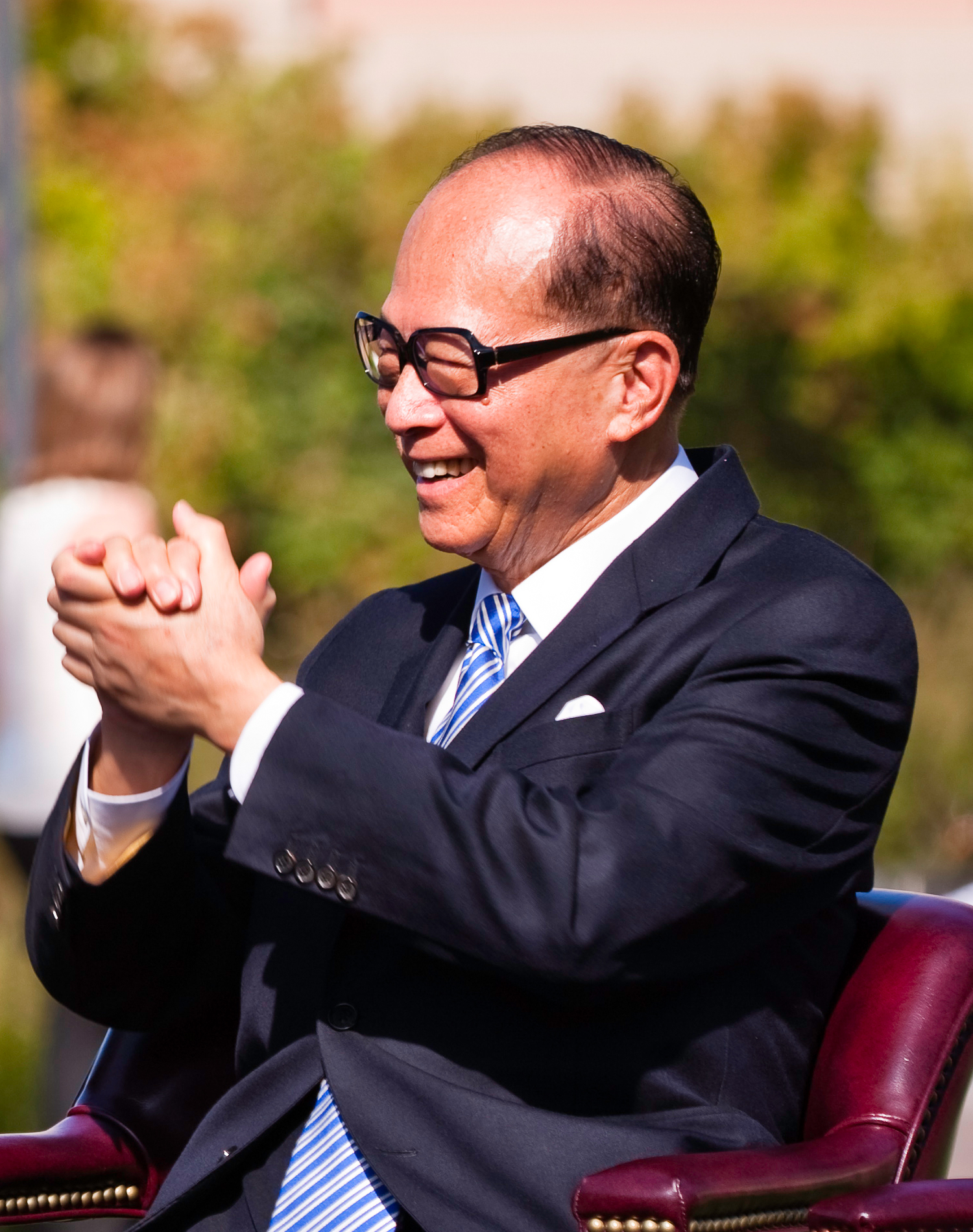
LI KA-SHING
The refugee kid who became Asia's richest man by building an empire that literally owns the infrastructure of daily life across five continents.
Li Ka-Shing fled mainland China at 15 with nothing, sold plastic flowers for a living, and went on to build a conglomerate so large it handles 30% of Hong Kong's container port throughput, owns chunks of European mobile networks, and operates thousands of pharmacies across the UK. He was Asia's richest person for 25 consecutive years. He retired at 89 in 2018 — and even then, his sons immediately took over a business worth tens of billions. The man didn't just build wealth. He built the plumbing.
Net Worth
$38 billion
Nationality
Hong Kong
Time Horizon
Generational
Risk Appetite
7 / 10
Net Worth Context
- · That's the GDP of a small country — around the size of Greenland.
- · Enough to buy an NBA team and keep $34B for snacks.
CAREER & BACKGROUND
Li Ka-Shing was born in Chaozhou, China in 1928. His father died of tuberculosis when Li was 15.
The family had already fled to Hong Kong to escape the Japanese occupation, and with no father and no money, Li dropped out of school and went to work in a factory making plastic watchbands. He was good at it.
By his early twenties he was running the factory. At 22, he started his own company — Cheung Kong — named after the Yangtze River.
He made plastic flowers. Fake blooms were fashionable in postwar Hong Kong and Li figured out how to make them faster and cheaper than anyone else.
Within a few years he was exporting them across the world.
The real pivot came in the 1970s. Hong Kong's property market had collapsed after riots and uncertainty, and Li had quietly been accumulating cash from his plastics business.
While everyone else was panicking, he bought real estate. Lots of it.
Cheung Kong grew into one of Hong Kong's largest property developers, and Li became very rich. But he didn't stop there.
In 1979, he pulled off one of the most consequential deals in Asian business history. He acquired Hutchison Whampoa — a sprawling British trading conglomerate with roots going back to the 1800s, a port business, retail operations, and a pile of debt.
It was the first time a Chinese businessman had taken control of a major British hong. The establishment was stunned.
Li paid HK$639 million for a controlling stake. Over the next two decades, Hutchison became the vehicle through which he built a genuinely global empire: ports, telecoms, retail, energy, infrastructure.
He sold his Canadian oil sands company Husky Energy stake, exited at the right times in telecoms, and invested early in Facebook when very few people in Asia were taking Silicon Valley seriously. By 2000 he was worth over $20 billion.
By 2015 he was restructuring his empire into two listed entities — CK Hutchison Holdings and CK Asset Holdings — simplifying decades of cross-holdings into something cleaner for his sons to inherit. He officially retired in May 2018 at age 89.
His sons Victor and Richard took over. Li announced the handover with a one-hour press conference and zero visible emotion.
COMPANIES & ROLES
Li's business empire runs through two main listed vehicles. CK Hutchison Holdings is the conglomerate side — it controls Hutchison Ports, one of the world's largest port operators with terminals in over 50 ports across 24 countries.
It owns 3 Group, one of Europe's biggest mobile networks, operating in the UK, Italy, Sweden, Denmark, Austria, and Ireland. It runs Watson's Group, which operates over 16,000 retail health and beauty stores in 27 markets — that's everything from Superdrug in the UK to Watson's across Asia.
CK Asset Holdings handles the real estate: major developments in Hong Kong, mainland China, the UK, and Australia.
Beyond the two listed companies, Li invested early and profitably in some of the biggest tech companies in the world. He backed Facebook before the IPO.
He invested in Zoom, Slack, Siri (which Apple later acquired), and Skype (which Microsoft later acquired). His early-stage tech bets, made through Horizons Ventures — his private investment arm — are legitimately impressive for someone who made his name in plastics, property, and ports.
He also held a huge stake in Canadian oil company Husky Energy for decades before eventually selling.
The ports business is particularly interesting. Hutchison Ports was the dominant global port operator for years — the company that handles the box goes into tells you something about how much of the world's trade flows through Li's infrastructure.
In 2025, his family agreed to sell a majority stake in the Hutchison Ports business to a BlackRock-led consortium for $22.8 billion — one of the biggest infrastructure deals in recent history.
INVESTING STYLE & PHILOSOPHY
Li Ka-Shing thinks in decades, not quarters. His approach is basically: find things people will always need, get in early or cheap when nobody else wants them, and hold until the value is undeniable.
Then sell at the top if the cycle has turned.
He applies this across asset classes. In property, he bought when Hong Kong was terrified.
In telecoms, he expanded into Europe when third-generation mobile networks were burning cash and the market hated them — he built the 3 network and eventually sold European assets for enormous returns. In tech, he was backing Silicon Valley startups from Hong Kong before most Western funds had figured out what a smartphone was.
Analogy: he thinks like a city planner, not a trader. He wants to own the port, the road, the pharmacy, the phone tower.
The things where once you own them, everyone has to deal with you. Not flashy businesses with great PR — boring infrastructure businesses with moats so wide they're basically government franchises.
A moat, by the way, means a competitive advantage that's genuinely hard for anyone else to copy. Li likes moats that are physical — try competing with a port you don't own.
He's also very patient about selling. He held Hutchison Whampoa for decades.
He held property through downturns. But when he does decide to exit, he's ruthless.
He sold a lot of Hong Kong assets in the 2010s as the political situation shifted — people noticed, some called it a vote of no confidence in Hong Kong's future, he denied it. Either way, he moved capital to Europe and elsewhere at prices that looked smart in hindsight.
His tech investing through Horizons Ventures is the wild card. He backed Siri in 2010 — Apple acquired it months later.
He backed Facebook in 2007 and 2008. He backed Waze, DeepMind, Summly.
Most of these bets were made when Li was in his late seventies and early eighties. The man was doing early-stage Silicon Valley venture investing while running a 300,000-person global conglomerate.
That's a specific kind of mental flexibility that most people half his age don't have.
THE PLAYBOOK
Risk Approach
Li Ka-Shing has a reputation for being cautious, but that's not quite right. The accurate version is: he takes calculated risks that look conservative because he always has a plan B — and usually a plan C.
He never over-leverages. He structures deals so that even if the bet goes wrong, it doesn't kill the whole enterprise.
His near-obsessive focus on cash flow and balance sheet strength means he can be aggressive when others are paralyzed.
The Hutchison Whampoa acquisition is the template. He paid HK$639 million for a struggling British hong with significant debt.
That was not a safe, boring purchase — it was a bet that he could turn around a complicated, multi-industry mess that had beaten previous owners. He was right.
But he had done his homework so thoroughly that he understood every part of the business before he signed anything. He doesn't do big bets on incomplete information.
In telecoms, he absorbed enormous losses building out 3G networks in Europe during the early 2000s. The investment looked terrible for years.
He stuck with it because he had modeled out what the business would look like when the market turned. When it did, he sold assets at multiples that more than covered the early pain.
What he won't do is speculate on things he doesn't understand or can't model. He doesn't do commodities trading.
He doesn't do high-frequency bets. He doesn't pile into bubbles.
When Hong Kong property was overheating in the mid-2010s, he was quietly selling. People questioned him.
He was right. His risk management is essentially: know what you own, know what it's worth, know what could kill it, and make sure you can survive if the worst happens.
Money Habits
For someone worth $38 billion, Li Ka-Shing is notoriously unglamorous about money. He wore the same style of simple watch for decades — a Seiko — and when people noticed and commented, his response was essentially: it tells time, what more do you need?
He has since upgraded, but the instinct is genuine. He grew up with nothing, and the memory of poverty doesn't leave you.
He's been known to carry only a small amount of cash and to be personally precise about expenses even when the amounts involved are trivial relative to his net worth. Stories circulate among people who have worked with him about his attention to small details in contracts and his insistence on understanding exactly where money is going.
Not because he's cheap — he's given away billions — but because he finds waste genuinely offensive.
His home base is in Hong Kong, where he's lived most of his life. He's not a jet-set billionaire with a dozen houses across three continents.
He works obsessively — into his late eighties he was still putting in full days. His social life reportedly revolves around a small circle of longtime friends, not the Davos circuit.
On philanthropy, he's serious. The Li Ka Shing Foundation has committed over $4 billion, with the bulk going to education and medical research.
He once said he considers the Foundation his third son. Shantou University — which he founded and has funded for decades — is his most personal project.
He pays for students' education because he never got the chance to finish his own.
He still reportedly reads voraciously, particularly science and technology publications, which is how he stays ahead of tech trends at an age when most investors are playing it conservative. The Horizons Ventures operation is run lean and moves fast.
That's deliberate.
BIGGEST WIN
The biggest win in dollar terms is probably the sale of the Hutchison telecom assets in Europe — most notably the $14.6 billion sale of Hutchison Whampoa's UK and Irish mobile operations to Vodafone and others in the early 2000s, followed by multiple further telecom exits across the continent over the following decade. He built out 3G networks in Europe when the market thought he was throwing money into a furnace, absorbed years of operating losses, and exited at returns that more than justified the pain.
But the founding win — the one that made everything else possible — was buying Hutchison Whampoa in 1979 for HK$639 million. A struggling, debt-laden British conglomerate that most sophisticated buyers had passed on.
Within a decade it was worth multiples of what he paid. Within two decades it was a global infrastructure empire.
The entire Li Ka-Shing story is downstream of that one deal.
His early Facebook investment is also worth mentioning. He invested $60 million in Facebook in 2007 and 2008, before the social network had proven it could make serious money.
When Facebook went public in 2012 at a $104 billion valuation, his stake was worth approximately $1.4 billion. That's a roughly 23x return.
Not bad for a side project from a man whose main job was running a multinational conglomerate.
The pattern across all his wins is the same: buy things that are out of favor, structurally sound, and necessary. Hold until the market catches up.
Exit when the premium reflects the value. Repeat.
BIGGEST MISTAKE
Li Ka-Shing has been careful enough — and private enough — that his mistakes are harder to document than his wins. But there are a few.
The most expensive acknowledged misstep was probably the deep losses he absorbed in the early years of building out the 3G mobile networks in Europe. The company burned through billions of dollars before the businesses turned profitable.
At the time, some analysts and shareholders questioned whether the whole European telecom strategy was a catastrophic error. In the end it wasn't — he exited at good prices and made money — but the pain along the way was real.
Estimates of the operating losses in the early 3G rollout years run to several billion dollars.
His late-stage relationship with Chinese political dynamics created strategic tension in the 2010s. He sold significant Hong Kong property and retail assets between 2013 and 2015 and shifted capital to Europe and elsewhere.
The Chinese state media criticized him. An article in People's Daily essentially accused him of disloyalty.
His response was measured, but the episode revealed the limits of building an empire that depends on operating in a market where political relationships matter enormously. How much money he left on the table by exiting early — versus how much he saved by getting out before conditions deteriorated — is genuinely hard to calculate.
He insists the sales were purely commercial. The timing suggests otherwise, and either way it was a complicated and costly repositioning.
Husky Energy — the Canadian oil company he held for decades — was also a mixed outcome. He eventually reduced his stake as oil sands became politically and economically challenging.
It was never a disaster, but it tied up capital in a sector that underperformed his other investments for an extended period.
FINANCIAL PHILOSOPHY
Li Ka-Shing keeps a list of principles he's articulated over the years, and they're more useful than most MBA programs. A few of the most important ones.
First: never borrow more than you can repay even in a bad scenario. This sounds obvious.
Almost nobody follows it. Li has talked about this repeatedly — the lesson came from watching companies with good businesses get destroyed by too much debt when the cycle turned.
He built Cheung Kong and later Hutchison with relatively conservative leverage for businesses of their size. It's part of why he survived every Hong Kong crisis from the 1970s through the 1990s when others didn't.
Second: always think about what happens to the other side of the deal. He's famous for saying he wants to make sure the person he's doing business with also benefits — not because he's unusually altruistic, but because he understands that a deal where one side loses breeds resentment and future problems.
Long-term thinking again.
Third: your reputation is your most valuable asset and it takes decades to build and minutes to destroy. Li has guarded his reputation ferociously.
He's had political pressures from Beijing, tensions with the Hong Kong government, controversies over his exit from Hong Kong assets — through all of it, he's maintained the image of a man who keeps his word. Whether or not that's fully accurate, it's been commercially valuable.
Fourth: invest in people. He's spent heavily on education — the Shantou University he founded in his home province has received billions from his foundation.
He genuinely believes the highest-return investment is human capital, and he practices it. His Li Ka Shing Foundation has given away billions.
Fifth: move early. His tech investments worked because he was looking at Silicon Valley when most of Asia wasn't.
His property acquisitions worked because he bought in downturns. The theme is consistent — the time to invest is before everyone else realizes they should.
FAMILY & PERSONAL LIFE
Li Ka-Shing was married to Chong Yuet-ming in 1963. They had two sons — Victor Li Tzar-kuoi and Richard Li Tzar-kai.
Chong died in 1990 from heart disease. Li never remarried.
He has spoken about her occasionally, always with evident feeling. By his account, her death was the hardest thing he ever experienced.
Victor and Richard took very different paths. Victor is the dutiful heir — he took over CK Hutchison and CK Asset Holdings when Li retired in 2018 and has run them in his father's image: conservatively, methodically, without drama.
Richard is the entrepreneur — he founded PCCW, Hong Kong's telecoms giant, and has been more volatile, more adventurous, and more headline-prone. Li reportedly helped bail Richard out during the early PCCW years when the company ran into trouble.
The father-son dynamic between Li and Richard has been described by people close to both as loving but complicated.
Li's relationship with his birthplace, Chaozhou in Guangdong province, has been a lifelong commitment. He funded Shantou University — near his hometown — for decades, pouring billions into it personally.
He sees it as an obligation to the place that shaped him and as a practical investment in the next generation. He has said that his Foundation is, in a real sense, his most important project.
He calls it his third son.
EDUCATION
Li Ka-Shing dropped out of school at 15 when his father died and the family ran out of money. He has one year of secondary school education.
Everything after that — business, finance, law, technology, global economics — he taught himself. He reportedly reads for several hours every day, a habit he has maintained his entire adult life.
When asked about his lack of formal education, he typically notes that Shantou University exists precisely so other kids from poor backgrounds don't have to learn the way he did. He holds honorary doctorates from several universities, including the University of Hong Kong and Cambridge.
He finds them gratifying. He finds the self-taught version more useful.
BOOKS & RESOURCES
Which covers Li critically and rigorously and is the best single-source analysis of how Hong Kong's tycoon class actually operates. Studwell's book is not flattering in places, which makes it more useful than the hagiographies
As an Amazon Associate, Netfigo earns from qualifying purchases. Book links above may be affiliate links.
QUOTES (6)
When you have money, think of the time when you did not have money. When you do not have money, think about when you had it.
No matter what work you do, you can learn to pay attention to the details. The success of your future lies in those details.
I always believe that one will finally get what he deserves. Success requires a solid foundation of integrity.
I spend most of my time thinking about the future and the world's direction. I do not like to look backwards.
You need to believe in your own abilities and work harder than everyone else. That is the only way for someone who starts with nothing.
The biggest risk is not taking any risk. In a world that is changing really quickly, the only strategy that is guaranteed to fail is not taking risks.
NETFIGO SCORE
Proprietary 5-dimension investor rating
Risk Appetite
Contrarian Index
Track Record
Accessibility
Time Horizon
Related Profiles
Investors
Masayoshi Son
Both built sprawling Asian conglomerates through bold, decade-long bets on infrastructure and technology — compared constantly by analysts covering Asian billionaire capital allocation.
Peter Thiel
Both backed early-stage Silicon Valley technology through private vehicles — Li via Horizons Ventures, Thiel via Founders Fund — before most institutional capital took consumer tech seriously.
Warren Buffett
Li Ka-Shing is frequently called the Warren Buffett of Asia — both built generational wealth by buying undervalued businesses with durable competitive advantages and holding for decades.
Head-to-Head
Compare Li Ka-Shing vs another investor.