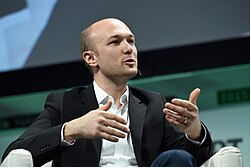
LOGAN GREEN
Co-founded Lyft, Uber's biggest rival, and became one of the first tech CEOs to build a company around sustainability.
Logan Green co-founded Lyft to prove that ride-sharing could be a friendlier, greener alternative to Uber — and spent a decade being crushed by Uber's scale and aggression. Lyft went public, peaked at a $24 billion market cap, and then lost 90% of its value. Green stepped down as CEO in 2023 after 11 years of building a company that was always number two. Being the nice guy in ride-hailing turned out to be a really expensive philosophy.
Net Worth
$300 million
Nationality
American
Time Horizon
Long-Term
Risk Appetite
7 / 10
CAREER & BACKGROUND
Born in Los Angeles in 1984. Grew up fascinated by transportation systems after traveling in Zimbabwe as a teenager and seeing shared minibus networks.
Studied business at UC Santa Barbara, where he launched a car-sharing program called Zimride in 2007 — connecting college students for long-distance rides.
Zimride pivoted to short-distance urban rides in 2012, and that product became Lyft. Green and co-founder John Zimmer positioned Lyft as the friendly, pink-mustachioed alternative to Uber's aggressive approach.
Lyft launched in June 2012 in San Francisco.
The Uber-Lyft rivalry became one of the most expensive competitive battles in tech history. Billions of dollars were spent on driver subsidies, rider discounts, and expansion.
Lyft went public in March 2019 at $72 per share. The stock is now below $15.
Green stepped down as CEO in April 2023, replaced by former Amazon executive David Risher.
COMPANIES & ROLES
Co-founded Lyft (2012, as a pivot from Zimride). CEO of Lyft 2012-2023.
Founded Zimride (2007, sold to Enterprise Rent-A-Car). Now focused on climate tech investments and advisory work.
Lyft went public in 2019.
INVESTING STYLE & PHILOSOPHY
Mission-driven builder. Green was never a pure financial optimizer — he built Lyft because he genuinely believed ride-sharing could reduce car ownership and carbon emissions.
His investments now focus on climate and transportation technology.
THE PLAYBOOK
Risk Approach
High at the company level. Green bet everything on competing against Uber with less money and fewer resources.
He spent over a decade in a winner-take-most market as the number two player. Personally, he is not a flashy risk-taker.
Money Habits
Lives in the Bay Area. Known for being environmentally conscious — rides a bicycle to work, drives an EV, and has talked about reducing his personal carbon footprint.
Not a flashy spender. Teammates describe him as genuine and humble.
BIGGEST WIN
Taking Lyft public. Despite being perpetually in Uber's shadow, Green built Lyft into a legitimate public company with $4+ billion in annual revenue and over 20 million riders.
The IPO in March 2019 was a milestone for the mission-driven approach to building a ride-sharing company.
BIGGEST MISTAKE
Never figuring out how to beat Uber on unit economics. Lyft consistently held about 28-30% of the US ride-sharing market — never able to close the gap.
The company has never been consistently profitable. Green poured billions into competing on subsidies and expansion but could never achieve the scale economics that Uber's global presence provided.
FINANCIAL PHILOSOPHY
Transportation is the key to reducing carbon emissions. Green founded Lyft not to get rich but because he believed shared transportation could replace individual car ownership.
The financial outcomes were secondary to the mission.
FAMILY & PERSONAL LIFE
Married. Keeps personal life private.
Based in the Bay Area. His parents supported his early interest in transportation systems.
EDUCATION
UC Santa Barbara (BS in Business Economics). His study-abroad experience in Zimbabwe — seeing shared minibus networks — directly inspired the concept that became Zimride and then Lyft.
BOOKS & RESOURCES
The comprehensive plan for reversing global warming that aligns with Green's climate focus
A critique of American car-dependent development
Reinventing Fire by Amory Lovins
The clean energy transition framework
As an Amazon Associate, Netfigo earns from qualifying purchases. Book links above may be affiliate links.
QUOTES (5)
I saw shared minibuses in Zimbabwe and thought: why can't this exist everywhere? That question became Lyft.
We were always the underdog. Uber had more money, more aggression, more everything. We had a better culture.
The world doesn't need a billion cars sitting idle 96% of the time. It needs shared transportation that works.
I stepped down because the company needed a different kind of leader for the next phase. That takes self-awareness.
NETFIGO SCORE
Proprietary 5-dimension investor rating
Risk Appetite
Contrarian Index
Track Record
Accessibility
Time Horizon
Related Profiles
Head-to-Head
Compare Logan Green vs another investor.