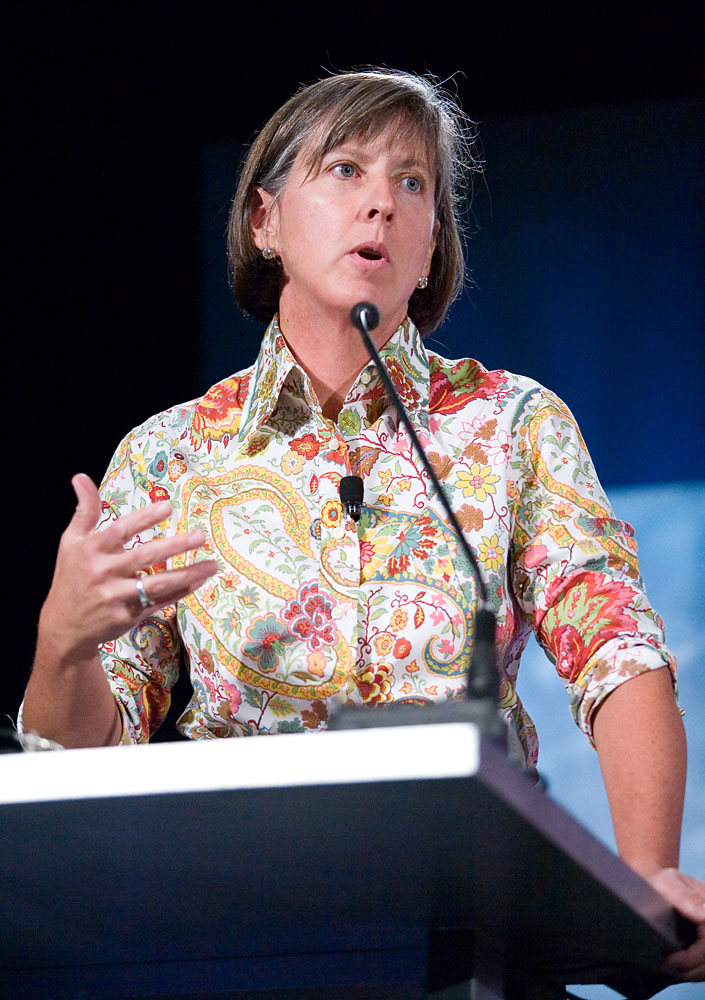
MARY MEEKER
The Wall Street analyst who wrote the bible on the internet economy, then became one of Silicon Valley's most powerful VC investors.
Mary Meeker spent the 1990s telling Wall Street what the internet was going to become — and she was so right, so early, that people called her the Queen of the Net. Her annual Internet Trends report, which she published every year for decades, became required reading for every founder, investor, and executive who wanted to understand where technology was headed. She left Morgan Stanley in 2010 to join Kleiner Perkins and bet her own capital on the same thesis she'd been writing about. Her portfolio includes Facebook, Twitter, Spotify, Airbnb, Instacart, and Snap. The research became the returns.
Net Worth
$1 billion
Nationality
American
Time Horizon
Long-Term
Risk Appetite
7 / 10
Net Worth Context
- · Still a billionaire — just the quiet kind at the end of the table.
CAREER & BACKGROUND
Mary Meeker grew up in Portland, Indiana — a small town that had nothing to do with finance or technology. She studied psychology at DePauw University, then got her MBA from Cornell.
She joined Morgan Stanley in 1991 as a technology analyst, which at the time meant covering companies like Microsoft and Apple — useful but not exactly a gold rush.
Then the internet happened. Meeker saw it before almost anyone on Wall Street.
In 1995, she co-authored 'The Internet Report' — a 300-page research document that analyzed the commercial potential of the web when most of her peers were still skeptical there was any. The report circulated everywhere.
It became a foundational document of the dot-com era. Suddenly, Meeker wasn't just a stock analyst.
She was the person explaining the future.
Netscape's IPO in 1995 was the moment the world noticed. Meeker was its lead analyst.
The stock doubled on the first day of trading. She became the most famous technology analyst on Wall Street.
Barron's profiled her. Fortune put her on covers.
She was advising CEOs on strategy, not just covering their stocks.
Through the boom and the bust, Meeker kept writing. When the dot-com bubble collapsed in 2000 and 2001, she took enormous criticism.
She'd maintained buy ratings on companies like Amazon and America Online even as they fell 80, 90 percent. The skeptics called her a cheerleader.
She argued — correctly, as it turned out — that the underlying thesis was right even if the valuations were insane. Amazon is now worth $1.8 trillion.
That particular argument aged well.
The Internet Trends report became her signature project. Every year at the All Things D conference, later at the Code Conference, Meeker would stand up and present 100-plus slides summarizing the state of the internet economy: mobile adoption, advertising spend, ecommerce penetration, global growth.
Founders read it. VCs used it to frame pitches.
CEOs cited it in shareholder letters. It was free, it was comprehensive, and it was the single best annual snapshot of where technology was going.
In 2010, she left Morgan Stanley after 18 years to join Kleiner Perkins Caufield & Byers — one of Silicon Valley's legendary VC firms. The move surprised people.
She was a Wall Street celebrity becoming an investor. But the transition made sense: she'd spent two decades figuring out which companies were going to win.
Now she wanted to own them.
She became a partner at Kleiner and kept writing the Internet Trends report, which if anything got more influential once she was inside the VC world rather than commenting on it from the outside. In 2019, she left Kleiner to found her own firm, Bond Capital.
The name was deliberate — a reference to forming bonds with founders. Bond raised a $1.25 billion fund and focused on later-stage tech investments.
COMPANIES & ROLES
Meeker's analytical career was built at Morgan Stanley, where she covered technology stocks from 1991 to 2010. During that time she was the lead analyst on some of the most important IPOs of the era — Netscape (1995), Amazon (1997), Google (2004).
Being the lead analyst means she wrote the research, set the initial price targets, and made the case to institutional investors for why they should buy.
At Kleiner Perkins from 2010 to 2019, she invested in some of the defining consumer internet companies of the decade. Her portfolio included Facebook (she invested in secondary market shares before the IPO), Twitter, Spotify, Airbnb, Instacart, Snap, Lending Club, DocuSign, and Square.
Not every bet worked, but the hits were enormous — Facebook alone was a generational investment.
She also invested in Pinterest, which listed in 2019, and DoorDash, which went public in 2020 at a valuation of $72 billion. Her instinct for platforms that aggregate demand — whether it's media, marketplaces, or logistics — ran through the whole portfolio.
Bond Capital, the firm she founded in 2019, raised $1.25 billion for its first fund. The focus is growth-stage technology — companies that have found product-market fit and need capital to scale.
The fund backed Canva, the design platform that reached a $40 billion valuation in 2021. Bond also has stakes in Hopin, the virtual events company, and several others.
The Internet Trends report, published annually from 1995 through 2019, is arguably its own entity. Twenty-four years of consecutive analysis of the technology economy.
The 2019 report — her last under the Kleiner banner — ran to 333 slides.
INVESTING STYLE & PHILOSOPHY
Meeker's approach starts with macro and works down to companies. She wants to understand the big structural trends — how many people are using smartphones, how fast mobile advertising is growing, how ecommerce is taking share from physical retail — and then find the companies positioned to ride those waves.
Think of it like surfing. Most investors try to find companies with good fundamentals and hope a wave shows up.
Meeker identifies where the wave is going to be, paddles to that spot first, and waits for the right company to come along that can actually catch it. She gets paid for reading the ocean, not just picking boards.
She's not a bottom-up value investor. She doesn't care much about current P/E ratios or free cash flow in year one.
She's betting on where markets are going to be in five to ten years. That means she'll back a company burning money aggressively if she believes the market they're going after is enormous and winner-take-most.
Facebook was burning money on growth when she backed it. Airbnb had regulatory problems on three continents.
Spotify had unsustainable royalty economics. She backed all of them anyway because the structural logic — massive global addressable market, network effects, data advantages — was compelling.
She's also a conviction investor. The Internet Trends report wasn't just a marketing document.
It was how she thought. She published her frameworks publicly, which made her accountable.
If she said mobile advertising was going to be the biggest advertising market in history, and then she didn't invest behind that thesis, someone would notice. The public nature of her research forced intellectual honesty.
At the later-stage growth investing level where Bond operates, she's looking for companies that are already working — revenue is real, unit economics are improving, the team has survived the early chaos — and need capital to scale internationally or into adjacent markets. It's lower-risk than seed investing but still plenty volatile.
THE PLAYBOOK
Risk Approach
Meeker's risk tolerance is genuinely high — but it's informed risk, not reckless risk. She spent decades studying technology markets and she has strong conviction in her structural theses.
When she's confident a market is going to grow 10x over the next decade, she doesn't need a low-risk entry point. She'll pay up.
During the dot-com collapse, she held onto her buy ratings on companies like Amazon when they were down 90 percent from peak. That looked irresponsible in 2001.
It looked prescient in 2005. The lesson she drew — and the one she applies as an investor — is that if the structural thesis is intact, short-term price destruction is noise.
Amazon's revenue kept growing through the crash. The business was fine.
The stock was wrong.
She's less comfortable with binary outcomes. She's not a contrarian who bets against consensus for sport.
Her highest-conviction bets are usually in categories she's tracked for years and already believes are inevitable — she's not trying to call something no one else sees, she's trying to get there before the price reflects what's obvious to everyone who's read her slides.
At Bond, where she's doing growth-stage deals, she's managing concentration risk by backing companies that already have product-market fit and real revenue. She's taken the coin-flip risk off the table.
The bets are still bold, but they're not lottery tickets.
Money Habits
Meeker is famously low-profile for someone with her professional influence. She doesn't do the Silicon Valley party circuit.
She doesn't show up at Burning Man. She doesn't have a podcast or a Twitter presence where she talks about her portfolio.
Her influence comes from the work — the reports, the investments, the relationships with founders — not from personal brand building.
She's known among founders for being extraordinarily well-prepared. When she takes a board seat or makes an investment, she has already done the analysis.
The Internet Trends report was partly a preparation mechanism — it forced her to understand every part of the technology economy in detail every year. By the time she was making investment decisions, she'd already thought through the market dynamics more carefully than most.
She's described as being generous with her time for founders she's backed. Multiple founders have said she responds to messages at unusual hours and is willing to work through strategic problems in real depth.
That's a kind of capital allocation too — time and attention, not just dollars.
At Bond Capital, she structured the firm specifically to be a small partnership. Not a massive fund with hundreds of portfolio companies and a huge team.
Bond's first fund was $1.25 billion — large by most standards, but disciplined relative to what she could have raised. The intention was to stay close to the companies rather than spray and pray.
BIGGEST WIN
Facebook. Meeker backed Facebook through secondary market purchases before the IPO and then held through years of controversy — the Cambridge Analytica scandal, the regulatory pressure, the questions about whether Zuckerberg was the right long-term CEO.
She stayed because the structural thesis was intact: two billion-plus users, dominant advertising business, massive data advantages, Instagram and WhatsApp as additional platforms. The position returned multiples.
It's the kind of investment that defines a career.
Airbnb is another one. She backed it during a period when the regulatory environment was genuinely threatening — cities were trying to ban it, hotels were lobbying against it, the liability questions were unresolved.
But she'd analyzed the accommodation market deeply enough to believe the platform network effects were irreversible. When Airbnb went public in December 2020, it was valued at $86 billion on its first day of trading.
She had been in since the growth stage.
The broader win, though, is the Internet Trends report itself. It didn't generate investment returns directly.
But it established her credibility as the person who understood the internet economy better than anyone — which gave her access to deals that otherwise wouldn't have been available to a newcomer to VC. The report was the original investment that made every other investment possible.
BIGGEST MISTAKE
The dot-com era is the obvious answer, and she's acknowledged it. She maintained buy ratings on companies like Priceline, Amazon, and America Online well into the collapse of 2000 and 2001, when those stocks fell 80 to 90 percent.
Institutional investors who followed her recommendations lost serious money. The criticism was brutal — a Senate subcommittee investigation looked at analyst conflicts of interest during that period, and her name came up.
She wasn't found to have done anything illegal, but the episode raised real questions about whether analyst recommendations during the boom were contaminated by investment banking relationships.
In hindsight, her thesis on companies like Amazon was right — she just couldn't separate the valid long-term thesis from the genuinely insane valuations. Amazon at $90 a share in 1999, when it had almost no earnings, was different from Amazon at $8 a share in 2001, which was actually cheap.
She didn't make that distinction clearly enough in her research. The cost to investors who trusted her ratings was real, even if the ultimate outcome proved her directionally correct.
She's also been quieter about failures in her venture portfolio. Lending Club had serious governance problems — its CEO resigned in 2016 after a loan scandal — and the stock fell dramatically from its IPO price.
It was a reminder that identifying the right market trend doesn't automatically mean the company executing in that market is trustworthy or well-run. Market analysis and company analysis are different skills.
FINANCIAL PHILOSOPHY
Meeker's core belief is that data tells you the future before the future arrives. She's spent 30 years collecting and analyzing metrics on technology adoption — and what she learned is that the adoption curves are real, they're predictable, and most people are always behind them.
The time to invest in mobile was 2010, when everyone was still asking whether smartphones were a fad.
She believes platform businesses with network effects are in a category of their own. Once a marketplace or a social network or a payment platform reaches critical mass, it becomes extraordinarily hard to displace.
That's why she'll pay what looks like an absurd multiple for a company that's clearly achieving platform status. The multiple isn't the point.
The defensibility is.
She also believes in founder-driven companies. Not just founder-friendly — founder-led.
The people who started the company, who obsessed over the problem at 2 a.m., who have personal identity wrapped up in the outcome — they're more likely to make the right long-term decisions than professional managers optimizing quarterly earnings. Facebook with Zuckerberg at the helm is a different company than Facebook without him.
She backed him knowing that.
On the macro level, she thinks most investors underestimate the pace of technology adoption in developing markets. India, Southeast Asia, Africa — these are massive populations getting internet access for the first time via smartphones, skipping desktop computing entirely.
The companies that figure out these markets will be enormous. She's been writing about this since 2010 and betting on it since 2015.
FAMILY & PERSONAL LIFE
Meeker is notably private about her personal life. She was born and raised in Portland, Indiana, where her father worked as a stockbroker — which presumably explains something about how she ended up in finance.
She studied at DePauw University and Cornell, the latter for her MBA.
She's been with her partner for many years but doesn't discuss her personal life in interviews or public appearances. This is consistent with her overall approach to personal brand: the work is public, the person is private.
In an industry full of people who treat their personal life as content, Meeker is conspicuously absent from that game.
Colleagues describe her as intensely focused and genuinely curious — someone who reads everything and asks good questions. She's known for building long-term relationships with founders she backs, sometimes spanning decades.
Jeff Bezos has spoken about her early Amazon coverage as important to the company's public market credibility in the late 1990s.
EDUCATION
DePauw University in Indiana for her undergraduate degree, where she studied psychology — not finance. The psychology background is actually relevant: she's always been interested in how people behave and what motivates adoption, not just the financial mechanics.
Then Cornell for her MBA, which got her the Morgan Stanley job. Neither school was particularly fashionable in Silicon Valley terms.
She got to where she is through the quality of the work, not the pedigree of the degree.
BOOKS & RESOURCES
Meeker hasnt written a traditional book, but her body of work is more influential than most books
The Internet Trends reports from 1995 through 2019 are all archived and still worth reading — not just the recent ones, but the older ones to see how her frameworks evolved and which calls proved right. The 2010 report calling the shift to mobile is particularly instructive. It's available for free online
The book that explains why established companies get disrupted not because they make bad decisions but because they make rational decisions that turn out to be wrong. She's cited it repeatedly as a lens for understanding why incumbents consistently underestimate internet challengers
' 'Diffusion of Innovations' is foundational to how she thinks about adoption curves. When she's presenting data on smartphone penetration or internet usage in emerging markets, she's essentially applying Rogers' S-curve framework to current data. Understanding that framework makes her reports significantly more useful
Ben Thompsons Stratechery (stratechery.com) is the closest modern equivalent to the analytical tradition Meeker pioneered — rigorous, public, framework-driven technology analysis
She's acknowledged the work as excellent
As an Amazon Associate, Netfigo earns from qualifying purchases. Book links above may be affiliate links.
QUOTES (6)
Data is the new oil. But like oil, it's only valuable if it's refined.
The internet is the largest legal creation of wealth in the history of the planet.
Mobile has surpassed desktop internet usage. That shift changes everything about how you build a product and how you reach customers.
The best founders I've backed all have one thing in common: they're more obsessed with the problem than they are with being right.
Amazon was a buy in 2001 at $8. The thesis didn't change when the stock went down 90%. I got the timing wrong but the business right.
We are still in the early stages of internet adoption globally. Billions of people are coming online for the first time — most of them via smartphones.
NETFIGO SCORE
Proprietary 5-dimension investor rating
Risk Appetite
Contrarian Index
Track Record
Accessibility
Time Horizon
Related Profiles
Investors
Chamath Palihapitiya
Both made large bets on Facebook early and on the structural growth of the internet economy; Chamath was at Facebook as VP of Growth while Meeker was covering and investing in the company.
Marc Andreessen
Both defined the VC landscape for consumer internet companies; Andreessen Horowitz and Bond Capital competed for the same growth-stage deals throughout the 2010s.
Companies
Airbnb
Meeker backed Airbnb at Kleiner Perkins during the growth stage, holding through regulatory battles across multiple continents before the $86B IPO in December 2020.
Canva
Bond Capital's most visible early-stage investment; Canva reached a $40 billion valuation in 2021, making it one of Bond's flagship portfolio companies.
Head-to-Head
Compare Mary Meeker vs another investor.