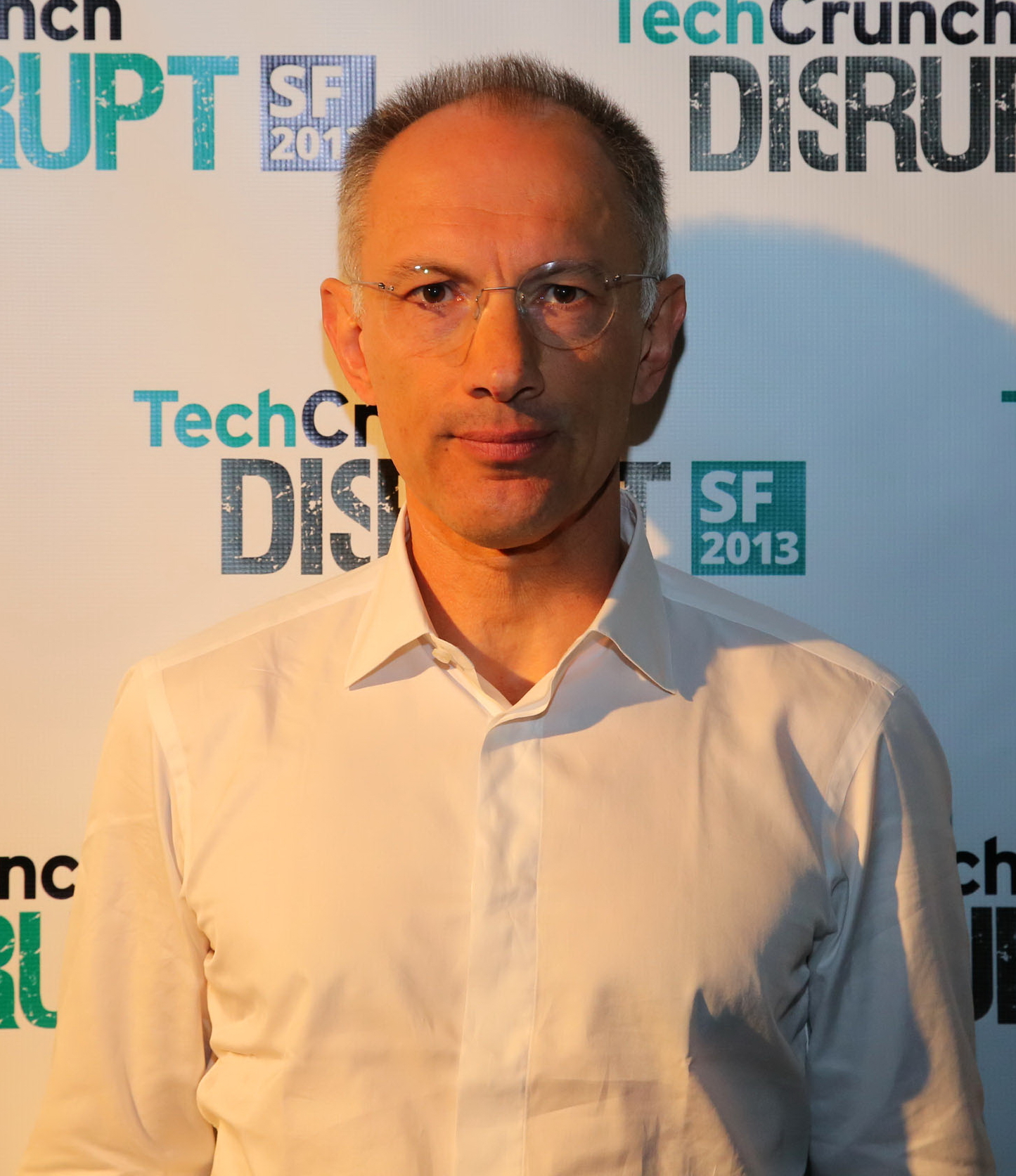
MIKE MORITZ
The Sequoia partner who backed Google, Yahoo, and PayPal before anyone else believed in them.
Mike Moritz was a journalist who stumbled into venture capital and proceeded to write the most profitable investment story in Silicon Valley history. He joined Sequoia Capital in 1986, backed Yahoo for $1 million when it was two guys with a directory, then wrote a check to Google when every other VC had already passed. His investments returned somewhere north of $10 billion. The former Time magazine reporter turned out to be better at spotting the future than almost anyone who actually trained for it.
Net Worth
$4.5 billion
Nationality
British-American
Time Horizon
Long-Term
Risk Appetite
8 / 10
Net Worth Context
- · Still a billionaire — just the quiet kind at the end of the table.
CAREER & BACKGROUND
Moritz grew up in Cardiff, Wales, the son of a doctor. He was bookish, curious, and clearly going somewhere — he won a scholarship to Christ Church, Oxford, where he studied history.
He came to the United States for business school at Wharton, then pivoted hard into journalism, joining Time magazine as a technology reporter in San Francisco in the early 1980s.
The timing was extraordinary. He was covering Silicon Valley at the exact moment personal computing was about to detonate.
He interviewed Steve Jobs repeatedly during the Macintosh era and eventually wrote a book about Apple — 'The Little Kingdom' — in 1984. That book got him noticed by Don Valentine at Sequoia Capital.
Valentine brought Moritz in as a partner in 1986. It was an unusual hire — VCs didn't typically recruit journalists — but Valentine had a nose for people who could identify talent and tell a story, and Moritz had both.
His first major deal was Apple spinoff Claris. Then came Flatiron Partners, eToys, and a string of early internet bets that made money but not legends.
The legend came in 1995 when Moritz led Sequoia's $1 million investment in Yahoo. Jerry Yang and David Filo were Stanford PhD students with a web directory.
Moritz saw something nobody else saw — not the technology, which was simple, but the brand and the habit. Yahoo went public in 1996.
Sequoia's return was somewhere around 5,000%.
Then in 1999, Moritz wrote a check to two Stanford PhD students named Larry Page and Sergey Brin. Google had been rejected by multiple VCs.
Moritz and Sequoia co-led the Series A alongside Kleiner Perkins for $25 million combined at a $75 million pre-money valuation. That investment eventually returned over $4 billion to Sequoia alone.
He also backed PayPal, LinkedIn, YouTube, Zappos, and dozens of other companies that defined the early internet era. By the time he stepped back from active deal-making in 2012 after a health diagnosis — later revealed to be a rare autoimmune disorder — Sequoia had become the most influential venture firm in the world, and Moritz had been its defining partner for 25 years.
He became chairman of Sequoia in 2012, a role he held until 2022 when he officially departed the firm. In his post-Sequoia life he has been philanthropic, outspoken, and occasionally controversial — writing opinion pieces in the Financial Times about everything from British education to Silicon Valley culture.
COMPANIES & ROLES
Sequoia Capital is the mothership — the venture firm Moritz joined in 1986 and shaped for over three decades. It is the investor behind Apple, Cisco, Oracle, Google, YouTube, Instagram, WhatsApp, Airbnb, and about a hundred other companies that define modern technology.
Moritz didn't build the firm but he arguably built its reputation during the internet era.
Yahoo was the deal that made him. A $1 million investment in 1995 in two Stanford students with a web directory.
Yahoo became the defining internet portal of the late 1990s and Sequoia's return was staggering — some estimates put it at 600x.
Google was the deal that defined a generation. The 1999 Series A investment, made when most VCs were scared of the valuation and uncertain about the business model.
Moritz led Sequoia's participation alongside John Doerr at Kleiner Perkins. The combined $25 million investment became, conservatively, $4 billion for Sequoia alone when Google went public in 2004.
PayPal came early too — Sequoia invested before PayPal was even called PayPal, when it was Confinity and working on beaming money between Palm Pilots. Moritz saw the payments angle before the product figured itself out.
Zappos was a Moritz bet on the idea that people would buy shoes online — which seemed insane in 2000. Amazon bought Zappos in 2009 for $1.2 billion.
The thesis was right, the exit was better than anyone expected.
LinkedIn was another early Moritz investment in the professional networking space. He backed Reid Hoffman's vision before professional social networking was a category anyone recognized.
INVESTING STYLE & PHILOSOPHY
Moritz invests in founders first, markets second, and everything else a distant third. He has said repeatedly that he is fundamentally betting on the person — their obsession, their intelligence, their willingness to be wrong and correct quickly.
The business model can evolve. The market can expand.
But the founder either has it or they don't, and you can't fix that.
He has a journalist's eye for narrative. He is looking for the story — what is the person's founding myth, why do they care, what would they have to believe to be right, and is that belief plausible?
That sounds soft but it's actually a rigorous filter. Founders who can't answer those questions clearly usually can't recruit, can't fundraise, and can't convince customers either.
He is a contrarian by instinct. Some of his best investments came after other investors had passed.
Google had been to Excite, to AltaVista, to RealNetworks. Everyone said search was a commodity and there was no business model.
Moritz heard 'no one else wants this' and heard opportunity.
He is not a thesis investor. He doesn't sit in Menlo Park and say 'this year we are investing in enterprise software' and then hunt for deals that fit.
He follows curiosity. He meets founders.
He tries to figure out if the thing they believe — the specific, weird, counterintuitive thing — might be true. If yes, he writes a check.
He is fast. One of his most cited traits is the ability to make decisions quickly.
He is comfortable with incomplete information because complete information in venture capital means you waited too long. The price of certainty is usually a deal that's already done.
THE PLAYBOOK
Risk Approach
Moritz operates at the highest risk end of the asset class that is already considered extremely high risk. Venture capital is the place where nine companies fail for every one that succeeds, and Moritz has been comfortable with that math his entire career.
What he is less comfortable with is the risk of not being in the game. He has talked about the venture mindset as one of constant forward motion — you cannot play defensively, because the defensive posture in venture is to wait for more proof, and by the time you have more proof the price has moved and often so has the window.
His approach to individual deal risk is to back founders he trusts and then give them room. He doesn't hedge by loading boards with advisors or writing in excessive control provisions.
If he's wrong about the founder, those protections won't save the investment anyway. If he's right, they'll only slow things down.
He has also said that the biggest risk in venture isn't losing money on bad deals — that's expected. The biggest risk is missing the great ones.
Passing on Google, missing Facebook, being too cautious about an obvious outlier — those errors of omission are the ones that compound into irrelevance. That framing shapes everything.
Money Habits
Moritz is famously private about his personal life and finances. He does not appear on year-end lists of Silicon Valley spenders, does not own a sports team, and generally avoids the conspicuous displays that define the nouveau riche tech billionaire.
He and his wife Harriet Heyman — a novelist and co-founder of the literary magazine Zoetrope: All-Story — are known for their philanthropy. They donated $75 million to the University of Oxford in 2012 for graduate scholarships for students from low-income backgrounds, one of the largest private donations in Oxford's history.
They subsequently donated another $50 million to the same cause.
They donated $300 million to the University of California, San Francisco for medical research — another enormous gift that is now one of the largest philanthropic commitments in UCSF's history.
He maintains homes in San Francisco and elsewhere but does not publicize them. He drives himself, travels without an entourage, and is reportedly uncomfortable in the flashier corners of Silicon Valley culture.
His public persona is intellectual — books, journalism, long-form opinion — not yachts and vanity projects.
He has said that his most expensive habit is buying books. Given that he's a former journalist who turned intellectual curiosity into $4 billion, that tracks.
BIGGEST WIN
Google. Full stop.
In 1999, Larry Page and Sergey Brin had already built something remarkable — a search engine that was obviously better than everything else. But the dotcom boom was in full swing, search was considered a commodity, and there was no clear business model for giving away free search results.
Moritz and John Doerr at Kleiner Perkins co-led the Series A at a $75 million pre-money valuation, putting in $12.5 million each for a combined $25 million.
When Google went public in August 2004, Sequoia's stake was worth over $4 billion. That single investment returned more money than most venture funds make across their entire existence.
Moritz has been diplomatic about calling it his best deal, but the arithmetic is undeniable.
The Yahoo investment in 1995 deserves a mention too — $1 million into what became one of the defining internet brands of its era, at returns that reportedly hit 600x. But Google is the one that echoes through history.
BIGGEST MISTAKE
Moritz has been less forthcoming about his mistakes than his wins, which is not unusual for someone of his generation in venture. But one he has publicly acknowledged is not investing more aggressively in companies he already knew were working.
The failure mode of backing great companies with positions that are too small is a real one — you're right about the outcome and still leave money on the table.
He also passed on or under-weighted Facebook in its early days, which became one of the defining missed opportunities for Sequoia during his active tenure. Sequoia did eventually invest in Facebook but later and smaller than the returns would have justified.
Given that Facebook is worth over $1 trillion today, even a percentage point of ownership difference in the early rounds would have been worth billions.
He has also been frank about the fact that some of his instincts about founders were simply wrong — smart, compelling people he backed who ultimately couldn't build durable businesses. He doesn't name names, but he's acknowledged that pattern recognition only takes you so far and that founders can fake almost everything except execution over time.
FINANCIAL PHILOSOPHY
Moritz's core belief is that exceptional people find a way, and your job as an investor is to identify those people early and then stay out of their way. He is skeptical of over-engineered investment processes and portfolio construction theories.
The companies that made Sequoia famous were not the result of a systematic framework. They were the result of someone smart saying yes to something that looked risky.
He believes in concentration and conviction. Diversification across hundreds of companies is a hedge against not knowing what you're doing.
If you genuinely believe in a founder, the right response is not to write a small check alongside fifty other small checks — it's to lead the round and own meaningful equity.
He has been vocal that the venture industry has gotten too comfortable, too fee-dependent, and too focused on process over judgment. In his view, the best investors are those who remain perpetually uncomfortable — who never feel like they've figured it out, who are always worried they're missing something.
On the question of returns vs. relationships, he believes they are not in conflict.
The way to generate extraordinary returns in venture is to be the investor founders most want to work with. That means being honest when it hurts, showing up when things go wrong, and never prioritizing your fund's optics over the company's needs.
FAMILY & PERSONAL LIFE
Moritz was born and raised in Cardiff, Wales. His father was a doctor.
He has spoken about growing up in a household where education was treated as the most important thing — which perhaps explains why he has given hundreds of millions of dollars to universities.
He has been married to Harriet Heyman since the 1980s. She is a novelist and the co-founder of American Zoetrope's literary magazine, which she ran alongside Francis Ford Coppola.
The marriage has clearly been a genuine intellectual partnership — she is not a trophy spouse but someone with her own serious creative life.
They have kept their family life very private. Moritz almost never discusses his children publicly and is one of the few Silicon Valley billionaires who has successfully maintained a meaningful separation between his professional and personal identities.
He was diagnosed with a rare autoimmune disorder in 2012 that was initially thought might end his career. He has since managed the condition and continued working, but the experience reportedly sharpened his views on time, priorities, and what actually matters.
EDUCATION
Moritz won a scholarship to Christ Church, Oxford, where he read history. Oxford in the 1970s was exactly what you'd expect — rigorous, text-heavy, and oriented toward argument rather than answers.
He has credited that training with teaching him how to think about incomplete information and make judgments under uncertainty. Then Wharton for an MBA, which is where he first started paying close attention to business rather than just history.
The journalist career came after, which turned out to be the most useful education of all — he spent years being paid to understand businesses quickly, ask the questions founders hadn't thought of, and figure out what was actually true beneath the PR.
BOOKS & RESOURCES
As essential reading for understanding why good companies fail and what the disruption pattern actually looks like before it's obvious
As an Amazon Associate, Netfigo earns from qualifying purchases. Book links above may be affiliate links.
QUOTES (6)
We are looking for someone who is extraordinary. Not just good at their job but someone who is going to fundamentally change something.
The companies that have succeeded most spectacularly were those built by people who had an immense amount of self-belief at a time when others felt the odds were impossibly long.
You can't invest in the rear-view mirror. By the time you're certain, it's too late.
The biggest mistake an investor can make is not being in the game. Missing the great companies is far more costly than losing money on the bad ones.
I've always felt that journalism was the best possible training for venture capital. You learn to understand businesses quickly, ask uncomfortable questions, and figure out what's really going on.
The best founders share one characteristic: they are completely unreasonable about what they think they can accomplish.
NETFIGO SCORE
Proprietary 5-dimension investor rating
Risk Appetite
Contrarian Index
Track Record
Accessibility
Time Horizon
Related Profiles
Investors
John Doerr
Co-led the Google Series A in 1999 alongside Moritz, with Kleiner Perkins and Sequoia splitting the $25 million round
Marc Andreessen
Both shaped modern venture capital; Andreessen Horowitz and Sequoia have competed for and co-invested in the defining tech companies of the past two decades
Peter Thiel
Both defined the early Silicon Valley venture landscape; Thiel backed PayPal which Moritz also invested in through Sequoia
Head-to-Head
Compare Mike Moritz vs another investor.