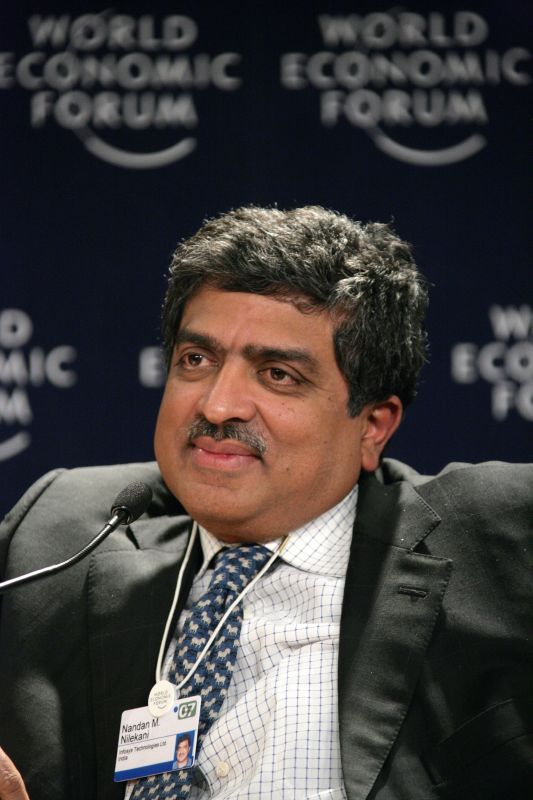
NANDAN NILEKANI
Infosys co-founder and Aadhaar architect — gave 1.3 billion Indians a digital identity
Nandan Nilekani co-founded Infosys and helped put India on the global tech map. Then he left the private sector to run Aadhaar, the world's largest biometric identification system — enrolling 1.3 billion people. The man essentially gave an identity to hundreds of millions of Indians who had never had a government-recognized ID. He then went back to Infosys as chairman to save it from a corporate governance crisis. Most people have one career highlight. Nilekani has three, and any one of them would be enough for a lifetime.
Net Worth
$3.8 billion
Nationality
Indian
Time Horizon
Long-Term
Risk Appetite
6 / 10
Net Worth Context
- · Still a billionaire — just the quiet kind at the end of the table.
CAREER & BACKGROUND
Born in 1955 in Bangalore, India. Co-founded Infosys in 1981 with N.R.
Narayana Murthy and five others — they started with $250 pooled together. Served as CEO of Infosys from 2002 to 2007.
Under his leadership, Infosys grew from $100 million to over $3 billion in revenue. Left Infosys in 2009 to take on a government role: chairman of UIDAI (Unique Identification Authority of India).
Built Aadhaar from scratch — the world's largest biometric ID system, enrolling over 1.3 billion people. Aadhaar became the foundation of India's digital public infrastructure — enabling direct benefit transfers, digital payments (UPI), and financial inclusion for hundreds of millions.
Returned to Infosys as non-executive chairman in 2017 during a corporate governance crisis. Author of "Imagining India" — a blueprint for India's digital transformation.
COMPANIES & ROLES
Infosys (co-founder, former CEO, current chairman). UIDAI / Aadhaar (founding chairman).
Personal investments through Fundamentum Partnership — a growth-stage VC fund focused on Indian startups. Invested in companies like Vogo (electric scooters), Bounce (mobility), LivSpace (home interiors), and several Indian fintech and SaaS companies.
INVESTING STYLE & PHILOSOPHY
Nilekani invests through Fundamentum Partnership, focusing on Indian growth-stage companies building for India's massive domestic market. He looks for companies leveraging India's digital public infrastructure — the systems he helped build.
His investing thesis is that India's combination of 1.4 billion people, widespread smartphone adoption, UPI payments, and Aadhaar identity verification creates unique opportunities that don't exist anywhere else. He prefers companies solving real problems for mass-market India, not luxury or niche plays.
THE PLAYBOOK
Risk Approach
Moderate. Nilekani takes calculated, thesis-driven risks rather than speculative bets.
Co-founding Infosys with $250 was an enormous gamble in 1981 India. Taking the Aadhaar role — leaving a billionaire's life to run a government project — was a career risk most people wouldn't take.
But his investment style is measured and research-heavy. He backs companies he deeply understands and avoids hype-driven sectors.
Money Habits
Nilekani is known for being quietly disciplined. He's an early riser and a voracious reader.
Despite his $3.8 billion net worth, he lives modestly by billionaire standards. He gives extensively to education and healthcare causes.
He's one of the most respected figures in Indian tech — both the private sector and government listen when he speaks. He maintains a thoughtful public presence, writing op-eds and giving talks about India's digital future.
BIGGEST WIN
Aadhaar is arguably the biggest win of any person on this list — not in terms of personal wealth, but in terms of sheer impact. Before Aadhaar, hundreds of millions of Indians had no government-recognized identity — they couldn't open bank accounts, receive government benefits, or prove who they were.
Nilekani built a system that enrolled 1.3 billion people using biometric data. This infrastructure enabled India's UPI payment system (processing billions of transactions monthly), direct benefit transfers that eliminated middleman corruption, and the India Stack digital platform that's become a global model.
BIGGEST MISTAKE
Nilekani ran for parliament in 2014 as a Congress party candidate from Bangalore South and lost to the BJP candidate. The political venture was seen as ill-suited to his technocratic strengths.
He was better at building systems than campaigning. Some critics also argue that Aadhaar's biometric database creates privacy risks — the system has faced legal challenges over surveillance concerns, and while the Supreme Court upheld it, the privacy debate hasn't been fully resolved.
FINANCIAL PHILOSOPHY
Nilekani believes technology should be public infrastructure, not a private moat. His philosophy is that digital systems — identity, payments, data — should be open platforms that anyone can build on, just like roads and electricity.
He's said "India can't copy the West. India needs to build its own models." He advocates for "population-scale" thinking: solutions that work for 1.3 billion people, not just the urban elite.
FAMILY & PERSONAL LIFE
Married to Rohini Nilekani, a prominent author and philanthropist. Rohini runs Arghyam Foundation (water and sanitation) and EkStep Foundation (education technology).
They have two children. The Nilekanis are among India's most generous philanthropists — they've signed the Giving Pledge and donated hundreds of millions.
EDUCATION
Graduated from IIT Bombay with a degree in electrical engineering in 1978. IIT Bombay is one of India's most competitive engineering schools — admission rates are under 2%.
BOOKS & RESOURCES
As an Amazon Associate, Netfigo earns from qualifying purchases. Book links above may be affiliate links.
QUOTES (6)
We enrolled 1.3 billion people into Aadhaar. That means we gave a verifiable identity to hundreds of millions of Indians who had never been able to prove who they were. A bank account, a phone number, a government benefit — all of it starts with knowing who you are.
India can't copy the West. We have 1.4 billion people, most of them on low incomes. We need solutions that work at population scale and near-zero cost. That's why we built digital public infrastructure — open, free, and universal.
We started Infosys with $250 between seven of us. Today it's worth $80 billion. The lesson is simple: you don't need money to start. You need an idea, a team, and the willingness to work harder than anyone else for a very long time.
Technology should be public infrastructure, not a private moat. Identity, payments, data sharing — these should be open platforms that anyone can build on. Like roads. Like electricity. Open and universal.
UPI processes billions of transactions a month in India. It's free. It works on any phone. And it was built on Aadhaar. That's the power of digital public infrastructure — one layer enables the next.
NETFIGO SCORE
Proprietary 5-dimension investor rating
Risk Appetite
Contrarian Index
Track Record
Accessibility
Time Horizon
Related Profiles
Head-to-Head
Compare Nandan Nilekani vs another investor.