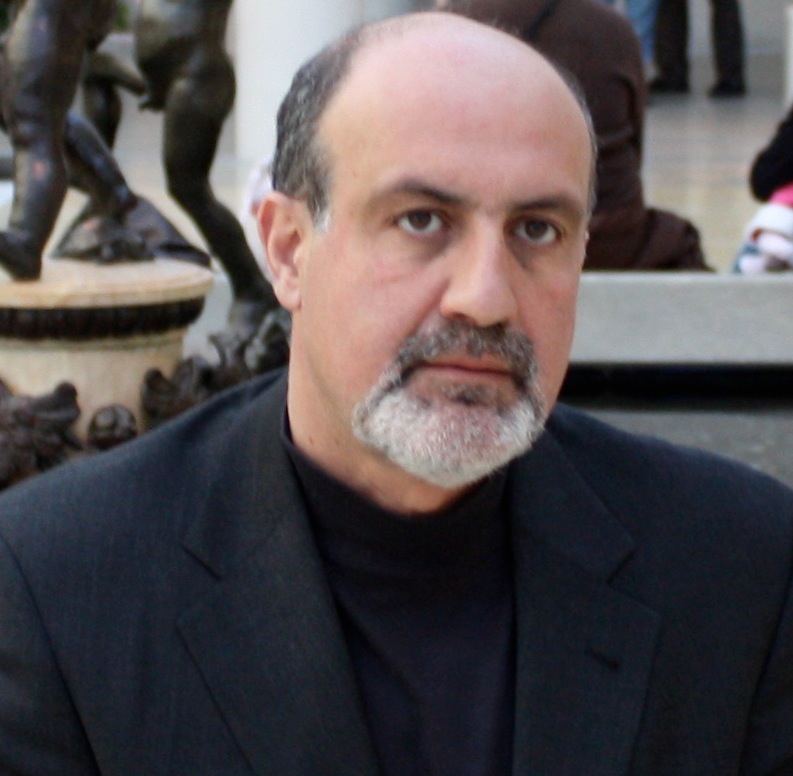
NASSIM TALEB
Writing The Black Swan and building a career on the idea that the world's most important events are the ones nobody sees coming.
Nassim Taleb is the guy who wrote the book on things nobody can predict — literally. The Black Swan, published in 2007, sold over three million copies and became required reading after the 2008 financial crisis proved his point more spectacularly than he could have scripted. He spent years on trading desks making asymmetric bets — small losses when he was wrong, massive gains when he was right — and walked away wealthy enough to never need anyone's approval again. He is also, by his own design, the most difficult intellectual in finance to argue with, because if you disagree with him, he'll tell you you're the sucker who doesn't understand fat tails. The thing is, he's usually right.
Net Worth
$50 million
Nationality
Lebanese-American
Time Horizon
Long-Term
Risk Appetite
6 / 10
CAREER & BACKGROUND
Taleb grew up in Lebanon during the civil war — which, as origin stories go, gives you a pretty visceral education in how quickly stable systems collapse. His family were Greek Orthodox Christians with deep roots in the region; his grandfather and great-grandfather had both been deputy prime ministers of Lebanon.
Then the war started, and the world he'd grown up in was simply gone. That experience — watching a functioning society disintegrate with almost no warning — is the emotional core of everything he later wrote about risk.
He left Lebanon for France, then moved to the United States to do an MBA at Wharton. He followed that with a PhD in Management Science from the University of Paris.
Then he went to work on Wall Street, trading derivatives at firms including Credit Suisse, UBS, and CIBC Wood Gundy. He ended up as a proprietary trader and pit trader at several shops, and eventually started his own trading operation.
His core strategy was always the same: buy cheap options on tail events. The idea is simple — most of the time you bleed small losses because nothing catastrophic happens.
But occasionally, something catastrophic does happen, and the payout is enormous. He called this being 'long volatility.' The strategy requires patience and the psychological fortitude to watch small losses stack up month after month while waiting for the earthquake.
He wrote Fooled by Randomness in 2001, which made a modest splash in finance circles but didn't break through to mainstream audiences. Then he wrote The Black Swan in 2007.
Then 2008 happened. The timing was so perfect it looked staged.
Suddenly every banker, regulator, and policymaker in the world was reading a book that explained, in plain English, why they hadn't seen the crisis coming — and why they were structurally incapable of seeing it coming.
After The Black Swan, Taleb became a genuine global intellectual. He wrote Antifragile in 2012, Skin in the Game in 2018, and continued publishing academic papers on probability and risk.
He holds a position as Distinguished Professor of Risk Engineering at New York University's Tandon School of Engineering. He also runs Universa Investments as a scientific advisor — the fund built explicitly around his tail-risk hedging philosophy.
During the COVID crash of March 2020, Universa reportedly returned 3,612% for the quarter. Which is not a typo.
COMPANIES & ROLES
Taleb's most direct commercial vehicle is his advisory relationship with Universa Investments, a tail-risk hedge fund based in Miami and run by Mark Spitznagel. Taleb serves as scientific advisor rather than portfolio manager — Spitznagel runs the day-to-day — but the intellectual framework is entirely Taleb's.
The fund exists to do one thing: protect investors from catastrophic losses by being long volatility at all times. It bleeds money slowly during calm markets and pays off spectacularly during crashes.
In Q1 2020, when markets dropped 35%, Universa reportedly returned 4,144% gross on its tail-hedging sleeve, helping client portfolios survive largely intact.
Before Universa, Taleb ran his own trading operation through Empirica Capital, which he founded in 1999. Empirica was the original live test of his tail-risk philosophy.
It made money during the dot-com crash in 2000–2001, then ground through years of small losses during the calm mid-2000s markets. Taleb eventually closed it, which is honest — the strategy is psychologically brutal during quiet periods.
His publishing career is also a business. The Incerto series — Fooled by Randomness, The Black Swan, The Bed of Procrustes, Antifragile, Skin in the Game — has sold millions of copies worldwide and been translated into dozens of languages.
He also self-publishes technical papers and maintains an active presence across academic and public intellectual circuits.
INVESTING STYLE & PHILOSOPHY
Taleb doesn't think about investing the way most people do. Most investors ask: 'What's likely to happen?' Taleb asks: 'What happens if everything we think we know turns out to be wrong?'
His core framework is asymmetry. He wants bets where the downside is small and capped — say, losing the premium you paid for an option — but the upside is theoretically unlimited.
He calls this being 'long convexity.' Think of it like buying insurance on a house fire. You pay premiums every month and mostly those premiums disappear.
But if the house burns down, you collect enormously. The key is that the cost of being wrong is small and the payoff of being right is huge.
Most traders hate this strategy because it requires losing small amounts consistently. Humans are psychologically wired to hate losses more than they love gains — what Kahneman called loss aversion.
Sitting there month after month, watching your options expire worthless, is genuinely painful. Most people can't do it.
That's why the strategy works when it works — because so few people actually have the stomach to run it properly.
The philosophical underpinning is his concept of 'black swans' — rare, high-impact events that are impossible to predict in advance but seem obvious in retrospect. He argues that the normal distribution — the bell curve everyone uses in finance — massively underestimates the probability of extreme events.
Real markets have 'fat tails,' meaning catastrophes happen far more often than standard models predict. The 2008 crisis, the COVID crash, the 1987 single-day 22% drop in the Dow — these are all supposed to be virtually impossible under conventional risk models.
They keep happening anyway.
His investment advice for ordinary people is surprisingly simple: keep most of your money in extremely safe assets (cash, Treasury bonds), and put a small portion — maybe 5–10% — in high-risk, high-upside bets. He calls this the 'barbell strategy.' By avoiding the middle — the supposedly 'moderate risk' options that conventional advisors recommend — you eliminate the possibility of catastrophic middle-of-the-road ruin while keeping asymmetric upside.
THE PLAYBOOK
Risk Approach
Taleb has very little tolerance for risks he considers ill-defined or where the downside is potentially ruinous. He is obsessed with what he calls 'ruin' — outcomes from which there is no recovery.
His rule is simple: never take a risk that could wipe you out, no matter how good the odds look.
He thinks most professional risk managers are dangerously bad at their jobs — not because they're stupid, but because they use models that underestimate tail events by design. Value at Risk, the standard risk metric at most banks, assumes normal distributions.
Taleb has spent a career arguing this is like designing a flood barrier based on the average rainfall and ignoring the possibility of a once-in-a-century storm.
Personally, he structures his own exposure so that he cannot be ruined by any single event. The small losses from his options strategy are predictable and manageable.
The large gains are uncertain but potentially enormous. He has no exposure to the 'blow up' scenario — the situation where one bad event destroys everything.
He is also deeply skeptical of leverage. Borrowing money to invest amplifies both gains and losses, and Taleb thinks the loss side is always worse than people model it to be.
He has written extensively about how leverage transforms manageable bad luck into permanent ruin. His advice: if you have to borrow to make the investment work, don't make the investment.
He walks the walk on this. His personal barbell — safe assets plus asymmetric bets — means he is genuinely comfortable with volatility in his speculative positions because he knows his core financial security cannot be touched by them.
Money Habits
Taleb lives well but deliberately. He is not flashy.
He is famously comfortable spending money on physical experiences — good food, good wine, weightlifting, long walks — and deeply skeptical of spending on status signaling. He lifts heavy weights obsessively and has written about strength training as a form of barbell strategy for the body: build robustness and resilience, not optimization for a specific outcome.
He divided much of his adult life between New York and the Mediterranean, particularly Lebanon and the south of France. He has spoken about feeling most alive near the sea — the Mediterranean being the literal backdrop of the ancient trading cultures he writes about admiringly in his books.
He values his time with unusual ferocity. Since achieving financial independence in the late 1990s from trading, he has been ruthless about not spending time on things or people he finds intellectually dishonest.
He has a long list of public enemies — economists, Nobel laureates, journalists — whom he will not engage with and has publicly dismissed. He calls these people 'IYIs' — Intellectually Yet Idiots — which gives you a sense of his social style.
He is a prolific writer in the literal sense: notebooks, papers, books, social media. He posts on Twitter and other platforms constantly, often to pick fights with academics he disagrees with.
He has blocked a reported list of thousands of people. This is, in its way, a form of time management.
He eats according to what he describes as ancestral or Mediterranean patterns — not as a diet per se, but as a philosophy that the food humans evolved eating is probably better for them than modern processed alternatives. He fasts occasionally.
He drinks wine. He does not count calories.
BIGGEST WIN
The 2008 financial crisis. Taleb and his trading partner Mark Spitznagel, running Empirica and then advising on Universa's strategy, had been positioning for exactly this kind of event for years — buying cheap out-of-the-money options on catastrophic moves that everyone in the market considered essentially impossible.
When Lehman Brothers collapsed in September 2008 and markets entered freefall, those positions paid off enormously. Reports at the time indicated that funds running Taleb's strategy returned in the range of 65–115% in 2008, while the S&P 500 fell 37%.
Universa's returns were reported to be even more dramatic on its tail-hedging sleeve.
But more important than the trading profits was the intellectual payoff. The Black Swan had been published just 18 months earlier.
Taleb had spent years being dismissed by mainstream finance as a crank and a pessimist. In 2008, everything he had argued proved out in real time, in front of the entire world.
The models had failed. The 'impossible' events had happened.
The people who had ignored fat tails had been wiped out. He went from interesting contrarian to vindicated prophet in about six months.
He repeated the trick in March 2020. When COVID hit and markets crashed 35% in weeks, Universa — which Taleb advises — reportedly returned 3,612% for the quarter on its tail-hedging positions.
The fund's clients, who had been paying small ongoing premiums for crash protection, ended the quarter with portfolios that had barely moved despite the broader carnage. It was the strategy working exactly as advertised, for the second time in 12 years.
BIGGEST MISTAKE
Taleb's biggest acknowledged mistake is Empirica Capital. He ran the fund from 1999 to roughly 2004, and while it made serious money during the dot-com crash of 2000–2001, the subsequent calm markets ground it down.
The strategy is designed to bleed slowly during quiet periods — that's the cost of the tail insurance — and from 2002 to 2004, the markets were quiet enough that the ongoing option premiums became psychologically and financially exhausting. He eventually wound the fund down.
He has been reasonably candid about this. The problem wasn't the strategy — it was the operational and psychological cost of running a strategy that requires losing money most of the time.
Investors don't like paying ongoing losses even when they intellectually understand why they're doing it. The fund had difficulty retaining capital during the drawdown years despite the eventual payoff potential.
He estimated in various interviews that managing other people's money in a tail-risk strategy is one of the hardest things to do psychologically — harder than the trading itself.
There's also a second, softer mistake: his Twitter presence has cost him some of his intellectual credibility in certain circles. His attacks on people — sometimes specific academics, sometimes random critics — have occasionally been personal and disproportionate in ways that distract from his ideas.
Some critics argue he's become more focused on fighting than thinking. Whether or not that's fair, it's a pattern he acknowledges is deliberate — he sees public intellectual combat as part of his skin-in-the-game philosophy — but the collateral damage to his reputation among people who might otherwise be allies is real.
FINANCIAL PHILOSOPHY
The central rule is: distinguish between risks that can ruin you and risks that can't. Everything else follows from that.
If the downside of a bet is capped and small, take risks aggressively. If the downside is potentially catastrophic — 'absorbing states,' he calls them, situations you can't recover from — avoid it entirely, regardless of what the expected value calculation says.
The math of expected value breaks down completely when one of the outcomes is ruin. Dead is dead.
He also believes deeply in 'skin in the game' — his 2018 book title and his most practical principle. He argues that people who give advice but don't bear the consequences of that advice will systematically give bad advice.
Bankers who get bonuses when bets pay off but don't lose money personally when they blow up will always take too much risk. Economists who advise on policy they don't live under will always miss something.
His test for any expert: are they personally exposed to the downside of their own recommendations?
He extends this to ethics. He thinks it's not just financially dumb to lack skin in the game — it's morally wrong.
Transferring risk onto others while keeping the upside for yourself is, in his framework, a form of theft from the future.
On forecasting, he is basically nihilistic. He thinks economic forecasters, political analysts, and most financial pundits are performing an elaborate charade.
Studies show expert predictions are barely better than chance for complex systems. He doesn't try to predict the future — he tries to build positions that benefit from unpredictability itself.
He is also deeply suspicious of optimization. Highly optimized systems — lean supply chains, just-in-time manufacturing, over-leveraged financial institutions — are fragile by design.
They work perfectly until they don't, and then they collapse completely. He wants slack in the system.
Redundancy. The spare tire.
The cash reserve. Things that look wasteful during calm times and save you during storms.
FAMILY & PERSONAL LIFE
Taleb was born in 1960 in Amioun, a small town in northern Lebanon. His family were Greek Orthodox Christians with deep political roots — both his grandfather and great-grandfather held senior government positions in Lebanon.
The family was prosperous and well-connected before the civil war upended everything.
He has been married and has children, though he keeps his immediate family life largely out of public view, which given his general disdain for social performance seems entirely consistent. He spent years splitting time between the New York area and the Mediterranean and has spoken warmly about his Lebanese cultural identity despite having lived most of his adult life in the United States and Europe.
He maintains close friendships with a small number of intellectuals he respects — he has spoken fondly of his relationship with Daniel Kahneman and collaborated with academics across mathematics, statistics, and philosophy. He also has a famously combative relationship with most of the economics profession, which he has described collectively as people who make predictions about systems they don't understand and bear no consequences when they're wrong.
Physically, he is a committed weightlifter and has been outspoken about the value of physical strength as both practical resilience and philosophical statement. He has written that he doesn't trust the advice of anyone who hasn't been physically tested — a claim that earns him both admiration and eye-rolls in equal measure.
EDUCATION
Taleb did his undergraduate work in France, then earned an MBA from the Wharton School at the University of Pennsylvania — which he has since described with varying degrees of affection. He followed that with a PhD in Management Science from the University of Paris (Paris Dauphine).
The PhD gave him the technical grounding in probability and statistics that underpins all his later work. He has said that his formal education in finance was less useful than his years on actual trading floors, where he learned that the models he'd been taught bore only a passing resemblance to how markets actually behave.
BOOKS & RESOURCES
's The Misbehavior of Markets — Mandelbrot was a mentor figure to Taleb and the original voice arguing that markets have fat tails and are far more dangerous than standard models suggest. He also frequently cites Daniel Kahneman's Thinking, Fast and Slow, though he has public disagreements with some of Kahneman's conclusions. For anyone interested in probability more broadly, he points to the work of the mathematician Henri Poincaré on complex systems
He is dismissive of most standard finance and investing books — he thinks the genre is dominated by survivorship bias and narrative fallacy
He's particularly allergic to books that draw lessons from successful people without accounting for all the identical people who did identical things and failed. Read his books first. Everything else will look different afterwards
As an Amazon Associate, Netfigo earns from qualifying purchases. Book links above may be affiliate links.
QUOTES (6)
Wind extinguishes a candle and energizes fire. Likewise with randomness, uncertainty, chaos: you want to use them, not hide from them.
The three most harmful addictions are heroin, carbohydrates, and a monthly salary.
The market is a large collection of people predicting the actions of other people predicting the actions of other people. It is not a machine for pricing assets.
Missing a train is only painful if you run after it. Likewise, not matching the idea of success others expect from you is only painful if that's what you are seeking.
The problem with experts is that they do not know what they do not know.
NETFIGO SCORE
Proprietary 5-dimension investor rating
Risk Appetite
Contrarian Index
Track Record
Accessibility
Time Horizon
Related Profiles
Investors
George Soros
Soros's reflexivity theory and Taleb's black swan framework both attack the efficient market hypothesis from different angles — both argue markets are far less rational and predictable than models assume.
Michael Burry
Both built careers on betting against consensus and being right about catastrophic events the mainstream missed — Burry's Big Short trade is the closest real-world example of Taleb's black swan theory in action.
Ray Dalio
Taleb and Dalio share a core belief that most investors dangerously underestimate tail risk, though they disagree on how to handle it — Dalio diversifies across risk factors, Taleb just buys cheap options on disaster.
Head-to-Head
Compare Nassim Taleb vs another investor.