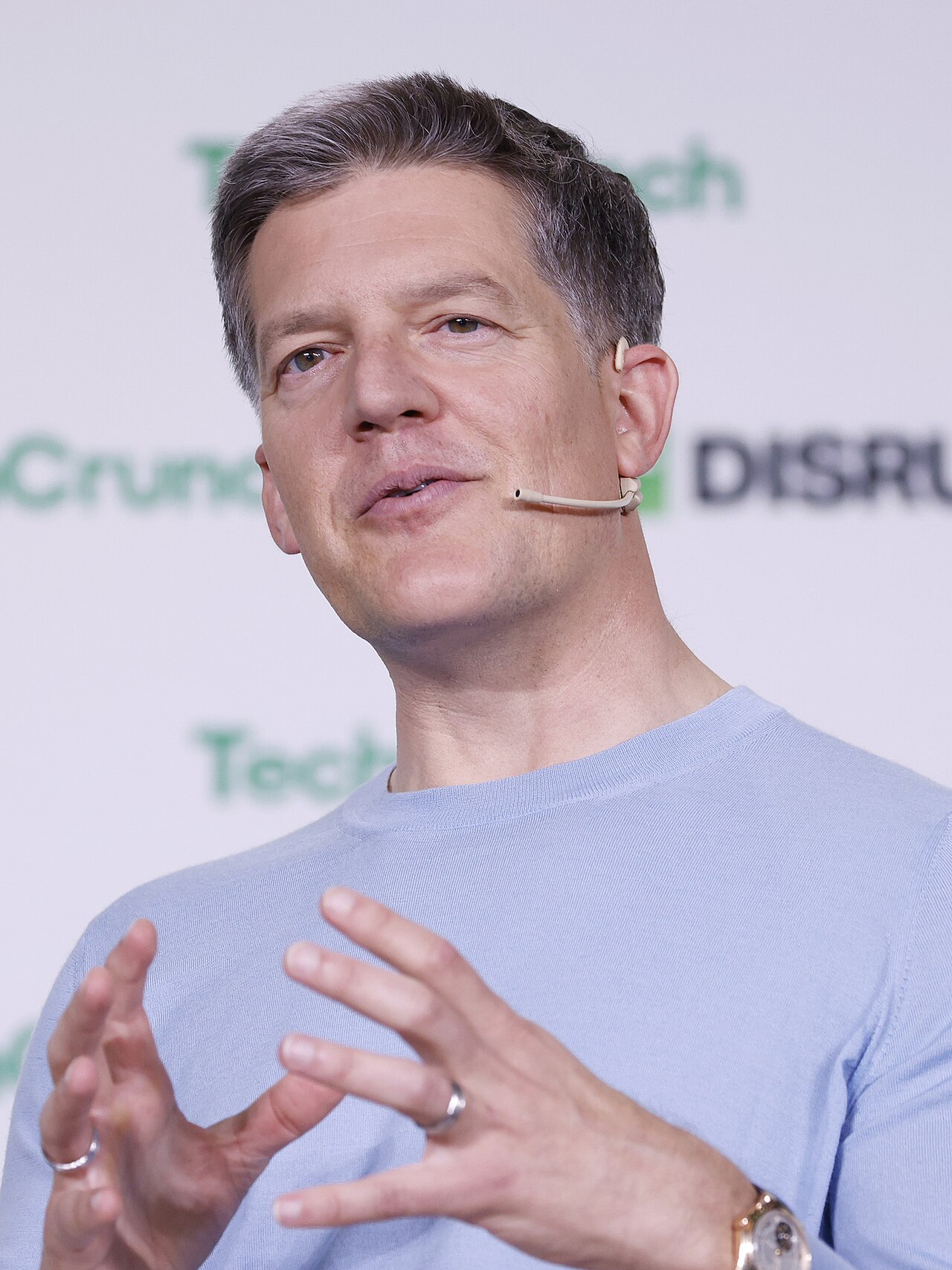
ROELOF BOTHA
The Sequoia partner who backed YouTube, Instagram, and Square before anyone else understood what they were.
Roelof Botha grew up in apartheid South Africa, became a CFO at 29, and then quietly became one of the most successful venture capitalists alive. He joined Sequoia in 2003 and went on to lead investments in YouTube, Instagram, Unity, and Square — a portfolio that, if it were its own fund, would embarrass most firms in the business. YouTube alone sold to Google for $1.65 billion in 2006, just 16 months after Sequoia invested. He now runs Sequoia Capital as its managing partner. Not bad for a kid from Cape Town who came to America for a graduate degree and just sort of never left.
Net Worth
$500 million
Nationality
South African
Time Horizon
Long-Term
Risk Appetite
7 / 10
Net Worth Context
- · 500x the average American's lifetime earnings, stacked and waiting.
CAREER & BACKGROUND
Roelof Botha was born in South Africa in 1973, the grandson of Pik Botha — South Africa's longest-serving foreign minister. Growing up under apartheid gave him an early education in how quickly systems collapse, how institutions can fail, and why the status quo is never as permanent as it looks.
That worldview never left him.
He studied actuarial science at the University of Cape Town — a discipline built entirely around quantifying risk and probability. It's basically a four-year course in never losing money.
Then he went to Stanford for an MBA, which is where South Africa ended and Silicon Valley began.
His first real job out of Stanford was at PayPal, where he became CFO at 29 years old. That's not a typo.
Twenty-nine. He joined in 2000, during the dot-com collapse, helped navigate the company through one of the worst markets in tech history, and was instrumental in taking PayPal public in 2002 and then engineering its sale to eBay for $1.5 billion in 2003.
He was the finance guy in the room when the PayPal Mafia was being assembled — and he paid attention to what made those people different.
He joined Sequoia Capital in 2003, almost immediately after the eBay deal closed. At Sequoia, he found his real calling.
Not running companies — finding them. His first major bet was YouTube, which he invested in just a few months after the site launched.
That investment returned roughly $500 million to Sequoia when Google acquired YouTube for $1.65 billion in 2006. It was one of the fastest venture returns in the firm's history at the time.
From there, Botha became one of the most prolific deal-makers in Silicon Valley. Instagram.
Square. Tumblr.
MongoDB. Unity.
Eventbrite. Natera.
He had a knack for finding companies that looked toy-like or niche from the outside but had compounding dynamics that most investors couldn't see yet. He backed founders who were unconventional, scrappy, and building things the establishment thought were unnecessary.
In 2022, he was named managing partner of Sequoia Capital — the top job at arguably the most important venture firm in history. He stepped into a role that Mike Moritz and Doug Leone had held, which is a bit like being handed the keys to a firm that funded Apple, Google, Oracle, Cisco, WhatsApp, and Airbnb.
No pressure.
COMPANIES & ROLES
Sequoia Capital is the obvious one. Founded in 1972, it has backed more world-changing companies than any firm in history.
Botha joined as a partner in 2003 and has been the lead or co-lead on some of its most successful investments ever. He's now managing partner, which means he sets the strategy, runs the partnership, and has final say on how one of the most powerful pools of capital in tech gets deployed.
YouTube is the investment that put him on the map. Botha led Sequoia's $3.5 million seed investment in YouTube in November 2005 — the site had been live for less than a year, was burning cash, and had no clear business model.
Google bought it for $1.65 billion eleven months later. Sequoia's return was roughly 50x in under two years.
Instagram. He was on the board before Instagram was acquired by Facebook for $1 billion in 2012.
The company had 13 employees. One billion dollars.
That's the kind of sentence that sounds made up.
Square — now Block — was another Botha-led investment. He backed Jack Dorsey's payments company early and watched it become a $40 billion public company.
He sat on the board through the IPO and beyond.
Unity Technologies. The gaming engine that powers roughly half of all mobile games.
Botha led the investment before most people outside game development had heard of it. Unity went public in 2020 at a $13.7 billion valuation.
MongoDB. The database startup that seemed niche and technical until everyone realized that the old way of storing data was badly broken.
Botha backed it, it went public in 2017, and it's now a multi-billion dollar company.
At PayPal, he was CFO from age 29. Oversaw the IPO in 2002 and the $1.5 billion eBay acquisition in 2003.
That's the job that gave him his MBA in how Silicon Valley actually works.
INVESTING STYLE & PHILOSOPHY
Botha is a pattern-matcher who looks for what he calls 'slope not intercept.' In plain English: he doesn't care if a company is small right now. He cares whether it's getting better, faster, than anyone else around it.
A company with $1 million in revenue growing 20% a month is more interesting to him than one doing $50 million growing 5% a year. The direction matters more than the starting point.
His actuarial background shows. He thinks in probabilities, not certainties.
He's not trying to be right 100% of the time — he knows that's impossible in early-stage investing. He's trying to make sure that when he's right, the outcome is enormous enough to cover the losses and then some.
That's exactly how venture capital math works, but most VCs don't actually internalize it. Botha does.
He looks for founders with what he calls 'pirates' energy — people who don't color inside the lines, who are building something the incumbents haven't figured out yet, and who are slightly unreasonable about what they believe is possible. He invested in YouTube when video on the internet was a bad joke (bandwidth costs, slow connections, legal risk).
He invested in Instagram when the idea of a photo-sharing app seemed like a feature, not a company. Both times, the conventional wisdom was wrong and he was right.
He also thinks deeply about market timing — specifically, about when the enabling conditions for a business have finally arrived. YouTube required broadband penetration to hit a certain threshold.
Square required the smartphone to exist. MongoDB required cloud computing to make old database architectures a bottleneck.
Botha consistently found companies where the enabling infrastructure had just crossed a threshold that made a previously impossible business suddenly viable.
He doesn't chase hot sectors. During the peak crypto craze, he was quiet.
During the NFT boom, he was quiet. He tends to appear when something that looks boring or niche is actually sitting on a structural shift.
That restraint is harder than it sounds in an environment where everyone is pitching the next big thing every six months.
THE PLAYBOOK
Risk Approach
For a venture capitalist, Botha is thoughtful about risk in a way that most people in his industry aren't. His actuarial training means he actually understands probability distributions — he's not just saying 'high risk, high reward' as a vibe.
He quantifies it.
His framework is basically: accept that most early-stage investments will fail. Build a portfolio where the winners don't just compensate for the losers — they dwarf them.
YouTube alone returned more to Sequoia than the entire fund it came from. That's the model.
Not minimizing losses, but making sure the wins are enormous enough that the losses are mathematically irrelevant.
He's said publicly that he doesn't panic when portfolio companies struggle. His view is that the time to worry is before you invest — in the diligence phase.
Once you've made the bet, your job is to help, not to second-guess. He's critical of investors who spend their time managing fear rather than managing the actual problem in front of them.
He also carries a deep awareness of systemic risk from his South African upbringing. He grew up watching a political and economic system destabilize in real time.
That gives him a different frame than most American-born investors who've only ever known bull markets and functional institutions. He thinks about tail risks — the low-probability, high-impact events — more seriously than most of his peers.
Money Habits
Botha is not a flashy person by Silicon Valley standards. He doesn't have a famous car collection or a superyacht named after a portfolio company.
He lives in the Bay Area with his family and has maintained a notably lower public profile than many peers of equivalent success.
He's known to be methodical about how he spends his time — treating attention like a scarce resource, which it is. He limits speaking engagements and media appearances more than most people at his level, which in a world where visibility is currency is its own kind of statement.
His biggest public 'spending' is on his work — Sequoia. He's deeply involved in the firm's strategy, its fund structure, its expansion into Europe and Asia, and how it positions for the next decade.
He treats Sequoia like a founder would treat a company: always building, always asking what the next version looks like.
He's also known for investing heavily in people — spending significant time with founders well before there's a term sheet on the table. That's a form of capital allocation that doesn't show up on any balance sheet.
BIGGEST WIN
YouTube. Full stop.
In November 2005, Botha led Sequoia's $3.5 million seed investment in YouTube. The site was barely a year old.
It was burning enormous amounts of bandwidth with no clear monetization plan, and the copyright risk from user-uploaded content was a genuine existential threat. Most serious investors passed.
Eleven months later, Google acquired YouTube for $1.65 billion in stock. Sequoia's return was in the neighborhood of 50x in under two years — one of the fastest and cleanest venture returns in the firm's history at the time.
But the deeper win isn't just the return. It's what it established about Botha's framework.
He invested in something that looked broken (no business model, legal risk, negative unit economics) because he believed the enabling conditions — broadband penetration, falling storage costs, rising mobile usage — had just crossed a threshold that would make video on the internet inevitable. He was right, everyone else was late, and the numbers are written permanently in the venture capital history books.
BIGGEST MISTAKE
Botha has been candid about missing companies — the nature of venture capital is that every investor has a long list of things they passed on that went on to be enormous. He's mentioned missing companies in the consumer social space that became household names.
The more interesting category for Botha is probably the investments that worked but could have been more. He's talked about the challenge of position sizing in venture — when to double down versus hold.
In a portfolio with as many winners as his, the question of 'did I put enough in?' haunts more than 'should I have passed?'
One structural area he's been publicly reflective about is the challenge of keeping Sequoia's culture intact as it scaled globally and across more funds. The firm had a notable fallout with the FTX investment — Sequoia invested approximately $213 million in FTX, which collapsed in November 2022 in one of the largest financial frauds in history.
Sequoia wrote the entire investment to zero. The firm was publicly embarrassed by a fawning profile it had published about Sam Bankman-Fried shortly before the collapse.
Botha oversaw the firm's response — which was to acknowledge the loss directly, write it down fully, and move on. Whether the diligence failure represented a lapse in Sequoia's standards or just the nature of fraud is still debated.
FINANCIAL PHILOSOPHY
His most consistent principle is the slope versus intercept idea. Don't judge a company by where it is — judge it by how fast it's improving and whether the trajectory has any ceiling.
A startup that looks tiny today but is accelerating into a massive market is almost always more interesting than a mature company in a crowded one.
He believes deeply in founder quality over market size. His view is that great founders can create or reshape markets, so market size analysis is often misleading.
Instagram's 'addressable market' when he invested was a rounding error. The founders created the market.
He'd rather back a A+ founder in a B market than a B founder in an A market.
He also has a philosophy about board membership — he thinks most investors add friction, not value. His goal as a board member is to ask the questions the founder doesn't want to hear and then get out of the way.
He's had to fire executives, help navigate crises, and push back on founders in real time. He treats it like a job, not a ceremonial title.
On the macro side, his training as an actuary left him with a deep suspicion of certainty. He doesn't believe anyone can time markets.
He doesn't believe sector rotation is a real skill at the timescales most people claim. He believes in having a framework, sticking to it, and accepting that you will be wrong often.
The goal is to be spectacularly right often enough that it doesn't matter.
FAMILY & PERSONAL LIFE
Botha is married and has children, though he keeps his family largely out of the public eye — unusual in an industry where personal branding has become almost mandatory. His grandfather Pik Botha was South Africa's foreign minister for 18 years, which means Roelof grew up with a front-row seat to political history and all its complications.
He's said in interviews that growing up in South Africa during the apartheid era and its dismantling shaped how he thinks about change, systems, and why nothing lasts forever — including dominant companies. He moved to the United States for graduate school at Stanford and never moved back.
He holds both South African and American ties but has built his life and career entirely in Silicon Valley.
EDUCATION
University of Cape Town — actuarial science. That's the degree where you spend four years learning to quantify risk and build probability models.
It's essentially a mathematical training program for never being surprised by outcomes. He was good at it.
Stanford Graduate School of Business — MBA. This is where PayPal found him, or he found PayPal, depending on who's telling the story.
Stanford's MBA program in the late 1990s was basically a recruiting pipeline for the companies that would become the PayPal Mafia, and Botha was exactly the kind of rigorous, analytically sharp person that Peter Thiel and Max Levchin were looking for. The degree mattered less than the network it dropped him into.
BOOKS & RESOURCES
Botha hasnt written a book — hes too busy actually doing the work to write about it
But he's been thoughtful in interviews about what has shaped his thinking
As foundational — which makes sense given that Thiel was his boss at PayPal. The book's central argument (that the most valuable companies create something genuinely new rather than competing in existing markets) maps directly onto how Botha evaluates investments. YouTube wasn't competing with television. Instagram wasn't competing with Flickr. They were creating new behavior
As the best framework for understanding why large incumbents consistently miss disruptive technologies. Given that his entire career has been built on backing the things incumbents missed, this is not a coincidence
The collected wisdom of Buffett's partner — as essential reading on mental models and why having a latticework of thinking frameworks beats having one big idea
Beyond books, Botha is known for reading primary sources — S-1s, academic papers on new technologies, founder letters — rather than relying on secondary analysis
He forms views from raw material, not from what other people have already concluded about that material
As an Amazon Associate, Netfigo earns from qualifying purchases. Book links above may be affiliate links.
QUOTES (6)
I look for slope, not intercept. Where a company is today matters far less than how fast it's improving and whether that trajectory has a ceiling.
The best founders are slightly unreasonable. They believe things are possible that the consensus says aren't. That unreasonableness is a feature, not a bug.
Growing up in South Africa taught me that systems that look permanent can change very fast. That's made me more willing to bet on change and less willing to assume the status quo is durable.
Venture capital is not about being right most of the time. It's about making sure that when you're right, the outcome is large enough to matter enormously.
The companies that defined the internet looked toy-like or legally risky or too small when they started. YouTube looked like all three. That's why we invested.
My job as a board member is to ask the questions the founder doesn't want to hear, and then get out of the way. Most investors confuse activity with value.
NETFIGO SCORE
Proprietary 5-dimension investor rating
Risk Appetite
Contrarian Index
Track Record
Accessibility
Time Horizon
Related Profiles
Investors
Doug Leone
Leone co-led Sequoia alongside Moritz and shaped the firm's culture and standards that Botha inherited when he became managing partner.
Mike Moritz
Moritz was Botha's predecessor and mentor at Sequoia Capital, helping build the firm Botha now leads as managing partner.
Peter Thiel
Botha worked under Thiel as CFO of PayPal — Thiel's philosophy of zero-to-one thinking directly shaped how Botha evaluates early-stage companies.
Head-to-Head
Compare Roelof Botha vs another investor.