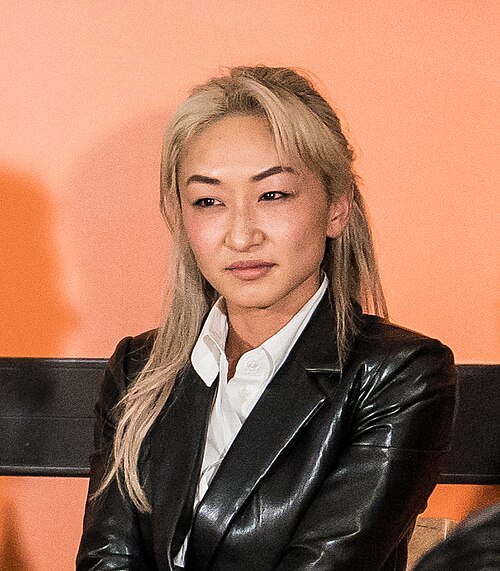
SARAH GUO
Former Greylock partner who left to start Conviction, one of the first VC funds built entirely around the AI wave before most people knew what a transformer was.
Sarah Guo placed her entire career bet on AI before it became the most overhyped — and then actually transformative — technology in a generation. She left Greylock in 2022, right before ChatGPT made everyone else scramble, and launched Conviction with a $200 million fund focused entirely on AI startups. She also started a podcast and newsletter called 'No Priors' that became required listening for anyone trying to understand what the AI moment actually means. She didn't just see the wave coming — she paddled out early and set up her whole shop there.
Net Worth
~$50 million
Nationality
American
Time Horizon
Long-Term
Risk Appetite
7 / 10
CAREER & BACKGROUND
Sarah Guo grew up in a Chinese-American family and was drawn to the intersection of technology and human systems from an early age. She studied computer science and economics at Stanford, which gave her the rare combination of being able to read a term sheet and debug a codebase on the same afternoon.
She joined Greylock Partners as one of the firm's few enterprise and infrastructure-focused investors, cutting her teeth at a firm that had already backed LinkedIn, Workday, and Palo Alto Networks. Over the next decade at Greylock, she made a name for herself backing enterprise software and developer tools — the kind of companies that are invisible to consumers but run the actual infrastructure of business.
She led or participated in investments in companies like Coda, Abnormal Security, and Figma's early rounds.
But the big turn came as AI started to look like something more than a research project. Guo had been watching foundation models and the companies being built on top of them with increasing intensity.
By 2022, she'd decided the opportunity was big enough — and different enough from traditional enterprise software — that it warranted something new.
She left Greylock in early 2022 and announced Conviction, a new AI-native fund. The timing was uncanny.
ChatGPT launched in November 2022 and made AI a household term. Guo had already been investing for months.
She wasn't lucky — she'd spent years developing conviction (the concept, not just the fund name) about where software was headed, and she acted on it before the crowd showed up.
She launched 'No Priors,' a podcast co-hosted with Elad Gil, focused on AI and technology. It quickly built an audience among founders, researchers, and investors trying to make sense of the AI transition.
Guo became one of the clearest voices in a space full of hype and noise — someone who had actual technical fluency and was willing to say what she actually thought.
COMPANIES & ROLES
Greylock Partners was where Guo built her investor reputation. Greylock is one of Silicon Valley's oldest and most respected venture firms — it backed Facebook, Airbnb, and LinkedIn among hundreds of others.
Guo worked there for roughly a decade, mostly focused on enterprise software: the boring-but-critical tools that companies use to run themselves. She led investments in Abnormal Security, a cybersecurity company using machine learning to detect email threats, which raised at a multi-billion-dollar valuation.
She backed Coda, a document and workflow tool that tried to collapse the gap between spreadsheets and apps. She was also involved in Figma, the collaborative design tool that Adobe tried to acquire for $20 billion before regulators blocked it.
Conviction is her own fund, launched in 2022 with $200 million in committed capital. The entire mandate is AI — not just companies using AI as a feature, but companies being built on the architectural shift that large language models represent.
The portfolio includes AI infrastructure, developer tools, and application-layer startups. She's been deliberate about distinguishing real AI companies from ones that slapped 'AI-powered' into their pitch deck.
No Priors is the podcast and media platform she co-hosts with investor Elad Gil. It features in-depth conversations with AI researchers, founders, and thinkers — people like Sam Altman, Andrej Karpathy, and Demis Hassabis.
It's become one of the most substantive sources on what's actually happening in AI, as opposed to what the press cycle says is happening.
INVESTING STYLE & PHILOSOPHY
Guo invests the way a good engineer debugs a system — she starts by trying to understand the architecture, not just the symptoms. Before she backs a company, she wants to understand the technical thesis: why does this approach work, what are the failure modes, and what has to be true for this to be a major business in ten years?
Her sweet spot is what she calls 'technical moats' — situations where the founders have a genuine insight about a technology shift that gives them a lasting advantage. She's not interested in companies that have a clever go-to-market strategy but no defensible core.
She wants the insight to be in the product itself.
Think of it like the difference between a restaurant that's popular because of its location versus one that's popular because the chef knows a technique nobody else does. Location advantages erode.
Technique compounds.
She also invests in people who have what she calls 'pre-distribution' — founders who are already trusted in the communities they're selling into. A former Stripe engineer who wants to build developer infrastructure has something money can't buy: credibility with the exact customer they need to win first.
Guo looks for that kind of embedded advantage.
On AI specifically, her framework is more nuanced than most. She distinguishes between AI as a feature (a company that adds a chatbot to existing software), AI as a business model shift (a company that charges differently because AI changes the economics), and AI as a new category entirely (something that could only exist because of the new capabilities).
She's mostly interested in the third bucket.
Her check sizes at Conviction are typically Series A and B, in the $5–15 million range, with reserves to follow on. She's not playing the spray-and-pray game.
The fund is concentrated enough that every company has to matter.
THE PLAYBOOK
Risk Approach
Guo has an unusual relationship with risk for a VC — she thinks about it more like a scientist than a gambler. Most VCs will tell you they have 'high risk tolerance' as if that's a badge of honor.
Guo talks about risk in terms of whether you understand it, not whether you're comfortable with it.
Leaving Greylock to start Conviction was the biggest personal risk she's taken. She walked away from a carry-laden track record at one of the best-known firms in the world, at a moment when the macro environment was deteriorating and LPs were getting nervous.
The asset-gathering math made no obvious sense. She did it anyway because she believed the AI thesis was big enough and differentiated enough that it couldn't be pursued properly inside an existing generalist fund.
On portfolio risk, she's concentrated rather than diversified. Conviction's mandate is narrow — she's not hedging across sectors.
If AI turns out to be a decade-long hype cycle that doesn't produce durable businesses, her fund suffers badly. She's made peace with that possibility.
Her view is that diversification across ideas is a way of admitting you don't have conviction — hence the fund name.
She also talks openly about the risk of being too early vs. being wrong.
A lot of investors won't back something until the market exists. Guo is willing to be early if the underlying technical logic is sound.
She says the risk of missing the category is worse than the risk of losing a check to timing.
Money Habits
Guo is not a conspicuous spender. She's based in San Francisco and has maintained a relatively low public profile on personal wealth compared to many of her peers in VC.
She doesn't have the social media presence of a charismatic founder-type or the billionaire lifestyle of a late-stage mega-fund partner.
Her visible investments in her public profile are intellectual, not material — she spends her time on the No Priors podcast, on writing, and on being embedded in the AI research and founder community. Her brand is built on having something to say, not on showing what she has.
She put her own capital into founding Conviction, which is the move that defines her financial posture more than anything else. You don't walk away from a GP carry stake at Greylock to start something new unless you genuinely believe the upside of the new thing outweighs the security of the old one.
That's a financial bet as much as a career bet.
She has spoken about the importance of being financially independent enough to take concentrated career risks — the idea that you should build enough of a financial buffer to make the decisions you actually believe in, rather than the safe ones. That's the frame she used for Conviction, and it's probably the most revealing thing about how she thinks about money.
BIGGEST WIN
Figma is the win that defined Guo's Greylock era. Figma, the collaborative design tool, raised its Series B in 2018 with Greylock's participation.
Adobe then agreed to acquire Figma in 2022 for $20 billion — at the time, the largest software acquisition ever attempted. Regulators in the UK and EU blocked it in late 2023, which was bad news for the acquirer but didn't meaningfully change Figma's position as the dominant design tool on earth.
The company is still private and valued at roughly $12.5 billion post-deal-collapse — still a massive multiple on the Series B entry.
Abnormal Security is the other standout. Guo led Greylock's investment in the email security company, which uses behavioral AI to detect sophisticated phishing attacks.
The company reached a $5.1 billion valuation in 2023. For an enterprise security startup, that's a major outcome.
The meta-win is Conviction itself. A $200 million first fund focused on AI, launched right before AI became the dominant investment theme globally, is structurally well-positioned.
The portfolio is still early, but backing the category before the crowd — with genuine technical conviction — is the kind of timing that defines careers.
BIGGEST MISTAKE
Guo has been candid in interviews about the investments she passed on — the ones where she had enough information to invest but talked herself out of it. She's mentioned passing on companies in the infrastructure space that went on to significant outcomes, typically because the market looked too early or too niche at the time.
The honest version of this is a pattern most VCs won't admit: the fear of a market being 'too small' has cost the industry more money than the fear of paying too much. Guo has acknowledged that she's had moments where technical understanding was present but market conviction was missing — and the market turned out to be enormous.
She's also navigated the challenge of being a woman in a historically male-dominated field, and has spoken about the extra cognitive load that comes with that — having to prove technical credibility in rooms where it's assumed for others, navigating firm politics differently. That's not a financial mistake, but it's a real cost that doesn't show up in the spreadsheet.
On Conviction specifically, the fund is still early enough that final outcomes aren't determined. The risk she's running — concentrated AI bets in a frothy market — means if the AI application layer doesn't produce the durable businesses she's betting on, the numbers will look bad.
She knows this. That's the bet on the table.
FINANCIAL PHILOSOPHY
Guo's core belief is that real value in technology comes from compounding technical advantages, not compounding distribution tricks. She's seen too many companies win the first round on marketing and then get competed to death because there was nothing proprietary underneath.
She thinks the best founders are the ones who understand what they know that nobody else does — what she'd call the 'edge.' It might be a research insight, deep customer relationships, or a specific technical implementation that takes years to replicate. Without an edge, you're just running fast on a treadmill.
On the AI wave specifically, she has a philosophy she articulates clearly: the infrastructure layer will matter, but the application layer will be where most of the value lands for end users. This is a contrarian position relative to many AI investors who are betting primarily on foundation model providers.
Her view is that applications built with genuine workflow integration and distribution advantages will be extremely hard to displace, even if the underlying model improves.
She also believes in intellectual honesty about uncertainty. She says the best investors are the ones who can hold a strong thesis and simultaneously identify the two or three things that would prove them wrong — and stay genuinely open to that evidence.
Most people, once committed, stop seeing disconfirming data. That's how you lose big.
FAMILY & PERSONAL LIFE
Sarah Guo grew up in a Chinese-American family in the United States. She has spoken publicly about the influence of immigrant family values on her work ethic and her approach to risk — the idea that you build something real and don't waste what you've been given.
She's relatively private about personal life beyond what she shares in professional contexts. She's active in the Stanford alumni network and the Bay Area tech community, and is known among peers as someone who is genuinely generous with her time for founders and junior investors trying to break in.
EDUCATION
Guo attended Stanford University, where she studied computer science and economics. Stanford gave her two things that mattered in VC: the ability to have a real technical conversation with founders, and a network in Silicon Valley that doesn't exist anywhere else in quite the same density.
She's mentioned that the CS background was essential — it meant she wasn't dependent on founders to explain the technical choices, she could form her own view.
BOOKS & RESOURCES
Guo doesnt have a book of her own yet — but if you want to understand how she thinks, the No Priors podcast is the most direct access
Episodes with Andrej Karpathy on AI development, with Sam Altman on the OpenAI mission, and with researchers from Google DeepMind give a clear window into how she interrogates technical problems
Which is about how paradigm shifts actually happen in science and how long it takes the field to catch up. It's the intellectual framework for how she thinks about AI being a genuine architectural shift, not just an incremental improvement
The book she and most of her peers recommend to founders who are about to experience something genuinely difficult for the first time
As an Amazon Associate, Netfigo earns from qualifying purchases. Book links above may be affiliate links.
QUOTES (6)
The best founders know something specific that others don't — a technical insight, a customer truth, a distribution advantage. Without that edge, you're just running fast.
I think diversification across ideas is a way of admitting you don't have conviction. The name of the fund is intentional.
AI is not just a feature you add to existing software. For the most interesting companies, it changes what's possible to build, who can build it, and how economics work.
The risk of missing a category is worse than the risk of being early. Timing risk gets talked about too much. Category risk doesn't get talked about enough.
Technical moats compound. Distribution moats erode. The best companies have both, but if I had to pick one, I'd pick technical every time.
The best investors I know hold a strong thesis and simultaneously know exactly what evidence would break it — and they stay genuinely open to seeing that evidence.
NETFIGO SCORE
Proprietary 5-dimension investor rating
Risk Appetite
Contrarian Index
Track Record
Accessibility
Time Horizon
Related Profiles
Investors
Ann Miura-Ko
Both are prominent women in early-stage venture capital with strong technical backgrounds and a focus on category-defining companies
Marc Andreessen
Both are leading voices in AI investing and have publicly debated the application vs. infrastructure layer opportunity in AI
Sam Altman
Guo has interviewed Altman on No Priors; both are central figures in the AI ecosystem and have overlapping portfolio interests
Head-to-Head
Compare Sarah Guo vs another investor.