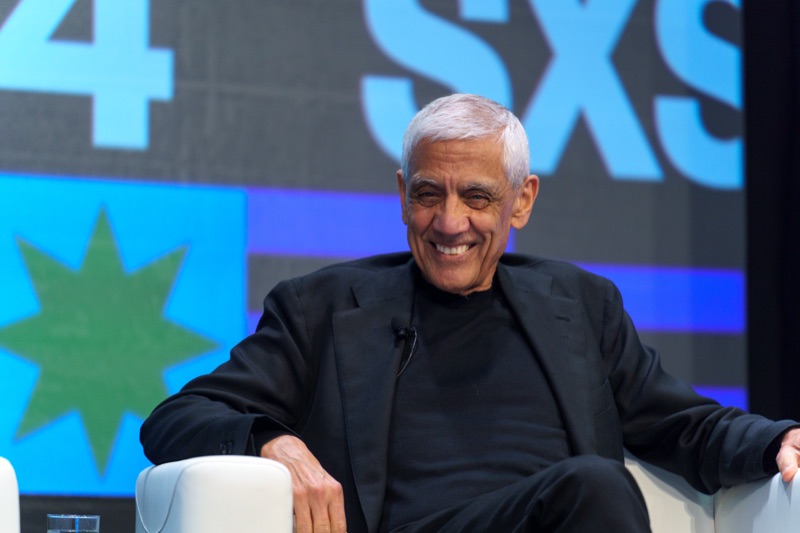
VINOD KHOSLA
The venture capitalist who co-founded Sun Microsystems, then bet billions on technologies most VCs were too scared to touch — clean energy, AI, and healthcare disruption.
Vinod Khosla co-founded Sun Microsystems at 27, turned it into a multibillion-dollar company, then walked away from the thing that made him rich to do something harder. He raised billions for clean energy bets at a time when most VCs thought climate tech was career suicide. Some of those bets exploded spectacularly — KiOR lost $600 million, Range Fuels cost investors hundreds of millions more. But he also backed Square, DoorDash, and OpenAI. His hit rate is imperfect. His ambition is not. He genuinely believes venture capital should try to solve the problems that actually matter — and he's been willing to lose real money proving it.
Net Worth
$6.1 billion
Nationality
American
Time Horizon
Generational
Risk Appetite
9 / 10
Net Worth Context
- · Still a billionaire — just the quiet kind at the end of the table.
CAREER & BACKGROUND
Vinod Khosla grew up in Delhi, India, the son of an army officer. He was 16 when he read about Intel's founding and decided, on the spot, that he wanted to build a technology company.
He applied to Stanford's graduate business school as a teenager. They rejected him.
He enrolled in IIT Delhi instead, got his engineering degree, then made it to Carnegie Mellon for a master's. Then he got into Stanford GSB.
He was in his early twenties, freshly arrived in Silicon Valley, and already obsessed with one idea: computers needed better software tools.
In 1982, he co-founded Sun Microsystems with Scott McNealy, Bill Joy, and Andy Bechtolsheim. He was 27.
Sun became one of the defining technology companies of the 1980s and 1990s, building the workstations and servers that powered the internet age. By the time Khosla left Sun in 1984 to pursue other interests, the foundation was in place for a company that would eventually be acquired by Oracle for $7.4 billion in 2010.
He joined Kleiner Perkins in 1986, one of Silicon Valley's most powerful VC firms, and spent almost two decades there learning the craft. He backed Juniper Networks during the networking boom.
He sat on boards. He built a reputation as someone who'd argue with founders, push hard on technical assumptions, and back bets others found too early or too weird.
In 2004, he left Kleiner Perkins and launched Khosla Ventures. The stated mission was provocative: invest in technologies that could have a massive positive impact on the world — specifically in energy, food, water, transportation, and health.
Not because those were obviously lucrative bets. Because the problems were real and the market was ignoring them.
Clean energy became his obsession. He raised hundreds of millions for biofuels, solar, and battery companies at a time when most of Sand Hill Road thought climate tech was a charity case dressed up as a business.
Some of those bets paid off. Many did not.
Khosla became both celebrated and mocked — the idealist VC who torched money on good intentions. He was unapologetic about it.
He still is.
The next chapter was AI and healthcare. He became one of the earliest institutional backers of machine learning applications in medicine, arguing loudly and publicly that AI would replace 80% of what doctors do within a generation.
That claim annoyed a lot of doctors. It also positioned Khosla Ventures perfectly for the 2020s AI wave.
His portfolio now includes OpenAI, Mistral AI, and a long list of health tech companies rewriting how medicine works.
COMPANIES & ROLES
Sun Microsystems is where it started. Khosla co-founded it in 1982 with three other Stanford-connected engineers.
Sun built the hardware and software that enterprises ran their servers on throughout the 1980s and 1990s. They invented Java.
They shipped the machines the early internet ran on. Oracle eventually bought them in 2010 for $7.4 billion, by which point Sun had long since peaked — but the foundational contribution to computing was real.
Khosla Ventures, his own fund, is the vehicle that defines his legacy now. It's backed hundreds of companies across energy, health, AI, and consumer tech.
Notable wins include Square (now Block), which went public in 2015 and has had a long run as a financial technology giant. DoorDash, which Khosla backed early and which IPO'd in 2020 at a valuation north of $39 billion.
Stripe, the payments infrastructure company. OpenAI, which needs no explanation in 2024.
On the energy side, the record is more complicated. He put serious money into biofuel startups like Range Fuels and KiOR at a time when cellulosic ethanol looked like the future of transport fuel.
Range Fuels burned through roughly $320 million — including $162 million in federal grants — before shutting down in 2011. KiOR raised about $600 million from investors including Khosla Ventures before collapsing in 2014.
The technology never worked at scale.
He's also backed Impossible Foods, the plant-based meat company that convinced Burger King to put a plant-based Whopper on the menu. Okta, the identity security company.
Good Eggs, an online grocery startup. The list is long, the outcomes vary wildly, and Khosla has been honest that failure is part of the model — you don't make asymmetric bets without blowing some up.
INVESTING STYLE & PHILOSOPHY
Khosla has a phrase he uses constantly: he's not trying to make good bets, he's trying to make bets that other people think are crazy but that have a small chance of being transformative. The distinction matters.
A good bet is one where the expected value is clearly positive. A Khosla bet is one where most sophisticated people think you're wrong, the downside is total loss, and the upside is changing an entire industry.
He calls this 'black swan farming.' The idea is that you can't predict exactly which big technical breakthroughs will happen — but you can position yourself to benefit from them by funding the experiments. Most experiments fail.
The ones that don't can return the fund many times over. He's explicit that he expects most of his energy and health bets to lose money.
The point isn't to bat .800. The point is to be in the room when something genuinely important works.
This makes him different from most VCs in a few ways. He gravitates toward bets that require a technical breakthrough — not just better execution on a known business model.
He'll back a team working on a technology that doesn't fully exist yet. He's less interested in 'is this team executing well?' and more interested in 'if this technical hypothesis is right, how big is the market?' That's a harder question to answer, and it means more failures.
He's fine with that.
He also has a high tolerance for going against consensus. During the clean energy bust of 2010-2012, when most VCs wrote off climate tech entirely, Khosla kept writing checks.
He took the losses on Range Fuels and KiOR publicly and didn't retreat. That contrarianism has cost him on specific bets — but it's also why he was positioned in AI and health before either became fashionable.
He does not pretend to be a financial optimizer. He has said explicitly that he could probably generate better returns by chasing safer bets in enterprise software.
He doesn't want to. He thinks the most interesting thing you can do with a venture fund is aim it at problems that don't have obvious solutions yet.
THE PLAYBOOK
Risk Approach
Khosla talks about risk in a way that most investors find uncomfortable. He genuinely believes you should be willing to lose everything on a bet if the potential upside is large enough and important enough.
He's not talking theoretically — he watched two of his highest-profile energy companies burn through hundreds of millions of dollars and collapse, in public, with extensive press coverage, and he did not change his investment thesis.
His framing is that risk and importance are correlated. The problems that matter most — climate, health, food security — are the ones where the solutions are hardest and most uncertain.
If you want to only invest in things where success is likely, you'll end up investing in things that don't matter very much. He's made peace with that trade-off.
That said, he's not reckless. He thinks hard about asymmetry.
A bet where you lose 1x if you're wrong but make 100x if you're right looks different from a bet where you lose 1x and make 3x. He'll take the first kind of bet at long odds.
He's much less interested in the second kind even at good odds. The size of the potential impact shapes his appetite for risk more than the probability of success.
He's also said that he tries to structure his portfolio so that no single failure is fatal. The blowups on KiOR and Range Fuels were painful but survivable because Khosla Ventures had other bets in flight.
That's not accident — it's how he thinks about portfolio construction. Each individual bet can be high-risk.
The aggregate portfolio needs to be able to absorb the losses.
Money Habits
Khosla is not conspicuous about wealth in the way some Silicon Valley billionaires are, but he's had his moments. The most famous is the Martins Beach controversy — he bought a California coastal property that included a road to a public beach, then blocked public access to it.
The legal fight lasted nearly a decade, attracted national coverage, and cost him significant reputational capital. California eventually forced him to open the access road in 2021.
It was not his finest moment, and it's the kind of fight a person of his wealth could have avoided entirely for a rounding error on his net worth.
He has been a significant philanthropist, donating tens of millions to Stanford and to global health initiatives. He co-founded the Khosla Foundation with his wife Neeru, focused on education and health in India.
He takes the philanthropic side seriously — it's not just check-writing, it's part of the same thesis about directing capital at important problems.
He is not particularly flashy about personal consumption. He doesn't show up in the press for buying yachts or art collections.
His public persona is almost entirely professional — what he cares about, he talks about, and it's almost always technology and investment thesis, not lifestyle. For a person with $6 billion, the personal spending footprint is fairly modest by Silicon Valley standards.
BIGGEST WIN
OpenAI is the bet that looks most remarkable in hindsight, but DoorDash might be the cleaner example of what Khosla Ventures actually does. Khosla backed DoorDash in its early rounds, when it was a small startup competing against Uber Eats, Grubhub, and Postmates in a market most investors thought was commoditized.
DoorDash IPO'd in December 2020 at a valuation of $39 billion and briefly hit a market cap north of $70 billion. The early investment returned many multiples.
Square is another. Khosla Ventures was an early investor in Jack Dorsey's payments company.
Square went public in 2015 and built into a multi-product financial services platform worth tens of billions. The early bet was on the idea that small businesses were being underserved by traditional payment processors — a fairly obvious problem in retrospect, but not an obvious venture bet in 2010.
But the defining win of the next decade could be OpenAI. Khosla Ventures invested in the company's early rounds, long before the ChatGPT moment.
OpenAI's current valuation is north of $80 billion. If the AI thesis plays out even partially as Khosla has argued it will, the return on that bet will dwarf everything else in the portfolio.
The irony is that his most controversial claim — that AI will replace most of what doctors do — may turn out to be the investment thesis that makes him the most money.
BIGGEST MISTAKE
The clean energy bets of the 2000s are the honest answer, even if Khosla doesn't fully frame them as mistakes. Range Fuels was a cellulosic ethanol company that received $162 million in federal loan guarantees and burned through roughly $320 million in total before shutting down in 2011.
It never achieved commercial-scale production. The technology worked in the lab and not in the plant.
KiOR was worse — it raised approximately $600 million, went public in 2012 at a $1.5 billion valuation, and filed for bankruptcy in 2014. The company claimed to be producing biofuels from wood chips.
It turned out the production yields were far lower than what they'd told investors and the board. There were later allegations of fraud by the CEO.
Khosla's defense is that he was backing the right problem with the wrong technology at the wrong time. That's partially true.
But the losses were real — hundreds of millions of investor capital gone, plus significant federal money. The criticism that he was too confident in unproven technology, not rigorous enough about the gap between lab results and commercial scale, has some merit.
The lesson he draws is that technical breakthrough bets require more patience and more capital than anyone expects, and that timing matters as much as thesis. The lesson a more skeptical observer might draw is that conviction without validation is expensive.
FINANCIAL PHILOSOPHY
Khosla has a philosophy that sounds simple and is actually hard to execute: invest where you're most likely to be wrong, because that's where the upside is biggest. Most people hear this and nod.
Very few actually do it, because being wrong in public is painful and losing institutional money is career-ending for most VCs. Khosla has enough personal wealth and enough confidence in his thesis that he can absorb both.
He believes the venture industry optimizes for the wrong thing. Most VCs want a portfolio that looks good — lots of small wins, few embarrassing losses.
Khosla thinks that's backwards. A portfolio that looks good is a portfolio that took safe bets.
Safe bets don't produce the returns that matter. He'd rather have nine failures and one OpenAI than ten modest winners.
On the specific question of clean energy and climate, he's argued that the sector was mis-timed rather than wrong. The biofuel bets of the 2000s failed partly because oil prices dropped dramatically.
The underlying technology problems were real, but the economic environment destroyed the companies before they could solve them. He sees those investments as expensive lessons in timing rather than evidence that the thesis was broken.
He also has a strong view on the role of capital in technical progress. Government funding does the basic science.
Markets fund the commercialization. The gap in between — early-stage technical companies trying to bridge the lab and the market — is where venture capital should be.
He thinks most VCs have retreated from that gap into safer, later-stage bets. He explicitly positions Khosla Ventures as filling the space others abandoned.
FAMILY & PERSONAL LIFE
Khosla married Neeru Khosla, a scientist and education advocate, and they have four children. Neeru is a founder of CK-12 Foundation, a nonprofit that provides free, customizable educational materials — she's not just an investor's spouse, she's done significant work in her own right on education access.
The family has deep ties to India, where they grew up and where much of their philanthropy is focused.
He's been relatively private about his family compared to many Silicon Valley figures of his profile. His children don't appear regularly in press coverage.
The Martins Beach controversy briefly pulled his personal life into public view in a way he clearly didn't intend, but the coverage was about the legal fight rather than his family.
He still has family connections in India and has talked about how his upbringing — the son of an army officer, watching India develop economically — shaped his belief that technology can change the trajectory of entire countries, not just individual companies.
EDUCATION
Khosla did his undergraduate engineering degree at IIT Delhi, one of India's most competitive technical universities. He then came to the US for a master's degree in biomedical engineering at Carnegie Mellon.
Then — the thing that actually mattered for his career — he got into Stanford Graduate School of Business. He graduated from Stanford GSB in 1980.
That gave him the network, the credibility, and the proximity to the early Silicon Valley ecosystem that made everything else possible. He's said the Stanford MBA was the inflection point.
The IIT engineering training gave him the technical foundation to evaluate technology companies. The Stanford network gave him access to the people who would co-found Sun Microsystems.
BOOKS & RESOURCES
Khosla hasnt written a traditional investment book — his thinking is scattered across long essays, talks, and interviews rather than collected in one place
His most-cited writing is a long essay called 'Is Venture Capital Broken?' in which he argues that the industry has become too focused on safe, software-only bets and has abandoned the hard technical problems that venture was originally designed to fund. It's worth reading even if you disagree with it
Another reference he returns to — the idea that paradigm shifts in science don't happen gradually but in sudden ruptures, which maps onto how he thinks about technological change
For understanding how he thinks about the future of health and AI, his TED talks and Aspen Ideas Festival appearances are probably the most efficient source
He's articulate and willing to make specific, falsifiable predictions, which makes watching him argue his thesis unusually useful compared to most investor content
As an Amazon Associate, Netfigo earns from qualifying purchases. Book links above may be affiliate links.
QUOTES (6)
I want to invest in things where I can be most wrong, because that's where the upside is most asymmetric.
The areas where failure is most likely are also the areas where success would be most important.
I believe we can replace 80% of what doctors do with AI. That's not a put-down of doctors — that's the scale of the opportunity.
Venture capital should be about funding things that can't get funded any other way. The moment you only fund safe things, you've stopped doing venture capital.
People ask why I keep investing in clean energy after the failures. The answer is: the problem didn't go away. The technology just needs more time and more capital.
Failure is a feature of doing important things, not a bug. If you're not failing a lot, you're not trying hard enough.
NETFIGO SCORE
Proprietary 5-dimension investor rating
Risk Appetite
Contrarian Index
Track Record
Accessibility
Time Horizon
Related Profiles
Investors
Chamath Palihapitiya
Both have made public, opinionated bets on climate tech and AI, and both have been willing to take high-profile losses defending controversial long-term theses.
Marc Andreessen
Both are defining figures of Silicon Valley venture capital who backed transformative technology companies in the 2010s and 2020s, including competing bets in AI infrastructure.
Peter Thiel
Thiel and Khosla both made early bets on OpenAI-era AI companies and share a contrarian, big-swing investment philosophy focused on transformative rather than incremental bets.
Head-to-Head
Compare Vinod Khosla vs another investor.