Compare / Jeff Bezos vs Bill Nygren
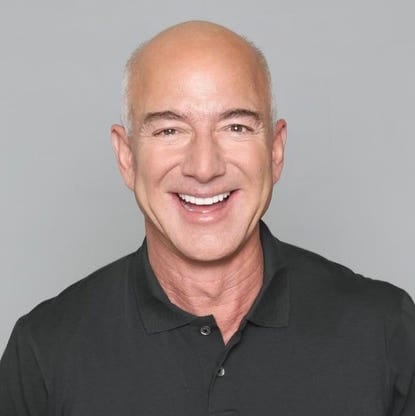
NETFIGO SCORE BATTLE
ORIGINAL DATARisk Appetite
Contrarian Index
Track Record
Accessibility
Time Horizon
AT A GLANCE
INVESTING STYLE
Jeff Bezos
Bezos's investment style is long-term and patient to an extreme degree. He built Amazon by deliberately losing money for years, reinvesting every dollar into infrastructure, logistics, and new businesses.
He told shareholders repeatedly that he would sacrifice short-term profitability for long-term market position. AWS was not a profit center for years — then it became Amazon's most profitable business unit.
He put $250,000 into Google personally in 1998, six years before its IPO, and that one cheque alone was worth hundreds of millions by 2004. Bezos Expeditions, his personal investment vehicle, came later and backed Airbnb, Uber and Twitter.
Bill Nygren
Classic large-cap value. Nygren buys businesses trading significantly below his estimate of intrinsic value — typically at least a 40% discount.
He focuses on companies with strong management teams, high free cash flow generation, and the ability to allocate capital intelligently. He runs concentrated portfolios (20-30 stocks) and is willing to hold positions for 3-5+ years.
He is a contrarian by default — his best ideas are usually in sectors the market hates.
FINANCIAL PHILOSOPHY
Jeff Bezos
His core philosophy is customer obsession combined with long-term thinking. He says most companies optimize for the next quarter.
He optimizes for the next decade. He invented the concept of "working backwards" — writing the press release and FAQ for a product before building it, to ensure the team starts from the customer's perspective.
He also invented the "two-pizza rule": if a team needs more than two pizzas to feed, it is too big.
Bill Nygren
Nygren believes the market is generally efficient but occasionally misprices individual businesses, especially during periods of fear or sector-wide pessimism. He thinks like a business buyer, not a stock trader — asking "what would a rational private buyer pay for this entire company?" He considers management quality and skill at investing company money as important as the financial statements.
RISK TOLERANCE
Jeff Bezos
Bezos told shareholders in 1999 that Amazon would lose money for years. He said the same in 2001.
He meant it. His risk tolerance comes from a framework he calls the "regret minimization framework" — imagining himself at 80 looking back — which weights the risk of not trying far more than the risk of failing.
The risk he manages carefully is existential: through all of Amazon's early loss years, he kept debt manageable and liquidity intact so that survival was never in question. He takes huge bets on the thesis, but he protects the foundation.
Bill Nygren
Moderate. Nygren runs concentrated portfolios which adds stock-specific risk, but he focuses on large-cap, established businesses with strong balance sheets.
He is not swinging at biotech startups or crypto. The risk is being early and looking wrong for extended periods while waiting for the market to recognize value.
THE PLAYBOOK
Jeff Bezos
Bezos lived frugally in the early Amazon years — he famously built his own desk from a door laid on sawhorses to keep costs down. The "door desk" became a symbol at Amazon.
He became extraordinarily wealthy but for years retained a modest personal style. Post-divorce and especially post-CEO, he moved to Miami, bought massive properties, and began a much more public lifestyle with Lauren Sanchez, whom he married in June 2025.
He exercises in the morning before checking his phone.
Bill Nygren
Low-profile lifestyle. Based in Chicago.
Nygren does not seek media attention and rarely appears on financial TV. He writes detailed quarterly commentaries for Oakmark shareholders that are some of the best free investing education available.
He lets his long-term performance record speak for itself.
BIGGEST WIN
Jeff Bezos
Amazon Web Services. AWS was an internal tool that Amazon began selling to external companies in 2006.
By 2023, AWS generated $91 billion in revenue and accounted for the majority of Amazon's operating profit. It is the dominant cloud computing platform in the world — Microsoft and Google are still playing catch-up.
Bezos had the idea when Amazon was already a massive retailer. He added an entirely different trillion-dollar business on top.
Bill Nygren
His consistency over nearly three decades. While many value managers have stumbled during the growth-dominated 2010s, Nygren adapted his approach to include "modern value" — companies like Alphabet and Meta that trade at low multiples relative to their growth rates.
His willingness to evolve his definition of value without abandoning the discipline has kept Oakmark relevant.
BIGGEST MISTAKE
Jeff Bezos
The Washington Post acquisition is the most common answer. He paid $250 million for it in 2013 and has poured money into it since.
The Post has struggled commercially and faces the same headwinds as all legacy print media. Separately, his rocket company Blue Origin has consistently lagged SpaceX in capability and ambition — Blue Origin's New Shepard is basically a tourist ride compared to SpaceX's reusable orbital rockets.
Bill Nygren
Holding financial stocks through the 2008 financial crisis. Oakmark Fund was down significantly in 2008 as bank and insurance stocks cratered.
While the long-term recovery proved him right on many of those holdings, the drawdown was painful for investors who redeemed at the bottom.
CAREER HIGHLIGHTS
Jeff Bezos
Jeff Bezos graduated from Princeton in 1986, worked at several finance firms, and became the youngest-ever senior vice president at D.E. Shaw hedge fund by age 30.
In 1994, he quit to drive cross-country with his then-wife MacKenzie, writing the Amazon business plan in the passenger seat. He started selling books from his Bellevue garage, moved operations to Seattle, and launched Amazon.com in 1995.
What followed is one of the greatest compounding business stories in history: books to everything, retail to cloud computing (AWS), a logistics network that rivals national postal services. Amazon's revenue in 2023 was $574 billion.
Bezos stepped down as CEO in 2021 to focus on Blue Origin, his space company. He also owns The Washington Post (acquired 2013 for $250 million).
Bill Nygren
Joined Harris Associates (parent of Oakmark Funds) in 1983. Became lead portfolio manager of the Oakmark Fund in 2000.
Lead manager of Oakmark Select Fund since 1996 and Oakmark Global Select since 2006. Oakmark Select Fund has returned over 11% annually since 1996 inception.
Manages over $20 billion across Oakmark strategies. Named Morningstar Domestic Stock Fund Manager of the Year in 2001.
Known for buying out-of-favor large-cap value stocks and holding them for years. Has consistently argued that the market overreacts to short-term problems and undervalues franchises with durable competitive advantages.
COMPANIES & ROLES
Jeff Bezos
Amazon (founder, executive chairman). Blue Origin (founder).
The Washington Post (owner). Bezos Expeditions (personal investment vehicle — early backer of Google, Airbnb, Twitter, Uber, and many others).
Previously: D.E. Shaw (SVP).
Bill Nygren
Oakmark Funds (lead portfolio manager), Harris Associates (partner)
EDUCATION
Jeff Bezos
Princeton University — Bachelor of Science in electrical engineering and computer science, summa cum laude, 1986.
Bill Nygren
CFA charterholder. MBA from the University of Wisconsin-Madison.
Undergraduate degree from the University of Minnesota. Has spent his entire career at Harris Associates — over 40 years at one firm.
BOOKS & RESOURCES
Jeff Bezos
Sam Walton: Made in America (Bezos studied Walmart obsessively)
As an Amazon Associate, Netfigo earns from qualifying purchases. Book links above may be affiliate links.
Bill Nygren
Nygren's own quarterly Oakmark commentaries are worth reading. He frequently cites Warren Buffett and Charlie Munger as influences
As an Amazon Associate, Netfigo earns from qualifying purchases. Book links above may be affiliate links.