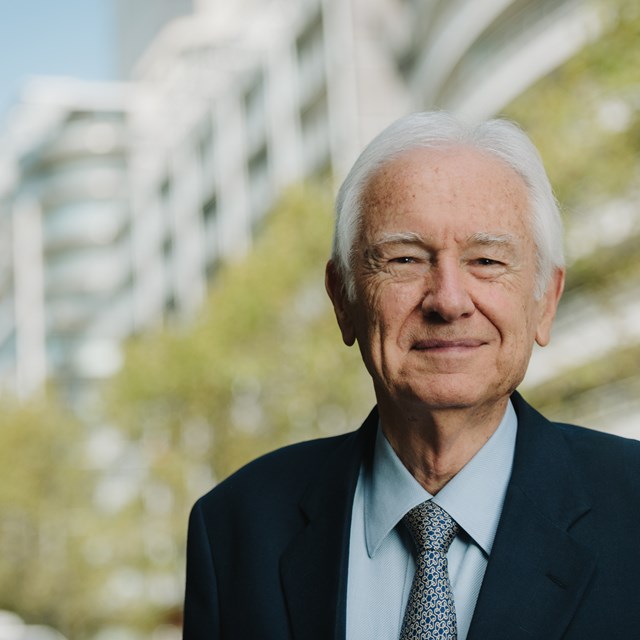
ALLAN GRAY
Founded Allan Gray Limited in 1974, building Africa's largest independent asset manager through contrarian value investing.
He returned to Cape Town in the early 1970s with a Harvard MBA and a conviction that markets were consistently wrong. In 1974, he founded Allan Gray Limited with a handful of clients and a philosophy borrowed from Benjamin Graham. By the time he died in June 2019, the firm managed over R600 billion — roughly $38 billion — making it the largest independent asset manager in Africa. He pledged his entire stake to charity. The compounding kept going after he was gone.
Net Worth
$1.5 billion (est.)
Nationality
South African
Time Horizon
Long-Term
Risk Appetite
3 / 10
Net Worth Context
- · Still a billionaire — just the quiet kind at the end of the table.
CAREER & BACKGROUND
Allan Gray was born in 1941 in Cape Town. He studied at Oxford University before completing his MBA at Harvard Business School in the late 1960s.
He spent a few years in the United States working in finance, then returned to South Africa with a conviction that value investing could work just as well in Cape Town as in New York. In 1974, he founded Allan Gray Limited with a small team and a clear mandate: buy things below their intrinsic value and wait.
At the time, South Africa barely had an investment industry worth speaking of. Over the next four decades, Gray built the firm into the dominant force in South African asset management.
He was famously private — he rarely spoke to the press and communicated with investors almost exclusively through carefully written fund commentary. In 2005, he established the Allan Gray Orbis Foundation to identify and support entrepreneurial young Africans through scholarships and mentorship.
When he died in June 2019, his controlling stake in Allan Gray Limited passed to the Foundation, meaning the business he spent 45 years building would permanently fund those programs in perpetuity. He never took a public exit.
He just compounded.
COMPANIES & ROLES
Allan Gray Limited — founded in Cape Town in 1974, the main firm. It manages unit trusts, retirement funds, and individual portfolios for South African investors.
Its flagship Allan Gray Balanced Fund has been one of the top long-term performers in its category for decades. Orbis Investment Management — co-founded in Bermuda in 1989 to bring the same philosophy to international markets.
Orbis now manages global equities and is one of the largest international asset managers accessible to South African investors. The Allan Gray Orbis Foundation — established in 2005 with the mission of backing entrepreneurial young Africans.
By the time of Gray's death, it had more than 2,000 scholars. The Foundation is now funded by investment returns from Allan Gray Limited itself, which is the clean thing about how he structured it.
INVESTING STYLE & PHILOSOPHY
Gray was a contrarian value investor. He bought things when they were cheap and unloved, and sold when they got expensive and popular.
Simple idea. Brutally hard to execute.
He talked about 'variant perception' — the concept that outsized returns only come when your view on a stock differs from the market's view, and you turn out to be right. He wasn't a trader.
He wasn't a momentum chaser. He was the kind of investor who'd hold an ugly position for three years while the press wrote it off.
The Allan Gray Balanced Fund regularly went through stretches of significant underperformance versus peers — which most managers would find career-ending. Gray treated those periods as the cost of the approach.
THE PLAYBOOK
Risk Approach
For Gray, volatility was not risk. Permanent loss of capital was risk.
He drew that distinction clearly and repeatedly. He was comfortable watching his portfolios look terrible on paper for extended periods, because it usually meant he was buying things at attractive prices while others sold.
He believed a fund that closely tracks a benchmark is not low-risk — it is just risk that's invisible until it isn't. The Balanced Fund had multi-year stretches of relative underperformance and he held firm.
That patience was the product.
Money Habits
Gray was private about his personal life, so details are limited. What is known: he was not a conspicuous consumer.
He built a substantial fortune and gave almost all of it away. His controlling stake in Allan Gray Limited passed to the Foundation on his death, meaning the business he spent 45 years building would permanently fund scholarships for young Africans.
He took a modest salary from the firm. He avoided the press.
He communicated via investor letters. His money habits, in the end, were inseparable from his values.
BIGGEST WIN
The biggest win is not a single trade — it is the compounding. The Allan Gray Balanced Fund, launched in October 1999, compounded at roughly 14-15% per year over more than 20 years.
R1 million invested at inception would be worth many multiples today. That kind of long-run performance is rarer than it sounds, because it requires not just skill but the discipline to hold an approach through years when it looks wrong.
The 2012-2017 period, when the fund lagged growth-oriented peers, tested that discipline publicly. Gray held the line and the long-term record vindicated him.
BIGGEST MISTAKE
The commodity supercycle of the 2000s was a painful stretch for the Allan Gray stable. The firm stayed underweight on resource stocks even as mining and energy shares dominated JSE performance for nearly a decade.
For clients benchmarking against peers, the relative underperformance was significant and some left. Gray believed resource stocks were priced for perfection and didn't offer adequate margin of safety.
He was eventually vindicated when the cycle turned. But the short-term cost in client redemptions and reputational pressure was real — and it tested whether investors actually believed in the approach or just believed in recent returns.
FINANCIAL PHILOSOPHY
Gray believed markets are not perfectly efficient — that prices diverge meaningfully from intrinsic value all the time, and that patient investors can exploit those gaps. He had no interest in predicting short-term price movements.
He was obsessed with one question: what is this business actually worth, and what am I paying for it? He thought most investors destroyed value by chasing recent performance — buying what had gone up and selling what had gone down.
He called that the return-chasing trap. His other core belief: compounding rewards patience above almost everything else.
He would say that the three-year return figure is almost meaningless. Think in decades.
FAMILY & PERSONAL LIFE
Gray was married and had children. He was private about family life almost to a fault — almost no personal details appear in public record.
He and his wife were deeply involved in the philanthropic work of the Allan Gray Orbis Foundation, which they co-built over many years. His legacy is defined less by personal wealth than by the institution he created and the fact that he structured it to outlive him.
EDUCATION
Oxford University for his undergraduate degree, then Harvard Business School for his MBA. He graduated from Harvard in the late 1960s.
Both institutions gave him analytical rigor and global perspective that he brought back to South Africa at a time when the country's investment industry was still in its earliest stages.
BOOKS & RESOURCES
Gray didnt write a book, but his investor letters are among the best long-form investment writing to come out of Africa
They're published on the Allan Gray website and are worth reading in sequence — they show how a contrarian thinks in real time about real markets
Was the foundational text for everything Gray built. His approach was essentially Graham's discipline applied to the South African context
The more technical companion. Both books shaped his thinking on intrinsic value and margin of safety in ways that show up directly in how the firm runs money to this day
As an Amazon Associate, Netfigo earns from qualifying purchases. Book links above may be affiliate links.
QUOTES (5)
Buying shares when they are out of favour and selling them when they become popular is simple to describe but requires discipline and patience to practise.
The only way to achieve returns meaningfully different from the market is to make investments meaningfully different from the market.
We do not view volatility as risk. Risk is the probability of a permanent loss of capital.
Short-term underperformance is the price we pay for the prospect of long-term outperformance. We accept it willingly.
The investor who chases recent performance is almost always buying at the wrong time and selling at the wrong time.
NETFIGO SCORE
Proprietary 5-dimension investor rating
Risk Appetite
Contrarian Index
Track Record
Accessibility
Time Horizon
Related Profiles
Investors
Koos Bekker
South Africa's two most celebrated investors of their generation, operating in different sectors but sharing an extraordinary track record of long-term wealth creation.
Warren Buffett
Both disciples of Benjamin Graham's value investing framework. Gray built Africa's equivalent of what Buffett built in America — a long-term compounding machine driven by patience and contrarian conviction.
Head-to-Head
Compare Allan Gray vs another investor.