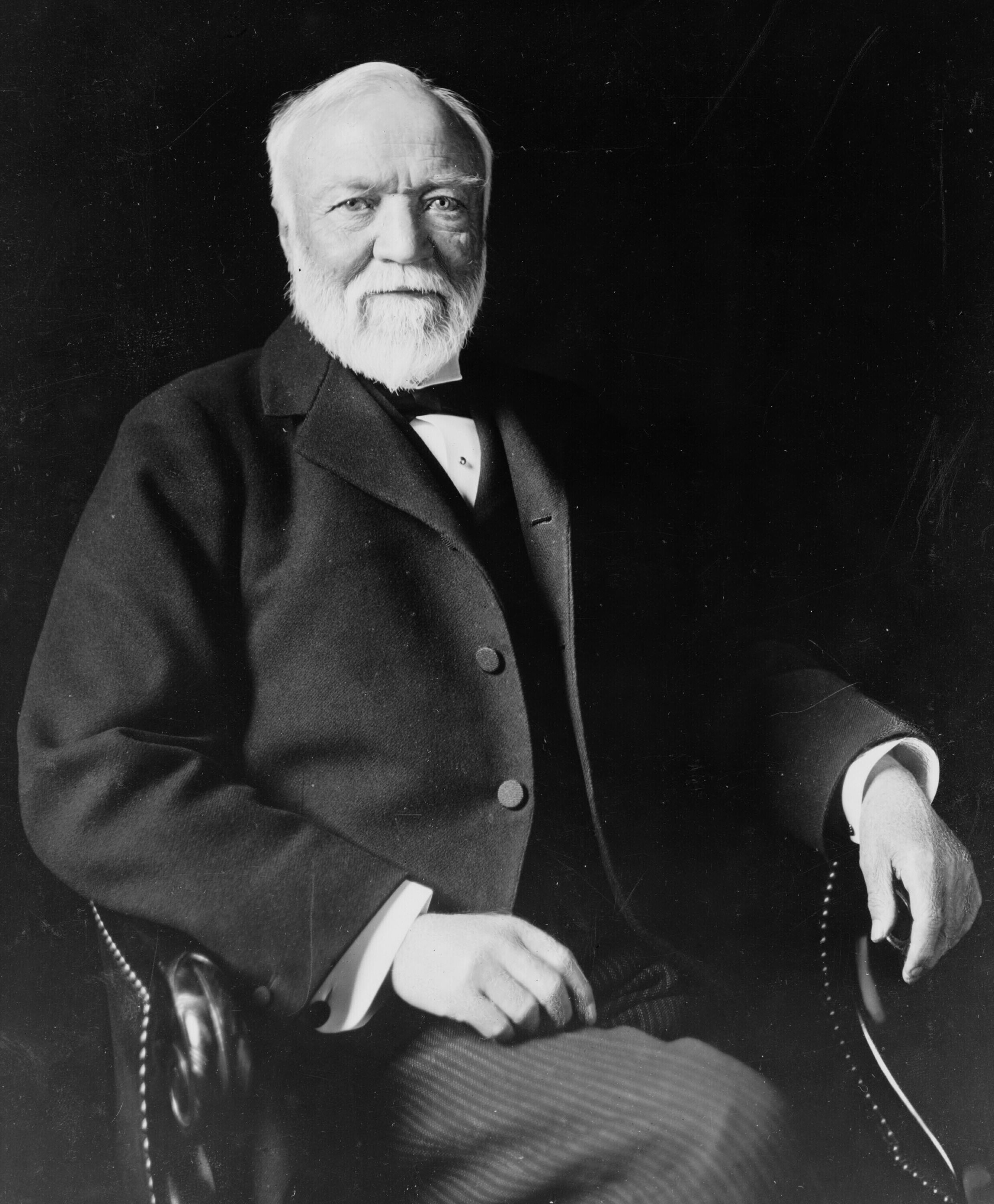
ANDREW CARNEGIE
Building the largest steel company in the world from immigrant poverty — and giving away virtually every dollar before he died
Andrew Carnegie emigrated from Scotland at 12 with nothing, started work at 13 for $1.20 a week, built the world's largest steel company, and sold it for $480 million in 1901. He then spent 18 years giving almost every dollar away. He built 2,500 libraries because books changed his life. He is the original proof that immigrant ambition, vertical integration, and counter-cyclical investing can produce the greatest fortune in human history — and that what you do with the money after is the more important question.
Net Worth
$380B (inflation-adjusted)
Nationality
Scottish-American
Time Horizon
Generational
Risk Appetite
8 / 10
Net Worth Context
- · Could buy every NFL team simultaneously and still have $220B left.
- · Earns roughly $36,149 per minute — assuming 5% annual return.
CAREER & BACKGROUND
Andrew Carnegie emigrated from Dunfermline, Scotland to Pennsylvania at age 12 with his family, who were destitute. He started work at age 13 as a bobbin boy in a cotton factory for $1.20 per week.
He taught himself to become a telegraph operator, was noticed by Thomas Scott of the Pennsylvania Railroad, and rose through management by pure intelligence and ambition. He invested strategically in oil, iron, and railways throughout the Civil War era.
In 1873 he focused entirely on steel, building Carnegie Steel into the world's largest steel company. He sold it to J.P.
Morgan in 1901 for $480 million — approximately $16 billion in today's dollars — the largest private business sale in US history at the time. He then spent the remaining 18 years of his life giving away virtually everything — founding 2,500+ libraries worldwide, Carnegie Hall, Carnegie Mellon University, and the Carnegie Endowment for International Peace.
COMPANIES & ROLES
Carnegie Steel Company — Founder (sold to J.P. Morgan for $480M in 1901, became US Steel).
Carnegie Hall — Funded. Carnegie Mellon University — Founded.
Carnegie Libraries — 2,500+ worldwide. Carnegie Endowment for International Peace — Founded
INVESTING STYLE & PHILOSOPHY
Vertical integration, strategic positioning, and patience. Carnegie built his steel empire by controlling raw materials, transportation, and processing simultaneously.
He invested counter-cyclically — buying companies and assets during panics when prices were lowest. His mantra was to put all your eggs in one basket, watch that basket, and dominate it.
THE PLAYBOOK
Risk Approach
8
Money Habits
Lived modestly until his late career, then lavishly (Skibo Castle in Scotland). Gave away $350 million (approximately $13 billion today) before his death in 1919.
Wrote extensively on wealth and philanthropy — "The Gospel of Wealth" argued that the rich have a moral obligation to give away their fortunes.
BIGGEST WIN
Selling Carnegie Steel to J.P. Morgan for $480 million in 1901.
Morgan had tried to buy Carnegie out before at lower prices. Carnegie waited until Morgan needed the business to create US Steel and extracted maximum value.
Patience in exit is as important as entry.
BIGGEST MISTAKE
He drove workers and managers brutally hard. The Homestead Strike of 1892 — where Carnegie Steel's management brought in Pinkerton agents against striking workers — resulted in deaths and permanently damaged his reputation.
He was in Scotland while it happened, which added cowardice to the charge of exploitation.
FINANCIAL PHILOSOPHY
Put all your eggs in one basket and watch that basket. Diversification is a protection against ignorance — if you know what you are doing, concentration is more profitable.
Give when you have it. Do not wait for death to decide.
FAMILY & PERSONAL LIFE
Married to Louise Whitfield Carnegie. One daughter, Margaret.
EDUCATION
Largely self-educated. Left school at 13.
Self-taught in business, reading, and eventually philosophy.
BOOKS & RESOURCES
As an Amazon Associate, Netfigo earns from qualifying purchases. Book links above may be affiliate links.
QUOTES (5)
No man will make a great leader who wants to do it all himself, or to get all the credit for doing it.
Concentrate your energies, your thoughts and your capital. The wise man puts all his eggs in one basket and watches the basket.
The first man gets the oyster, the second man gets the shell.
NETFIGO SCORE
Proprietary 5-dimension investor rating
Risk Appetite
Contrarian Index
Track Record
Accessibility
Time Horizon
Related Profiles
Head-to-Head
Compare Andrew Carnegie vs another investor.