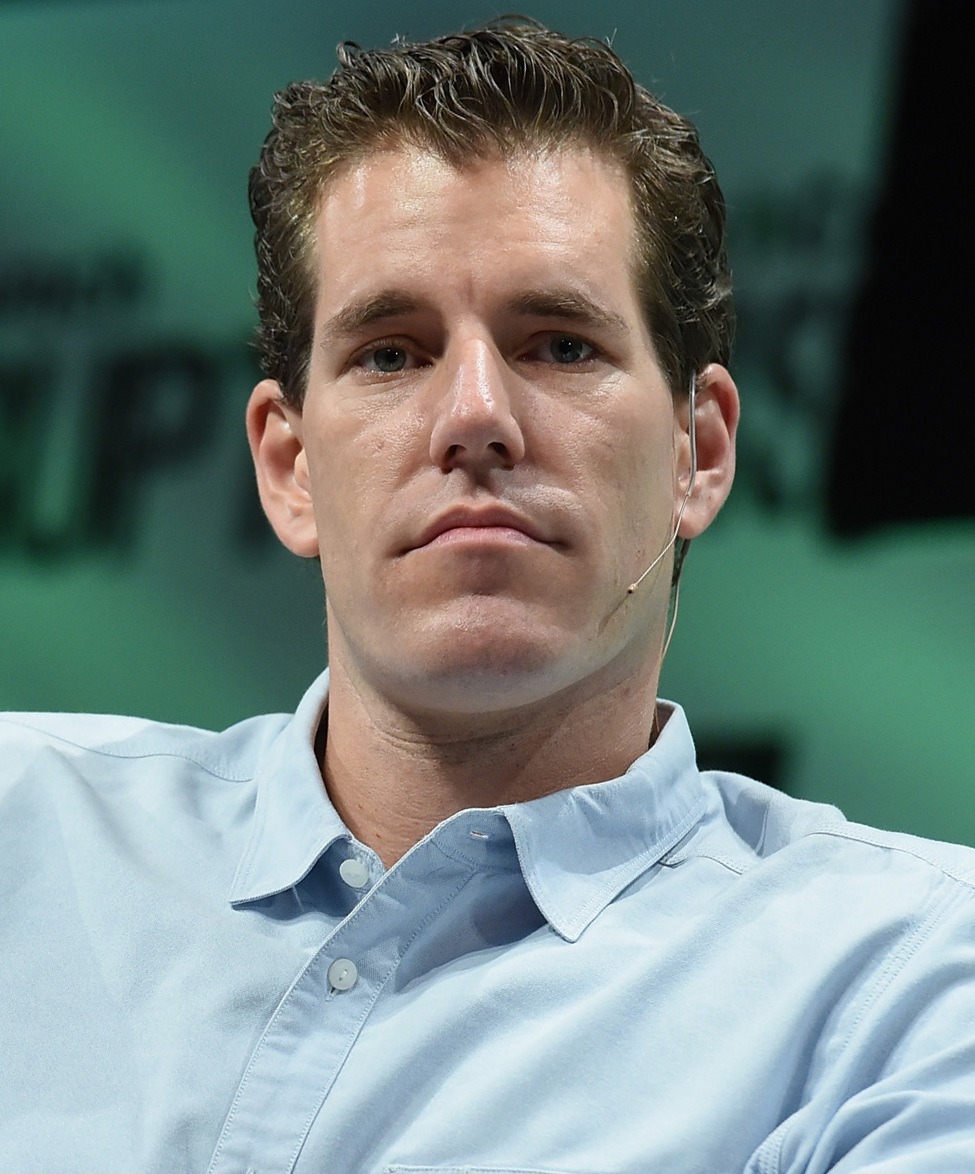
CAMERON WINKLEVOSS
The Harvard rower who sued Mark Zuckerberg, took the $65 million settlement, and turned it into a crypto empire worth billions.
Most people would have spent the Facebook settlement money on boats and therapy. Cameron Winklevoss bought Bitcoin — about 1% of all Bitcoin that will ever exist — at an average price of around $120 a coin. He and his twin Tyler cofounded Gemini, one of the few regulated crypto exchanges in the United States, and have been loudly right about Bitcoin for over a decade while everyone else was loudly wrong. The guy who lost the most famous lawsuit in Silicon Valley history arguably ended up ahead.
Net Worth
$3 billion
Nationality
American
Time Horizon
Generational
Risk Appetite
8 / 10
Net Worth Context
- · Still a billionaire — just the quiet kind at the end of the table.
CAREER & BACKGROUND
Cameron Winklevoss is one half of the most famous twin act in technology history. The story everyone knows starts at Harvard, where he and his brother Tyler were on the crew team, built a social network called HarvardConnection, and brought in a programmer named Mark Zuckerberg to help finish it.
What happened next became the subject of a book, a movie, and a $65 million settlement. The Winklevoss twins claimed Zuckerberg stole their idea.
Facebook became worth hundreds of billions. They got a check.
But here's where the story gets interesting. Cameron and Tyler didn't cash out and move to the Hamptons.
They trained for the 2008 Beijing Olympics — actually made it there, finishing sixth in the men's pair rowing event. Not a consolation prize.
A genuinely elite athletic achievement most people don't know about.
The legal battle with Facebook dragged on until 2011, when they finally settled for approximately $65 million in cash and Facebook stock. They immediately started looking for what to do next.
In 2012, they discovered Bitcoin at a party in Ibiza — reportedly through entrepreneur David Azar — when one Bitcoin cost less than $10. They started buying aggressively, eventually accumulating around 100,000 Bitcoin, which at Bitcoin's peak represented about $6 billion in value.
In 2014, they launched the Winklevoss Bitcoin Trust, an attempt to create the first Bitcoin ETF. The SEC rejected it three times before finally approving a spot Bitcoin ETF structure from other providers in January 2024, over a decade later.
Not exactly a fast regulator.
That same year, 2014, they founded Gemini — a federally regulated cryptocurrency exchange headquartered in New York. The thesis was simple: crypto needed a trustworthy, compliant exchange that institutions would actually use.
They pushed hard for regulation when the rest of the industry was running from it. Gemini launched in 2015, survived multiple crypto winters, and became one of the more credible names in an industry not exactly famous for credibility.
The FTX collapse in 2022 hit Gemini hard. The exchange had a yield product called Gemini Earn in partnership with Genesis Capital.
When Genesis froze withdrawals, roughly $900 million in Gemini Earn customer funds got locked up. Cameron became very publicly vocal about Genesis and its parent company Digital Currency Group, accusing DCG CEO Barry Silbert of bad faith in negotiations.
The dispute got messy and very public. Genesis eventually filed for bankruptcy in January 2023.
Gemini reached a settlement in 2024 to return funds to Earn customers, which Cameron framed as a win — though the episode was a bruising reminder that even the compliance-focused exchanges in crypto can get caught in contagion.
COMPANIES & ROLES
Gemini is the centerpiece. It's a cryptocurrency exchange — meaning you go there to buy, sell, and hold Bitcoin, Ethereum, and other cryptocurrencies.
The differentiator Cameron and Tyler built around was regulatory compliance. Most crypto exchanges in 2014 were operating in a gray area or actively avoiding regulators.
Gemini got a New York trust company charter, became subject to state banking regulation, and pitched itself to institutions as the safe choice. Whether that strategy paid off depends on your definition of paid off — Gemini was reportedly valued at $7.1 billion in 2021, but the crypto winter and the Earn debacle knocked it around considerably.
The Winklevoss Bitcoin Trust (now called the Winklevoss Bitcoin Trust) was their attempt to create a Bitcoin ETF — essentially a fund that would trade on a stock exchange and track the price of Bitcoin, letting ordinary investors get exposure without actually holding crypto. The SEC said no repeatedly, citing concerns about market manipulation and custody.
It took the broader industry until January 2024 to finally get a spot Bitcoin ETF approved — and by then, BlackRock and Fidelity were first in line. Cameron and Tyler were right about the product, a decade early, and got scooped by traditional finance in the end.
Winklevoss Capital is their family investment office, through which they back early-stage startups. Portfolio companies have included Hyperledger, BitInstant, and various other crypto and tech bets.
Cameron also holds a significant personal Bitcoin position that functions as its own investment thesis — the bet that Bitcoin becomes a global store of value.
Gemini Earn was the yield product that burned them. The idea was to let customers earn interest on their crypto by lending it out through institutional partners like Genesis Capital.
When the crypto market collapsed in 2022 and Genesis's parent DCG ran into trouble, those customer funds got frozen. It was exactly the kind of counterparty risk that the compliance-first positioning of Gemini was supposed to avoid.
The fallout cost Cameron months of public fighting, legal battles, and reputational damage.
INVESTING STYLE & PHILOSOPHY
Cameron Winklevoss is a concentration investor who makes high-conviction bets and holds for a very long time. He doesn't diversify much.
He found one thing he believed in — Bitcoin — and bought as much of it as he could afford. Then he built a business around it.
Then he fought regulators for a decade to legitimize it. That's not a portfolio strategy, that's an ideology with an investment attached.
The mental model he operates from is closer to venture capital than traditional investing. He looks for asymmetric opportunities — situations where the downside is losing what you put in, but the upside is potentially enormous.
Bitcoin in 2012 at $10 a coin fits that profile exactly. The worst case was losing everything.
The best case was exactly what happened.
He's also a macro thinker in the mold of investors like Raoul Pal or Michael Saylor. He believes fiat currencies are structurally broken, that central banks will keep printing money, and that Bitcoin is the escape hatch — a fixed-supply asset that governments can't inflate away.
He's written about Bitcoin as 'gold 2.0' and the thesis hasn't changed much since 2012. When something sells off 70%, he doesn't panic.
He's been through multiple cycles where Bitcoin fell 80% or more and came back.
The Gemini bet was an extension of the same logic: if Bitcoin is going to matter long-term, the infrastructure needs to be regulated and trustworthy. So build the infrastructure.
That's a longer, harder, more expensive bet than just holding Bitcoin, but it reflects his belief that this isn't a trade — it's a generational technology shift.
He also runs Winklevoss Capital as a more traditional early-stage fund, but crypto and Bitcoin are clearly where his conviction lives. He's not spreading across sectors trying to diversify.
He picked his hill and is standing on it.
THE PLAYBOOK
Risk Approach
Cameron Winklevoss has a genuinely high risk tolerance, but it's not reckless — it's the product of a specific worldview. He took a $65 million settlement and put a chunk of it into an asset that most serious people in finance considered either a scam or a curiosity.
He was comfortable with the possibility of losing most of it. He's described Bitcoin as 'the most rational bet he's ever made' — which tells you something about how he thinks about risk.
His risk framework is essentially: what's the worst that can happen, and can I survive it? With Bitcoin, the worst case in 2012 was that he lost his investment.
He could survive that. The expected value of the upside was so large relative to the downside that the math made sense even if the probability of success seemed low.
That's how he justifies concentration rather than diversification.
The Gemini Earn episode tested his risk tolerance in a different way — not market risk, but counterparty risk. Lending customer funds to Genesis through a business partnership exposed Gemini to another company's problems, which is a very different kind of risk than holding Bitcoin directly.
Cameron's response was to come out swinging publicly — calling out Barry Silbert and DCG by name, publishing open letters, using social media as a pressure campaign. Whether that was smart strategy or wounded pride is debatable, but it reflects someone who would rather fight loudly than absorb a loss quietly.
He's also gone on record saying he doesn't lose sleep over Bitcoin's volatility. When Bitcoin fell from $69,000 to $16,000 between 2021 and 2022, he didn't sell.
That's either discipline or stubbornness, and at this point the two are pretty much indistinguishable.
Money Habits
Cameron Winklevoss keeps a low profile for someone sitting on a multi-billion dollar Bitcoin position. He doesn't show up on lists of exotic car collectors or Manhattan penthouse buyers.
He's been known to live and work out of New York and Miami, which fits the broader crypto industry's Florida migration post-COVID.
He and Tyler were famously early adopters of Bitcoin as a payment method, trying to use it in daily life when almost nowhere accepted it. They once reportedly took a Virgin Galactic space flight deposit in Bitcoin — Richard Branson's company accepted it in 2013, one of the first major companies to do so.
He's clearly not spending aggressively on personal consumption given how much he's channeled back into Gemini and the Bitcoin thesis. Building and operating a regulated crypto exchange is not cheap — compliance, legal, banking relationships, security infrastructure all cost real money.
The business has consumed significant capital, which suggests Cameron treats his wealth more like a tool than a reward.
He and Tyler are known to work extremely closely together — co-CEOs of Gemini, joint Bitcoin holders, joint investors. They share a business philosophy and apparently a tolerance for long-drawn-out fights with regulators and adversaries.
The operational cost of that approach — years of legal battles with Facebook, years of SEC rejections, months of public conflict with DCG — is real, even if you're a billionaire.
He was an elite-level athlete before becoming a billionaire, and by all accounts maintains an intense physical discipline. The Olympic training mindset — years of work for one shot at a result — maps pretty clearly onto how he approaches business.
BIGGEST WIN
The Bitcoin position is the win. In 2012 and 2013, Cameron and Tyler accumulated approximately 100,000 Bitcoin at an average reported price of around $120 per coin.
Total investment: roughly $11 million. At Bitcoin's all-time high of approximately $69,000 in November 2021, that position was worth nearly $6.9 billion.
Which is an insane return on a $11 million bet made partly at a party in Ibiza.
The context makes it better. This was money from the Facebook settlement — money they got for a lawsuit about a social network that became one of the most valuable companies in history.
Most people would have looked at that as a moral victory turned into a financial consolation prize. Cameron and Tyler looked at it as starting capital.
They then took that starting capital and put a significant chunk into something that most investors, most technologists, and most regulators thought was either a joke or a threat.
The win isn't just the return. It's the conviction.
They held through Bitcoin going from $1,000 to $200 in 2014. They held through $20,000 to $3,000 in 2018.
They held through everything. At multiple points the position was down 80% or more and they didn't sell.
That kind of holding discipline is extremely rare and almost never talked about as the skill it actually is.
BIGGEST MISTAKE
Gemini Earn is the mistake that cost Cameron the most — both financially and reputationally. The product launched in 2021, promising users returns of up to 8% on their cryptocurrency by lending it to institutional borrowers through Genesis Capital, a subsidiary of Digital Currency Group.
It looked reasonable in the context of 2021's crypto bull market. Genesis was a major institutional lender.
DCG was a well-funded crypto conglomerate. The returns were attractive.
Gemini Earn attracted approximately $900 million in customer deposits.
Then the crypto market crashed in 2022. Genesis had massive exposure to Three Arrows Capital, a hedge fund that blew up spectacularly.
Genesis froze withdrawals in November 2022. Those $900 million in Gemini Earn customer funds were locked.
Gemini customers couldn't access their money for over a year.
The mistake wasn't just trusting Genesis — it was the structural design of the product. Gemini's entire brand was built on regulatory compliance and trustworthiness.
Earn introduced counterparty risk that sat outside Gemini's direct control. When the counterparty failed, Gemini took the reputational hit even though the direct fault was with Genesis and DCG.
Cameron's response — a very public, very aggressive campaign against Barry Silbert and DCG — arguably made things worse for the Gemini brand in the short term, even if it contributed to eventually recovering customer funds. Gemini reached a settlement in 2024 agreeing to return approximately $1.1 billion to Earn customers.
The customers got most of their money back. But the cost in trust, legal fees, and management distraction was enormous.
For the exchange that positioned itself as the responsible adult in crypto, it was an expensive lesson in counterparty risk.
FINANCIAL PHILOSOPHY
Cameron's financial philosophy starts with a macro premise: fiat money is broken. Central banks can print unlimited dollars.
Governments have every incentive to inflate their way out of debt. The purchasing power of cash erodes over time.
He doesn't think this is a temporary problem — he thinks it's structural and inevitable.
From that starting point, his philosophy is essentially: hold hard assets. Bitcoin, in his view, is the hardest asset in existence.
It has a fixed supply of 21 million coins. No government can create more.
No central bank can debase it. It's portable, divisible, and verifiable.
He calls it 'gold 2.0' not as a metaphor but as a literal technological upgrade — Bitcoin does everything gold does as a store of value but does it better.
He also believes strongly in building legitimate infrastructure. His bet with Gemini was that regulation isn't the enemy of crypto — it's what makes mass adoption possible.
Institutions need compliance. Pension funds and banks can't invest in things that might get shut down by the government.
So Gemini became the most regulated exchange in the industry as a strategic choice, not a concession. Whether that positioning wins long-term is still being decided.
On personal finance, Cameron is not the guy telling people to invest in index funds and max their 401k. His message is closer to: the traditional financial system is slowly failing you, Bitcoin is the hedge, and the earlier you understand that the better.
It's a conviction bet, not a balanced approach. He makes that clear and doesn't apologize for it.
He also has a streak of stubbornness that functions as philosophy. He fought Facebook for years in court when most people would have given up.
He fought the SEC for a decade over the Bitcoin ETF. He fought DCG publicly when most exchanges in his position would have tried to handle it quietly.
His philosophy, in a sentence, seems to be: if you believe you're right, keep going.
FAMILY & PERSONAL LIFE
Cameron is the twin brother of Tyler Winklevoss — they were born on August 21, 1981, in Southampton, New York. Their father Howard Winklevoss is an actuary and businessman.
They grew up in Greenwich, Connecticut, an upbringing that comes with certain advantages and certain expectations.
Cameron and Tyler are not just brothers — they're business partners at an unusual level. Co-CEOs of Gemini, joint Bitcoin holders, joint investors, joint litigants in the Facebook case.
They reportedly finish each other's sentences and have been known to coordinate their public messaging so tightly that they function almost as a single entity. Which is either an operational superpower or the world's longest-running twin study.
Cameron married Olivia Jenkins, an artist and activist, and has kept his personal life largely out of the public eye, which is notable for someone who is a pretty willing public figure on crypto Twitter and in media appearances. The Olympic story — sixth place in rowing at Beijing 2008 — is often used to humanize them, and it should be.
Getting to the Olympics in any event is a genuinely extraordinary achievement that most people in finance would never attempt.
EDUCATION
Cameron attended Greenwich Country Day School and Brunswick School in Connecticut before heading to Harvard, where he graduated in 2004 with a degree in economics. At Harvard he was a member of the Porcellian Club — the oldest and most exclusive of Harvard's final clubs — and rowed crew at a competitive level.
He later got an MBA from Oxford's Saïd Business School, which is where he and Tyler spent time after the Facebook dispute heated up. The Harvard connection is obviously what everything else pivots on — that's where HarvardConnection was built, where Zuckerberg entered the picture, and where the lawsuit that changed their financial trajectory began.
BOOKS & RESOURCES
Wrote about them, not by them. Their actual written output has mostly been blog posts, open letters, and op-eds arguing for Bitcoin adoption and better crypto regulation. Cameron's open letters to Barry Silbert during the Genesis dispute became required reading in the crypto industry in late 2022 for anyone trying to understand what was happening
The foundational text for Bitcoin maximalists, which argues that Bitcoin is the hardest money ever created and will eventually replace fiat currency
The narrative history of Bitcoin's early years, which is where a lot of his era of Bitcoin adoption is documented
Obviously essential context — it's the book about Cameron and Tyler's post-Facebook journey into crypto, written by the same author who wrote 'The Accidental Billionaires,' which became The Social Network. It's entertaining and reasonably accurate about the broad strokes, even if Mezrich's style leans cinematic. For anyone wanting to understand the Winklevoss arc, that's the starting point
As an Amazon Associate, Netfigo earns from qualifying purchases. Book links above may be affiliate links.
QUOTES (6)
Bitcoin is gold 2.0. It's a better store of value than gold in every way.
We've always felt like we had to earn the right to be taken seriously, and that's fine. We're patient.
If you don't believe it or don't get it, I don't have the time to try to convince you, sorry.
Regulation is not the enemy of innovation. It's actually required for mass adoption.
We've been through multiple cycles where Bitcoin lost 80% of its value. We didn't sell. That's the strategy.
The opportunity cost of not having Bitcoin in your portfolio is becoming greater every year.
NETFIGO SCORE
Proprietary 5-dimension investor rating
Risk Appetite
Contrarian Index
Track Record
Accessibility
Time Horizon
Related Profiles
Investors
Barry Silbert
Cameron's very public adversary during the Genesis Capital collapse and Gemini Earn crisis of 2022-2023
Changpeng Zhao
Rival crypto exchange founder — CZ built Binance while Cameron built Gemini, representing two very different philosophies on regulation and compliance
Michael Saylor
Fellow Bitcoin maximalist and major institutional BTC holder who shares Cameron's thesis that Bitcoin is the ultimate store of value
Head-to-Head
Compare Cameron Winklevoss vs another investor.