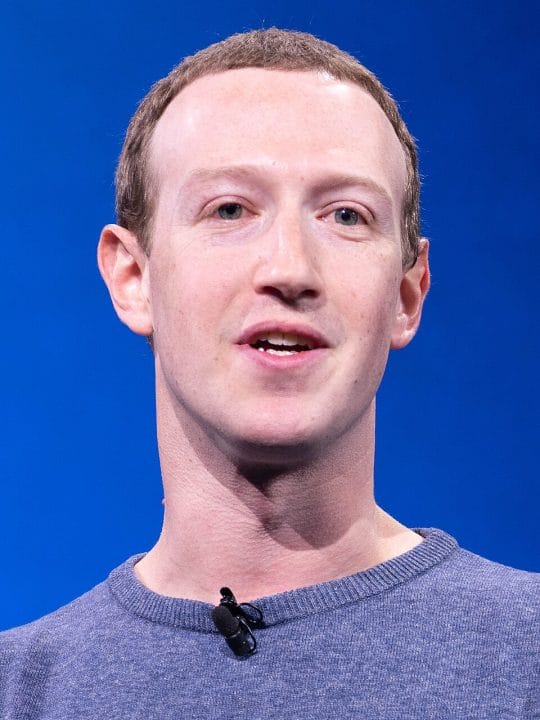
MARK ZUCKERBERG
Co-founder and CEO of Meta, creator of Facebook
Mark Zuckerberg built Facebook in a Harvard dorm room at 19, turned down a $1 billion acquisition offer from Yahoo at 22, and now runs a company with 3 billion daily active users and enough AI infrastructure to run a small country. He has also spent $50 billion on a metaverse that nobody asked for. The jury is still very much out on which of those decisions history will remember.
Net Worth
$222 Billion
Verified Aug 2026
Nationality
American
Time Horizon
Generational
Risk Appetite
8 / 10
Net Worth Context
- · Could buy every NFL team simultaneously and still have $62B left.
- · Earns roughly $21,119 per minute — assuming 5% annual return.
CAREER & BACKGROUND
Mark Zuckerberg launched Facebook from his Harvard dorm in February 2004. By the end of 2004, the site had 1 million users.
He turned down a $1 billion acquisition offer from Yahoo in 2006. By 2012, Facebook went public at a $104 billion valuation — the largest tech IPO in history at the time.
The stock immediately fell 50%. It then recovered to become one of the most valuable companies in the world.
In 2012, Facebook acquired Instagram for $1 billion (now worth over $100 billion). In 2014, it acquired WhatsApp for $19 billion.
In 2021, he rebranded the parent company to Meta to signal a pivot to the metaverse — a move that cost over $50 billion in investment and destroyed significant shareholder value before the company course-corrected toward AI.
COMPANIES & ROLES
Meta Platforms (CEO and controlling shareholder — holds majority voting control through supervoting shares). Key acquisitions: Instagram (2012, $1B), WhatsApp (2014, $19B), Oculus VR (2014, $2B).
Chan Zuckerberg Initiative (co-founded with wife Priscilla Chan — philanthropic LLC).
INVESTING STYLE & PHILOSOPHY
Zuckerberg does not invest in the traditional sense — he builds and holds. He controls Meta through a dual-class share structure that gives him roughly 61% of voting power with about 13% economic ownership, meaning no board or shareholder can remove him regardless of how the stock performs.
He has made massive bets inside Meta — on mobile (right), Instagram (very right), WhatsApp (right), VR/metaverse (wrong so far), and AI (still playing out). His investment thesis is that social connectivity is a fundamental human need and whoever owns the infrastructure owns everything.
THE PLAYBOOK
Risk Approach
Reality Labs, the VR and AR division, has run up more than $60 billion in operating losses since 2020, with little to show in revenue. He did not flinch.
He also bet Facebook's entire business model on going mobile in 2012, acquired Instagram for $1 billion when it had 13 employees and no revenue, and has held through Congressional hearings, advertiser boycotts, and multiple existential challenges from competitors. His personal financial risk is minimized by his dual-class share structure — he controls voting power regardless of what the stock does, so no board or activist investor can force his hand.
He can lose at scale for as long as he believes the thesis.
Money Habits
He wore the same grey t-shirt every day for years — he said it reduced decision fatigue. He trains MMA and Brazilian jiu-jitsu seriously, competing in actual tournaments.
He wakes up early, spends mornings with his family, and starts work at 8am. He has spoken about designing his schedule to protect creative work in the mornings.
He reportedly does not check email first thing.
BIGGEST WIN
Acquiring Instagram for $1 billion in 2012. Instagram was growing fast, potentially threatening Facebook's dominance with younger users.
Facebook bought it. It now generates an estimated $40-60 billion in annual revenue.
Many consider it the best acquisition in tech history on a return basis — $1 billion in for what became a $100B+ asset.
BIGGEST MISTAKE
The metaverse bet. From 2021 to 2023, Reality Labs — the VR and metaverse division — lost about $40 billion, and it has kept losing roughly $17 billion a year since, on minimal revenue.
The division lost $16 billion in 2023 alone. Meta's stock fell nearly 75% at its 2022 trough.
Zuckerberg was widely mocked, called the metaverse a disaster, and faced enormous internal and external pressure. He then pivoted hard to AI and the stock recovered.
The metaverse losses remain one of the most expensive executive vanity projects in corporate history.
FINANCIAL PHILOSOPHY
Zuckerberg thinks in decades, not quarters. His core belief is that the most important technology of the next century is whoever connects people at scale — first through social networks, then through AR/VR, and now through AI agents.
He is willing to absorb years of losses on bets he believes in. He says he would rather make a big bet and be wrong than be timid and miss the next platform shift.
FAMILY & PERSONAL LIFE
Married to Priscilla Chan since 2012, whom he met at Harvard. Three daughters: Maxima (Max), August, and Aurelia.
The Chan Zuckerberg Initiative, structured as an LLC (not a foundation), is committed to donating 99% of their Facebook shares over their lifetimes — estimated at over $100 billion. Priscilla is a pediatrician and runs the CZI education and science initiatives.
EDUCATION
Harvard University — studied computer science and psychology. Dropped out in 2004 to move Facebook to Palo Alto.
BOOKS & RESOURCES
He has cited Augustus Caesar as a historical figure he studies closely
As an Amazon Associate, Netfigo earns from qualifying purchases. Book links above may be affiliate links.
QUOTES (6)
Move fast and break things. Unless you are breaking stuff, you are not moving fast enough.
The biggest risk is not taking any risk. In a world that is changing quickly, the only strategy that is guaranteed to fail is not taking risks.
I started the site when I was 19. I did not know what I was doing. Most great things are started by people who do not know what they are doing.
People do not care about companies. They care about connecting with each other.
My goal was never to just create a company. A lot of people misinterpret that as if I do not care about revenue or profit or any of those things. But what not being just a company means to us is building something that actually makes a really big difference in the world.
I wear the same clothes every day so that I can focus on building the best products and services.
NETFIGO SCORE
Proprietary 5-dimension investor rating
Risk Appetite
Contrarian Index
Track Record
Accessibility
Time Horizon
Related Profiles
Investors
Bill Gates
Zuckerberg and Gates are the two defining examples of Harvard dropout founders who became defining tech billionaires — two generations apart, two completely different business models, same university departure story.
Bobby Murphy
offered $3B for Snapchat — Murphy and Spiegel declined
Elon Musk
Musk and Zuckerberg have one of the most publicly antagonistic rivalries in tech — they even scheduled a cage fight in 2023 that never happened. They are also building competing AI platforms.
Sam Altman
Zuckerberg and Altman are the two dominant figures in the public AI race — Meta's open-source Llama models compete directly with OpenAI's closed GPT models. Zuckerberg has been vocal that open-source AI wins.
Head-to-Head
Compare Mark Zuckerberg vs another investor.