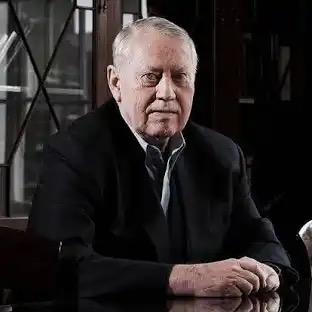
CHUCK FEENEY
Co-founded Duty Free Shoppers and secretly gave away his entire $8 billion fortune through Atlantic Philanthropies. The James Bond of philanthropy.
Chuck Feeney made $8 billion selling luxury goods in airports. Then he gave it all away. All of it. Secretly. For decades, nobody knew. He transferred his entire fortune to his foundation, Atlantic Philanthropies, in 1984 — and didn't tell anyone until a business dispute forced it public in 1997. By the time he was done, he had given away $8 billion to universities, hospitals, and human rights causes across the world. He now rents a small apartment, flies coach, wears a $15 watch, and has roughly $2 million left. Warren Buffett called him his hero. Bill Gates said Feeney was the inspiration for the Giving Pledge.
Net Worth
$2 Million
Nationality
American
Time Horizon
Generational
Risk Appetite
5 / 10
CAREER & BACKGROUND
Charles Francis Feeney was born in Elizabeth, New Jersey in 1931 to Irish-American parents. His father was an insurance underwriter and his mother was a nurse.
Feeney served in the Korean War and then attended Cornell University on the GI Bill. In 1960, he and Robert Miller co-founded Duty Free Shoppers Group (DFS), selling tax-free luxury goods to travelers in airports and shops across Asia and Europe.
The timing was perfect — international travel was exploding, Japanese tourists were buying luxury goods in enormous quantities, and DFS had exclusive licenses at key airports. By the 1980s, DFS was generating over $1 billion in annual revenue and Feeney was a billionaire.
In 1984, he secretly transferred his entire 38.75% stake in DFS to his foundation, Atlantic Philanthropies. For 13 years, nobody knew.
When the secret leaked in 1997 during a business dispute with co-founder Miller, the world discovered that one of its richest men had quietly given away his entire fortune. Atlantic Philanthropies went on to distribute $8 billion before closing in 2020.
COMPANIES & ROLES
Duty Free Shoppers Group (DFS) was the money machine — Feeney co-founded it in 1960 and it became the world's largest travel retailer. He also had interests in General Atlantic, a private equity firm he co-founded in 1980 that focused on technology and growth investing.
Atlantic Philanthropies was his giving vehicle — it funded Cornell University ($1 billion+), University of Limerick, Stanford, UC San Francisco, Salk Institute, and dozens of health, education, and human rights organizations globally. He was particularly focused on Ireland, where he funded universities, peace initiatives, and health infrastructure.
INVESTING STYLE & PHILOSOPHY
Feeney was a shrewd, patient investor in his DFS days. He understood retail monopolies — he locked up exclusive duty-free concessions at major airports for decades, creating a legal monopoly that generated enormous margins.
He invested his DFS profits into real estate and private equity through General Atlantic. But his real "investing" was philanthropic.
He treated giving the same way a great investor treats deciding where money goes — with rigor, research, and a demand for measurable outcomes. He funded things that had clear impact and pulled funding from things that didn't.
THE PLAYBOOK
Risk Approach
In business, Feeney was moderate on risk. DFS was a monopoly that generated reliable cash.
His private equity investments through General Atlantic were calculated growth bets. But in philanthropy, he was radically bold.
He gave away his entire fortune while alive — the most extreme form of "bet" imaginable. He could have endowed a foundation that would last forever.
Instead, he chose to spend it all down within his lifetime, believing that giving now was better than giving later. He called it "giving while living." He accepted the risk that some gifts wouldn't work out, as long as the aggregate impact was massive.
Money Habits
Feeney is legendary for his frugality. He rents a small apartment in San Francisco.
He flies coach. He doesn't own a car.
He wears a $15 Casio watch. He carries reading glasses held together with a safety pin.
He eats at diners. He has no yacht, no vacation home, no art collection.
He gave away $8 billion and kept $2 million. When asked why he doesn't keep more for himself, he said he has everything he needs.
He has lived this way for decades — this isn't a recent conversion.
BIGGEST WIN
Building DFS into a multi-billion-dollar monopoly. The exclusive airport duty-free concessions generated extraordinary margins for decades.
His personal fortune reached approximately $8 billion. But Feeney would say his biggest win was the giving: Atlantic Philanthropies funded the transformation of Irish higher education, contributed to the Northern Ireland peace process, helped build hospitals in Vietnam, and seeded the Affordable Care Act navigation system in the United States.
Cornell's technology campus on Roosevelt Island in New York — now Cornell Tech — received over $350 million from Feeney, its largest-ever donation.
BIGGEST MISTAKE
Feeney has said his only regret is not starting to give sooner. The business dispute with co-founder Robert Miller in the mid-1990s was painful and public, exposing the secret transfers and creating years of litigation.
Feeney has also acknowledged that some philanthropic investments didn't produce the hoped-for results, but he views those as acceptable costs of action. He once said, "I made a lot of mistakes.
But if you look at the broad picture, the money got used well."
FINANCIAL PHILOSOPHY
Feeney's philosophy is radical and simple: use your money while you're alive to do the most good possible, then die with almost nothing. He believes perpetual endowments are a cop-out — a way for rich people to put their names on buildings forever instead of solving problems now.
He believes money is a tool, not a trophy. He believes anonymity makes giving better because it removes the ego and keeps the focus on impact.
He once said, "I had one idea that never changed in my mind — that you should use your wealth to help people."
FAMILY & PERSONAL LIFE
Feeney has been married twice. His first wife, Danielle, and he had four daughters.
His second wife, Helga, and he had one daughter. He has lived in various places — France, London, Ireland, San Francisco — never putting down permanent roots in the way most billionaires do.
He is extremely private and has given very few interviews. His children have been supportive of his giving, though the decision to give away the entire fortune was not always easy on the family.
EDUCATION
Cornell University (B.S., Hotel Administration, 1956). He attended on the GI Bill after serving in the Korean War.
Cornell has been the single largest beneficiary of his philanthropy — he has given over $1 billion to the university, making him its largest donor in history.
BOOKS & RESOURCES
Giving Done Right by Phil Buchanan covers the kind of effective philanthropy Feeney pioneered.
As an Amazon Associate, Netfigo earns from qualifying purchases. Book links above may be affiliate links.
QUOTES (5)
I'm not the Rockefeller type. You can only wear one pair of shoes at a time.
Perpetual endowments are a cop-out. Give the money now, when it can do the most good.
I made a lot of mistakes. But if you look at the broad picture, the money got used well.
I had one idea that never changed in my mind — that you should use your wealth to help people.
I cannot think of a more personally rewarding and appropriate use of wealth than to give while you can.
NETFIGO SCORE
Proprietary 5-dimension investor rating
Risk Appetite
Contrarian Index
Track Record
Accessibility
Time Horizon
Related Profiles
Head-to-Head
Compare Chuck Feeney vs another investor.