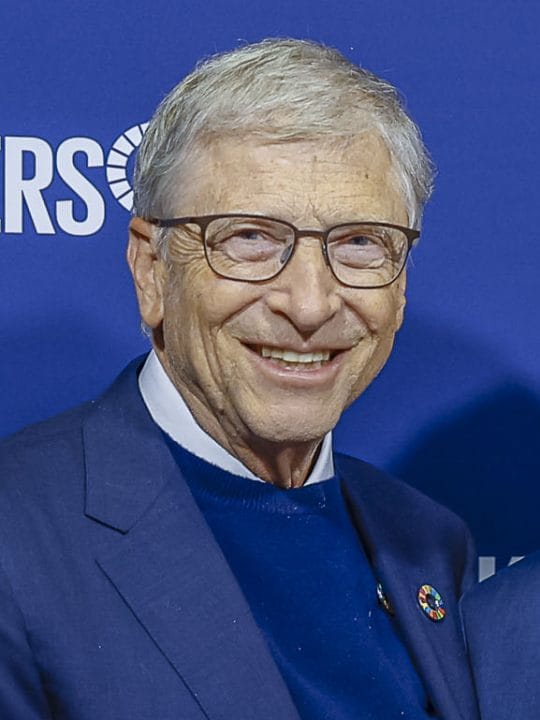
BILL GATES
Co-founder of Microsoft, co-chair of the Bill & Melinda Gates Foundation
Bill Gates built the most dominant software company in history by being intensely competitive — and that is an understatement from someone who once held a near-monopoly on personal computer operating systems. He has since given away more money than most countries have in their GDP and still keeps getting richer. The compounding is mildly unsettling.
Net Worth
$108 Billion
Verified Aug 2026
Nationality
American
Time Horizon
Generational
Risk Appetite
6 / 10
Fund
Gates Foundation Trust
Net Worth Context
- · Could buy every NFL team simultaneously and still have $-52B left.
- · Earns roughly $10,274 per minute — assuming 5% annual return.
CAREER & BACKGROUND
Bill Gates was born in Seattle in 1955. He taught himself to program on a PDP-10 at age 13.
He enrolled at Harvard in 1973, dropped out in 1975, and moved to Albuquerque with Paul Allen to found Microsoft. Their break came when they licensed an operating system to IBM for the original PC — and crucially, retained the rights to sell it to anyone else.
That decision made Microsoft. Windows became the standard operating system for the world.
Gates became the world's richest person in 1995 and held that title for much of the next 15 years. He transitioned out of Microsoft's day-to-day around 2000 and fully moved into philanthropy via the Gates Foundation.
COMPANIES & ROLES
Microsoft (co-founder, former CEO and chairman). Cascade Investment LLC (his personal investment vehicle).
Bill & Melinda Gates Foundation (co-chair). Major holdings through Cascade include Canadian National Railway, Deere & Company, and significant farmland.
Early Microsoft equity remains a massive portion of his net worth.
INVESTING STYLE & PHILOSOPHY
Gates invests through Cascade Investment LLC in established, cash-generative businesses — railroads, waste management, agricultural equipment, farmland. His biggest single Cascade holding for years was Canadian National Railway.
He has sold most of his Microsoft stock over time. His investment philosophy outside Microsoft mirrors Buffett's: durable businesses with pricing power, bought at reasonable prices.
THE PLAYBOOK
Risk Approach
Gates's risk tolerance is intellectual and deliberate rather than impulsive. He takes genuinely large bets — TerraPower on nuclear fission, billions into climate technology, the Gates Foundation's campaigns to eradicate diseases that kill millions — but only after intense research.
His Think Weeks exist to force slow, rigorous thinking on big decisions. At Microsoft, he kept enough cash on hand to run the company for a full year with zero revenue because he never wanted short-term survival pressure to force a bad long-term decision.
That discipline carries into his personal finances.
Money Habits
He wakes up early, exercises on a treadmill while watching documentaries, and reportedly does the dishes every night. He has said dishes are meditative.
For a man worth $108 billion, the emphasis on routine is either deeply grounded or very good PR. He drove himself to work at Microsoft for years and lived in a normal house long after he could afford otherwise.
BIGGEST WIN
Microsoft Windows. The decision to license MS-DOS to IBM for the PC while retaining the right to sell it to other manufacturers was arguably the most lucrative business decision in tech history.
Every PC manufacturer then licensed Windows. Gates captured the entire PC market without building the hardware.
By 1999, Microsoft's market cap hit $616 billion.
BIGGEST MISTAKE
Missing the internet. Microsoft was late and initially dismissive of the internet as a platform.
Gates eventually course-corrected and wrote the Internet Tidal Wave memo in 1995, redirecting the entire company toward internet strategy. But the delay allowed Netscape to establish footholds, and Microsoft's browser monopoly tactics led to the landmark antitrust case United States v.
Microsoft in 2000, which threatened to break up the company.
FINANCIAL PHILOSOPHY
His core framework: read obsessively, think long-term, and separate emotion from analysis. He takes annual Think Weeks — solo retreats to a lake cottage in the Pacific Northwest where he reads papers and books for two weeks with no interruptions.
He publishes a reading list twice a year at gatesnotes.com. He credits Warren Buffett, a friend since they were seated next to each other at a lunch in 1991, with teaching him to judge a business by how durable it is rather than how clever it is.
FAMILY & PERSONAL LIFE
Married to Melinda French Gates 1994-2021, divorced. Three children: Jennifer, Rory, Phoebe.
His father Bill Gates Sr. was a prominent lawyer and philanthropist who shaped his values around giving back.
Post-divorce he has maintained a private personal life.
EDUCATION
Harvard University — studied mathematics and computer science. Dropped out in 1975 after his sophomore year to found Microsoft.
BOOKS & RESOURCES
The Road Ahead (his own book)
Business at the Speed of Thought (his own book)
As an Amazon Associate, Netfigo earns from qualifying purchases. Book links above may be affiliate links.
QUOTES (6)
We all need people who will give us feedback. That is how we improve.
Software is a great combination of artistry and engineering.
Success is a lousy teacher. It seduces smart people into thinking they cannot lose.
It is fine to celebrate success but it is more important to heed the lessons of failure.
We always overestimate the change that will occur in the next two years and underestimate the change that will occur in the next ten.
LATEST KNOWN POSITIONS
BERKSHIRE HATHAWAY INC DEL
$9754.8B
19.4M shares
WASTE MGMT INC DEL
$6357.2B
28.9M shares
CANADIAN NATL RY CO
$5123.1B
51.8M shares
MICROSOFT CORP
$3719.6B
7.7M shares
CATERPILLAR INC
$3639.8B
6.4M shares
DEERE & CO
$1656.2B
3.6M shares
ECOLAB INC
$1369.8B
5.2M shares
WALMART INC
$934.8B
8.4M shares
FEDEX CORP
$688.7B
2.4M shares
COCA-COLA FEMSA SAB DE CV
$588.6B
6.2M shares
NETFIGO SCORE
Proprietary 5-dimension investor rating
Risk Appetite
Contrarian Index
Track Record
Accessibility
Time Horizon
Related Profiles
Investors
Elon Musk
Gates and Musk have a long-running public tension — Gates shorted Tesla, Musk found out and went public about it. Their disagreements on climate solutions and AI safety are also well-documented.
Jeff Bezos
Both Gates and Bezos represent the first generation of tech billionaires who pivoted from company-building to mega-philanthropy and long-term capital allocation — two different models of what post-CEO billionaire life looks like.
Melinda French Gates
former spouse and foundation co-chair
Paul Allen
Microsoft co-founders
Warren Buffett
Gates and Buffett are close friends — they met in 1991 and Gates credits Buffett with shaping his thinking on long-term investing and philanthropy. Their Giving Pledge was launched together.
Companies
Apeel Sciences
investor in
Beyond Meat
investor in
Commonwealth Fusion Systems
investor in
Form Energy
investor in
Ginkgo Bioworks
investor in
Impossible Foods
investor in
Inflection AI
investor in
Planet Labs
investor in
QuantumScape
investor in
Redwood Materials
investor in
Uber
Invested in Uber
Upside Foods
investor in
Head-to-Head
Compare Bill Gates vs another investor.