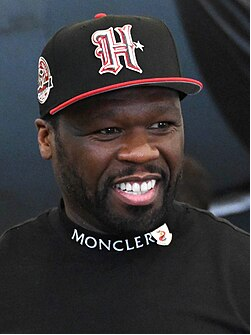
50 CENT
Rapper who survived being shot nine times, made $100 million from a Vitamin Water deal, filed for bankruptcy, and rebuilt his fortune through television production.
Curtis Jackson went from selling crack in Queens to selling Vitamin Water to Coca-Cola for $4.1 billion — pocketing roughly $100 million from his equity stake. Then he blew through most of it, filed for bankruptcy in 2015 owing $36 million, and rebuilt by becoming one of the most prolific producers in television with Power on Starz. The man has had more financial lives than a cat has actual lives.
Net Worth
$40 million
Nationality
American
Time Horizon
Medium-Term
Risk Appetite
9 / 10
CAREER & BACKGROUND
Born Curtis James Jackson III in 1975 in Jamaica, Queens, New York. Raised by his grandmother after his mother — a drug dealer — was murdered when he was eight.
Started dealing drugs at 12. Pivoted to rap in the late 1990s.
In 2000, he was shot nine times in front of his grandmother's house. He survived, spent months recovering, and used the experience to fuel his debut album Get Rich or Die Tryin' (2003), which sold 872,000 copies in its first week — making it the biggest debut in hip-hop that year.
The business genius was the Vitamin Water deal. In 2004, 50 Cent partnered with Glacéau to create Formula 50, a grape-flavored Vitamin Water variant.
Instead of a flat endorsement fee, he took an equity stake. When Coca-Cola bought Glacéau for $4.1 billion in 2007, 50 Cent reportedly made between $60-100 million.
Then came the fall. Lavish spending, bad investments, and a $17 million judgment in a lawsuit led him to file for Chapter 11 bankruptcy in 2015.
He listed debts of $36 million and assets of $20 million. But he bounced back through television — the Power franchise on Starz became a massive hit, and 50 Cent became one of the most in-demand producers in TV.
COMPANIES & ROLES
Founder of G-Unit Records. Creator and executive producer of the Power franchise (Starz).
CEO of G-Unit Film & Television. The Vitamin Water equity deal was the business masterstroke.
Has produced multiple TV series including Power, BMF, Power Book II: Ghost, and others. Real estate investor.
Previously owned a 52-room Connecticut mansion (bought from Mike Tyson for $4.1 million, sold for $2.9 million).
INVESTING STYLE & PHILOSOPHY
Opportunistic and brand-driven. 50 Cent is at his best when he takes equity instead of cash — the Vitamin Water deal is the perfect example.
He has learned through painful experience that spending money on flashy assets (mansions, cars, jewelry) destroys wealth, while owning a piece of growing businesses creates it.
THE PLAYBOOK
Risk Approach
Extremely high — in every direction. He took equity in a vitamin drink when he could have taken guaranteed cash.
He spent lavishly when he was rich. He filed for bankruptcy when he was broke.
He rebuilt from scratch in his 40s. 50 Cent's relationship with risk is not strategic — it is constitutional.
Money Habits
Went from flaunting stacks of cash on Instagram (some of which turned out to be prop money during his bankruptcy) to being relatively more disciplined. Still lives well but no longer in the 52-room Connecticut mansion.
Known for being extremely active on social media — his Instagram trolling is legendary and serves as free marketing for everything he produces.
BIGGEST WIN
The Vitamin Water equity deal. Taking a stake instead of a flat fee turned a simple endorsement into a $60-100 million payday when Coca-Cola acquired Glacéau for $4.1 billion in 2007.
It remains one of the smartest celebrity business deals ever made — right up there with Dr. Dre's Beats sale to Apple.
BIGGEST MISTAKE
The bankruptcy. By 2015, 50 Cent owed $36 million — $23 million to creditors and $17 million from a revenge-porn lawsuit judgment.
He had burned through the Vitamin Water money on a lavish lifestyle, bad investments, and legal battles. Filing for Chapter 11 was humbling for a man who literally named his debut album "Get Rich or Die Tryin'."
FINANCIAL PHILOSOPHY
Get the equity, not the check. After the Vitamin Water deal, 50 Cent has consistently pushed for ownership stakes rather than flat fees.
He took backend deals on Power and its spinoffs rather than selling the IP outright. He has said the lesson of his career is "own things, don't just work for people who do."
FAMILY & PERSONAL LIFE
Has one son, Marquise Jackson, from a previous relationship — the two have had a very public estrangement. Has another son, Sire Jackson, who has appeared in his social media and business ventures.
Not currently married. Was raised by his grandmother, Beulah Jackson, after his mother was killed.
EDUCATION
No college education. Left school to pursue drug dealing and then music.
Self-educated in business through experience — both the Vitamin Water triumph and the bankruptcy disaster.
BOOKS & RESOURCES
A collaboration with the author of The 48 Laws of Power about fearlessness. The Art of War by Sun Tzu — 50 Cent has cited it as a foundational text for his approach to competition
As an Amazon Associate, Netfigo earns from qualifying purchases. Book links above may be affiliate links.
QUOTES (5)
I went bankrupt owing $36 million. You know what I learned? Money comes back. Hustle doesn't expire.
Own things. Don't just work for people who do. That's the difference between being rich and being wealthy.
I took equity in Vitamin Water instead of a check. That one decision changed my life more than any album ever did.
I got shot nine times and survived. After that, a bad quarter doesn't really scare you.
NETFIGO SCORE
Proprietary 5-dimension investor rating
Risk Appetite
Contrarian Index
Track Record
Accessibility
Time Horizon
Related Profiles
Head-to-Head
Compare 50 Cent vs another investor.