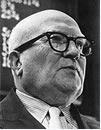
GERALD LOEB
Writing The Battle for Investment Survival (1935) and preaching that diversification is the refuge of the ignorant — concentrate, cut losses fast, and stop pretending you own 40 stocks you barely know.
He wrote the trading rulebook in 1935 that most active traders still copy today, whether they know it or not. Gerald Loeb believed diversification was a lie told to amateurs, and he said so bluntly in the middle of the Great Depression. His answer: own a few stocks cold, cut every loss the moment it moves against you, and let winners run. He spent five decades at E.F. Hutton proving the method survives bear markets, crashes, and everything else Wall Street throws at you.
Net Worth
Estimated $10 million
Nationality
American
Time Horizon
Swing
Risk Appetite
7 / 10
CAREER & BACKGROUND
Gerald Loeb was born in San Francisco in 1899 and walked into the brokerage world in the 1920s, joining what would become E.F. Hutton & Company.
He became a founding partner and stayed for five decades — an almost unheard-of loyalty in a business that burns people out. The Crash of 1929 hit him hard, as it did everyone, but it sharpened his thinking rather than ending his career.
By 1935, right in the depths of the Depression, he published The Battle for Investment Survival. Writing a trading book when markets were down 90% took nerve.
He spent the rest of his career both trading and writing, eventually moving to Beverly Hills where he ran the Hutton office that served Hollywood money. He died in New York in 1974, having outlived most of his contemporaries and remained relevant through every market cycle.
COMPANIES & ROLES
Loeb spent his entire career at E.F. Hutton & Company, one of the most prestigious brokerage names on Wall Street through the mid-20th century.
He wasn't running a hedge fund — he was a broker who traded alongside his clients and documented everything honestly. He eventually became a founding partner of the firm.
E.F. Hutton later collapsed in a check-kiting scandal in 1987, thirteen years after Loeb's death, so he never had to watch that particular ending.
He also ran the Beverly Hills office in his later years, catering to entertainment industry wealth and turning what could have been a sleepy outpost into a high-revenue operation.
INVESTING STYLE & PHILOSOPHY
Loeb was a momentum trader before the term existed. He bought stocks that were already moving up, not beaten-down names waiting for a recovery that might never come.
He was obsessively concentrated: own 3 to 5 positions you know deeply rather than 40 you barely track. He watched price action the way a doctor watches a patient's pulse — the tape tells you everything if you're willing to listen.
His famous line was that the greatest reward goes to the investor who puts all resources into one investment almost certain to pay off hugely. Which sounds obvious, until you try to do it.
THE PLAYBOOK
Risk Approach
Loeb's insight on risk was counterintuitive and remains underappreciated: diversification doesn't reduce risk, it spreads ignorance. He preferred knowing three stocks cold to owning thirty superficially.
His stop-loss discipline was absolute — if a stock moved against him by roughly 10%, he sold. No debates with himself, no waiting for the recovery, no averaging down.
He believed the market was always right and his opinion was always provisional. The moment the market disagreed with his position, he treated that as information, not as a temporary inconvenience to wait out.
Money Habits
Loeb was a well-compensated broker who lived comfortably without making his wealth obvious. He worked the Beverly Hills office of E.F.
Hutton in later years, serving clients from the entertainment industry — people with serious money but often little financial knowledge. He enjoyed the intellectual side of the business more than the accumulation itself.
He continued writing, speaking, and trading into his 70s. He wasn't the kind of person who bought boats or made headlines for his spending.
He made his impression through his ideas, not his lifestyle.
BIGGEST WIN
Loeb's biggest wins came from riding the great postwar bull market of the 1950s and early 1960s, when American equities went on one of their best sustained runs in history. He caught the major momentum moves of that era by following his own rules: buy strength, add to winners, and get out the moment a position turns on you.
His most lasting win, though, was structural — 50 years of not blowing up. In a business where fortunes get wiped out regularly, surviving while compounding quietly is its own kind of record.
BIGGEST MISTAKE
In The Battle for Investment Survival, Loeb was unusually honest about his own failure mode: holding losers too long. He knew the rule — sell when it hurts — but he acknowledged that knowing the rule and actually following it when you're down 20% and convinced the stock will recover are completely different tests.
He watched one position fall badly before finally selling, and it turned that moment into a life rule. He didn't pretend discipline came naturally.
He said it required a constant, ongoing fight against your own instincts. Which is exactly why the book has lasted 90 years.
FINANCIAL PHILOSOPHY
Loeb had three rules, and they're really the same rule said three different ways. First: protecting your capital is the only thing that matters, because a 50% loss requires a 100% gain to recover.
Second: the biggest gains come from concentrated bets on things you've researched properly. Third: let winners run and cut losers without mercy.
He was also deeply skeptical of expert opinion. He wrote: 'The tape is the only friend you need.' Watch what stocks actually do.
Not what analysts say they should do. Not what the fundamentals suggest.
What the market is actually doing right now.
FAMILY & PERSONAL LIFE
Loeb was born in San Francisco in 1899 to a Jewish family and grew up in California. He spent much of his professional life in New York, where Wall Street's center of gravity was, but eventually moved operations to Beverly Hills.
He was a known social figure in California financial circles without being tabloid-famous. He died on April 26, 1974, in New York.
He left behind a body of work that outlasted him by decades.
EDUCATION
Loeb entered the brokerage business in the 1920s without a formal university degree — which was entirely normal for Wall Street professionals of his generation. He was self-taught through observation, trading, and reading.
This may be exactly why his writing cuts through: he had nothing to prove to academics and wrote like a person who'd learned everything the hard way.
BOOKS & RESOURCES
As an Amazon Associate, Netfigo earns from qualifying purchases. Book links above may be affiliate links.
QUOTES (6)
The greatest investment reward comes to those who by good luck or good sense find the occasional opportunity in a lifetime to put all their resources in one investment almost certain to pay off hugely.
Once you find a good reason to buy, stay with it unless you find an equally good reason to sell.
Accepting losses is the most important single investment device to insure safety of capital.
The most important single factor in shaping security markets is public psychology.
Diversification is an admission of not knowing what to do and an effort to strike an average.
All the knowledge in the world is worthless unless backed by the courage to act.
NETFIGO SCORE
Proprietary 5-dimension investor rating
Risk Appetite
Contrarian Index
Track Record
Accessibility
Time Horizon
Related Profiles
Investors
Jesse Livermore
Both were pioneering market technicians of the early 20th century who believed in momentum and reading price action over fundamental analysis.
Mark Minervini
Minervini built his SEPA methodology on many of the same principles Loeb articulated in 1935 — cut losses fast, buy strength, concentrate.
Nicholas Darvas
Darvas acknowledged Loeb as an influence. Both championed concentrated positions in strong momentum stocks and quick loss-cutting.
Head-to-Head
Compare Gerald Loeb vs another investor.