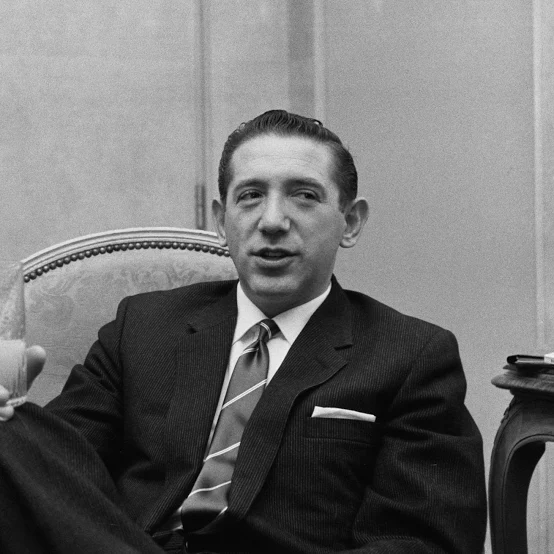
NICHOLAS DARVAS
A professional ballroom dancer who made $2 million in the stock market in the late 1950s using a self-taught system he operated entirely by telegram while touring the world.
Nicholas Darvas was a professional ballroom dancer who turned $36,000 into over $2 million in the stock market between 1957 and 1959. He did it while touring the world, receiving stock quotes by telegram in hotel rooms from Saigon to Calcutta. He had no financial training, no broker whispering in his ear, and no Bloomberg terminal. Just a theory about boxes, a stack of telegrams, and the audacity to bet big on stocks that were already going up. Wall Street hated that a dancer figured out what they couldn't.
Net Worth
$2 Million (1960s)
Nationality
Hungarian-American
Time Horizon
Medium-Term
Risk Appetite
7 / 10
CAREER & BACKGROUND
Nicholas Darvas was born in Hungary in 1920. He fled the country during World War II to escape the Nazis and eventually became one of the highest-paid ballroom dancers in the world with his half-sister Julia.
They performed in nightclubs and theaters across the globe. Darvas started investing in the stock market in the mid-1950s almost by accident — he received 6,000 shares of a Canadian mining company called Brilund as payment for a performance.
The stock tripled. He was hooked.
He lost most of those gains learning the hard way — tips, rumors, and broker advice all failed him. Then he developed his own system.
He noticed that stocks moved in "boxes" — price ranges where they traded before breaking out to new highs. He started buying stocks that broke out of their box to the upside, with strict stop-losses if they fell back in.
Between 1957 and 1959, he turned $36,000 into over $2 million. He did all of this by telegram while dancing in hotels around the world.
Time magazine covered his story. He wrote a book about it that sold millions.
COMPANIES & ROLES
Darvas was not a company builder. He was a solo trader and a performer.
His "business" was the Darvas-Julia dance act, which toured globally for decades. His investing was entirely personal — he traded his own money through a single brokerage account, primarily in growth stocks on the New York Stock Exchange.
He did not manage money for others. His entire financial legacy comes from his books and his personal trading record.
INVESTING STYLE & PHILOSOPHY
Darvas developed what he called the "Box Theory." He watched stocks trade in ranges — a stock might bounce between $45 and $50 for weeks. That's a box.
When the stock broke above $50 on strong volume, he bought. If it fell back below the bottom of the box, he sold immediately.
No second-guessing. He only bought stocks making new highs — never tried to catch falling knives.
He combined this technical approach with a fundamental filter: he wanted companies in growing industries with rising earnings. He called it the "techno-fundamentalist" approach.
The key was discipline. He had hard rules and followed them mechanically, which is what separated him from the millions of people who have theories but can't execute them.
THE PLAYBOOK
Risk Approach
Darvas had extremely tight risk management for his era. He used stop-loss orders on every position, typically set 5-10% below his purchase price.
If a stock fell through the bottom of its box, he was out. No hoping, no praying, no averaging down.
He also sized his positions based on conviction — his biggest bets were on stocks with the strongest box breakouts and the best fundamentals. He was willing to take concentrated positions but always with a defined exit point.
His downside was always capped. His upside was theoretically unlimited because he let winners run.
Money Habits
Darvas lived well from his dance career earnings. He performed in the best hotels and nightclubs in the world.
He spent freely on travel and experiences. But with his investment money, he was disciplined.
He didn't spend his trading profits on luxury. He reinvested them.
His lifestyle was funded by dance income, and his wealth was built through the market. He had no particular interest in displaying wealth.
He was primarily motivated by the intellectual challenge of beating the market and the freedom that financial independence provided.
BIGGEST WIN
His 1957-1959 run, turning $36,000 into over $2 million. His biggest single win was Lorillard, a tobacco company.
He bought it around $27 after it broke out of a box, and rode it to over $80. He also made huge gains on Thiokol Chemical (which made rocket fuel — this was the Sputnik era) and Universal Controls.
The beauty of his system was that his winners were massive and his losers were small, because he cut losses immediately and let profits compound. His win rate wasn't spectacular, but his reward-to-risk ratio was enormous.
BIGGEST MISTAKE
His early years of investing before developing his system. He lost almost everything he'd made on the Brilund windfall by following broker tips, hot rumors, and Wall Street gossip.
He bought stocks he didn't understand based on advice from people who didn't know any more than he did. He estimated he gave back most of his initial Brilund profits before he stopped listening to others and started developing his own method.
The lesson he took away: nobody cares about your money as much as you do.
FINANCIAL PHILOSOPHY
Darvas believed the market told you everything you needed to know if you listened carefully. He didn't care about macroeconomics, interest rates, or what the Fed was doing.
He watched price and volume. He believed that stocks in strong uptrends tend to keep going up, and stocks in downtrends tend to keep going down.
He believed that cutting losses quickly was more important than picking winners. He believed that discipline was the only edge a retail investor really had.
And he believed — perhaps most radically — that being far away from Wall Street was actually an advantage, because it removed the temptation to overtrade based on noise.
FAMILY & PERSONAL LIFE
Darvas was very private about his personal life. He was born in Hungary and fled during World War II.
He performed his dance act with his half-sister Julia Darvas. He lived internationally, spending time in Paris, New York, and wherever his dance tour took him.
Details about his family life, marriages, or children are largely absent from the public record. He preferred to be known for his dancing and his market method rather than his personal life.
He died in 1977.
EDUCATION
No formal financial education. He studied economics briefly in Hungary before the war disrupted his education.
He was entirely self-taught as an investor. His "school" was losing money on bad tips and then figuring out a better way through observation and experimentation.
BOOKS & RESOURCES
Darvas wrote two essential books
How I Made $2,000,000 in the Stock Market (1960) is the classic. It reads like a thriller — the story of a dancer sending telegrams from Calcutta, making and losing fortunes. It's one of the best investment books ever written and has sold millions of copies over 60+ years. His second book, Wall Street: The Other Las Vegas, is more cynical about the industry and less practical but still worth reading. Both are short, readable, and timeless in their core lessons about discipline and risk management
QUOTES (5)
I became a millionaire by dancing and a multi-millionaire by buying stocks. The dancing was harder.
I was never afraid of buying a stock at a new high. What I was afraid of was buying a stock at a new low.
I keep my losses small and let my profits run. That is the whole secret.
I never argue with the tape. If a stock goes down, I get out.
Being far away from Wall Street was the best thing for my investing. I couldn't hear the noise.
NETFIGO SCORE
Proprietary 5-dimension investor rating
Risk Appetite
Contrarian Index
Track Record
Accessibility
Time Horizon
Related Profiles
Head-to-Head
Compare Nicholas Darvas vs another investor.