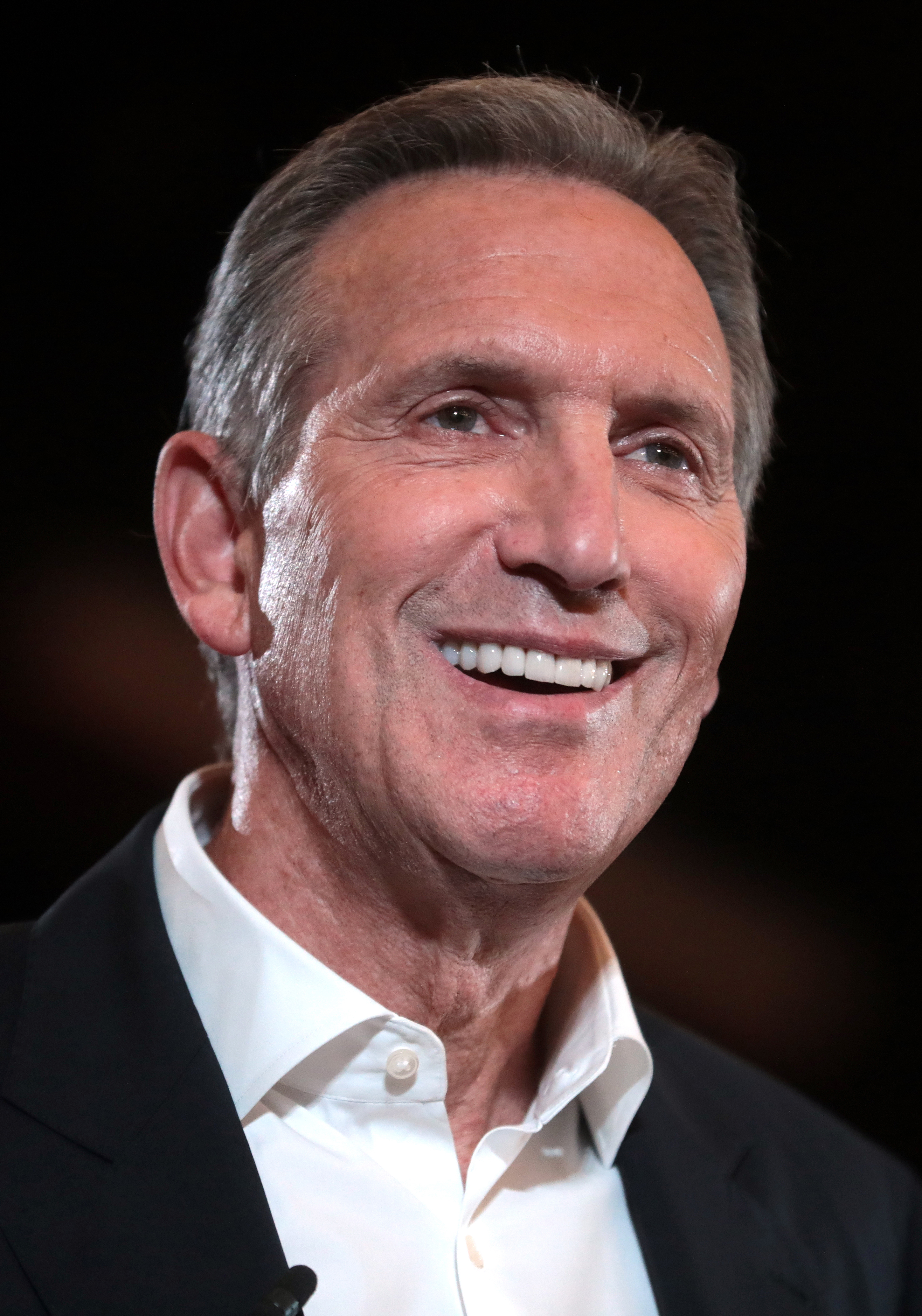
HOWARD SCHULTZ
Built Starbucks from 11 stores into a 35,000-store global empire — convinced the world to pay $5 for coffee
The man who bought a Seattle coffee bean shop for $3.8 million and turned it into a $100 billion company by convincing America that coffee is an experience, not a beverage. Grew up in Brooklyn public housing. Visited Milan, saw espresso bars on every corner, and thought "we need this." He was right to the tune of 35,000 stores in 80 countries. The most successful retail CEO since Sam Walton — selling something that costs 12 cents to make.
Net Worth
$5 billion
Nationality
American
Time Horizon
Long-Term
Risk Appetite
5 / 10
Net Worth Context
- · Still a billionaire — just the quiet kind at the end of the table.
CAREER & BACKGROUND
Born in 1953 in the Bayview housing projects in Canarsie, Brooklyn. His dad drove a delivery truck, broke his ankle on the job, and had no health insurance.
That memory shaped everything Schultz later built.
Got a football scholarship to Northern Michigan University — first in his family to attend college. After graduating in 1975, he sold Xerox machines door to door.
Then moved to a Swedish kitchenware company where he noticed a tiny Seattle outfit called Starbucks ordering an unusual number of drip coffee makers.
He flew out to investigate. Walked into the original Pike Place Market Starbucks in 1981 and fell in love.
Joined as head of marketing in 1982 when they had four stores selling only beans — no brewed coffee. In 1983, he went to Milan and had his eureka moment.
There were 200,000 espresso bars in Italy. Nobody was doing this in America.
He pitched the cafe concept to the founders. They said no.
So he quit and started Il Giornale in 1985. Two years later, the founders wanted out.
Schultz bought all six Starbucks stores for $3.8 million. Grew to 1,000 stores by 1996.
Took it public that year. Stepped down in 2000, came back in 2008 during the recession, closed 7,100 stores for one afternoon to retrain baristas.
Revenue nearly tripled over the next decade. Briefly ran for president in 2019, came back as CEO a third time in 2022 during the union fight, and handed off in 2023.
COMPANIES & ROLES
Starbucks is the whole story. Schultz turned it into the "third place" concept — not home, not work, the third place where you hang out.
He popularized the idea that a coffee shop is a community hub, not just a caffeine stop. Beyond Starbucks, he led a group that bought the Seattle SuperSonics in 2001 and invested in several consumer brands through his family office.
But make no mistake — this is a one-company guy. Everything he is comes from those green aprons.
INVESTING STYLE & PHILOSOPHY
Schultz isn't really an investor. He's an operator who happens to be rich.
When he puts money to work, it's almost always in consumer brands he can understand — things people eat, drink, or experience. He backs founders and stories, not spreadsheets.
His entire career was one bet: people will pay more for a premium experience, even for something as basic as coffee. That bet worked so well he never needed another one.
THE PLAYBOOK
Risk Approach
Moderate risk with deep conviction. Schultz bet his career on one idea — Italian-style coffee bars in America — when the founders of Starbucks literally told him no.
But once he found his thing, he went all-in and never diversified. He doesn't take fliers on stuff he doesn't understand.
No crypto, no SPACs, no complex financial instruments. He backs what he knows, deeply and patiently.
Money Habits
Despite a $5 billion net worth, Schultz isn't flashy. He owns a penthouse in Manhattan and a place on Fisher Island, but you won't see him on yachts or Instagram.
He grew up genuinely poor — the broken-ankle story isn't a myth. He still visits Starbucks stores unannounced to check quality.
He's donated hundreds of millions to veterans' causes and youth employment. His lifestyle is wealthy but not billionaire-ostentatious.
BIGGEST WIN
Buying Starbucks for $3.8 million in 1987. That one deal turned into a company worth over $100 billion at its peak.
The stock went from about $17 at its 1992 IPO to over $100 by 2019. His 2008 comeback was almost as impressive — he returned to a company in crisis, closed thousands of stores, retrained every employee, and rebuilt it to record highs.
The stock went from $7.83 in late 2008 to triple digits.
BIGGEST MISTAKE
Selling the Seattle SuperSonics. Schultz bought the NBA team in 2001 for $200 million, sold to an Oklahoma City group in 2006 for $350 million.
The team became the Thunder. Seattle lost its NBA franchise, and the city has never forgiven him.
His third CEO return in 2022 was also controversial — he came back mainly to fight unionization and left the company in a messy leadership transition. The stock dropped 20% during that stretch.
FINANCIAL PHILOSOPHY
Brands win by earning emotional loyalty, not by being the cheapest. Schultz is obsessed with the customer experience — every cup of coffee is a personal interaction.
He was one of the first CEOs to offer health insurance and stock options to part-time workers, back when that was considered insane. His logic: invest in people first, returns follow.
Growth should never compromise the soul of the company. He's repeated that line roughly ten thousand times.
FAMILY & PERSONAL LIFE
Married to Sheri Kersch Schultz since 1982. Two kids: Jordan and Addison.
Sheri is an interior designer who helped design early Starbucks store concepts. The family keeps a low profile compared to other billionaires.
Schultz has talked publicly about how his father's injury — and having no safety net — drove his obsession with employee benefits at Starbucks.
EDUCATION
Grew up in Canarsie, Brooklyn, in the Bayview housing projects. Football scholarship to Northern Michigan University — first in his family to attend college.
Graduated 1975 with a communications degree. No MBA, no finance background.
He learned business selling Xerox machines door to door.
BOOKS & RESOURCES
His autobiography covering the Starbucks origin story, from Brooklyn projects to global brand. The essential Schultz read
The 2008 comeback story. How he pulled Starbucks out of crisis. Basically a masterclass in turnaround leadership
His most recent book, mixing business lessons with reflections on the American Dream and his brief presidential campaign
Not written by Schultz but a deep dive into the operational philosophy he built. Good companion piece
As an Amazon Associate, Netfigo earns from qualifying purchases. Book links above may be affiliate links.
QUOTES (5)
In times of adversity and change, we really discover who we are and what we're made of.
Risk more than others think is safe. Dream more than others think is practical.
I grew up in federally subsidized housing. I know what it's like to live on the other side of the American Dream.
NETFIGO SCORE
Proprietary 5-dimension investor rating
Risk Appetite
Contrarian Index
Track Record
Accessibility
Time Horizon
Related Profiles
Head-to-Head
Compare Howard Schultz vs another investor.