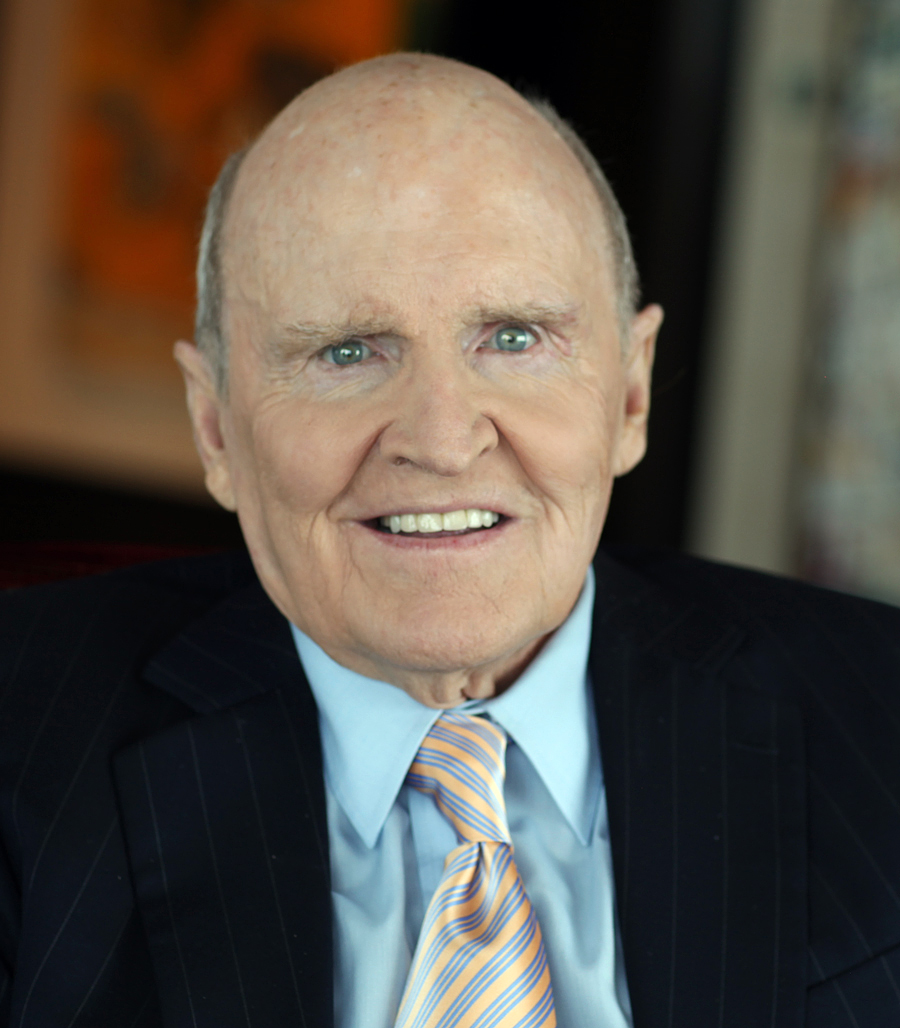
JACK WELCH
Transforming GE into the world's most valuable company as its youngest-ever CEO — and writing the management playbook for an era
Jack Welch became GE's CEO at 44, laid off 118,000 people (earning "Neutron Jack"), and grew GE from $14 billion to $400 billion in 20 years. His $417M retirement package was the most controversial exit in corporate history at the time. He wrote four bestselling business books, died in 2020, and his management framework is still taught in business schools worldwide. Whether you admire or criticize him, he changed how large companies are run.
Net Worth
$750M
Nationality
American
Time Horizon
Long-Term
Risk Appetite
7 / 10
Net Worth Context
- · 750x the average American's lifetime earnings, stacked and waiting.
CAREER & BACKGROUND
Jack Welch became GE's youngest-ever CEO at age 44 in 1981. He ran it for 20 years and transformed it from a solid industrial manufacturer into the world's most valuable company at its peak — worth over $400 billion.
He did this through radical restructuring (earning the nickname "Neutron Jack" for laying off 118,000 employees while leaving buildings standing), aggressive acquisitions, building GE Capital into a global financial powerhouse, and introducing management frameworks — rank-and-yank performance management, Six Sigma quality methodology, Work-Out sessions — that were widely adopted across corporate America. He retired in 2001 with a $417 million retirement package, the largest in US history at the time, which generated significant public controversy.
He is credited with creating more wealth for shareholders than virtually any CEO in history.
COMPANIES & ROLES
General Electric — Chairman & CEO (1981–2001). General Electric Capital — Built into one of the world's largest financial institutions.
Multiple board positions post-retirement. Business writing and advisory work
INVESTING STYLE & PHILOSOPHY
Differentiation, operational excellence, and portfolio management. Welch believed every GE business should be #1 or #2 in its market — or be fixed, sold, or closed.
He acquired NBC, sold GE's appliance businesses, and built GE Capital into a $100B financial institution. His framework was explicitly: dominate your category or exit it.
THE PLAYBOOK
Risk Approach
7
Money Habits
Famous for his retirement package controversy — $417M triggered public debate about executive compensation. Continued to work intensively post-retirement: wrote bestselling books, ran GE alumni networks, coached business leaders.
Died in 2020. One of the most widely studied CEOs in history.
BIGGEST WIN
GE's transformation from 1981 to 2000. When Welch took over, GE was worth $14 billion.
When he left, it was worth $400 billion. That 28x increase in 20 years is one of the greatest wealth creation records in American corporate history.
BIGGEST MISTAKE
Building GE Capital into a $500 billion institution — which his successor Jeffrey Immelt allowed to become even larger, leading to the 2008 crisis. Welch created the template.
Immelt overextended it. The responsibility is shared but the architecture was Welch's.
FINANCIAL PHILOSOPHY
Be #1 or #2 in every market you compete in. If you cannot be, fix it, sell it, or close it.
Companies that try to compete in markets where they will never win waste resources that could be deployed where they can dominate.
FAMILY & PERSONAL LIFE
Married three times. Married Suzy Wetlaufer (his third wife) after a controversial relationship.
Four children from first marriage.
EDUCATION
Bachelor's in Chemical Engineering, University of Massachusetts Amherst. MS and PhD in Chemical Engineering, University of Illinois.
BOOKS & RESOURCES
As an Amazon Associate, Netfigo earns from qualifying purchases. Book links above may be affiliate links.
QUOTES (5)
Before you are a leader, success is all about growing yourself. When you become a leader, success is all about growing others.
If the rate of change on the outside exceeds the rate of change on the inside, the end is near.
An organization's ability to learn, and translate that learning into action rapidly, is the ultimate competitive advantage.
NETFIGO SCORE
Proprietary 5-dimension investor rating
Risk Appetite
Contrarian Index
Track Record
Accessibility
Time Horizon
Related Profiles
Head-to-Head
Compare Jack Welch vs another investor.