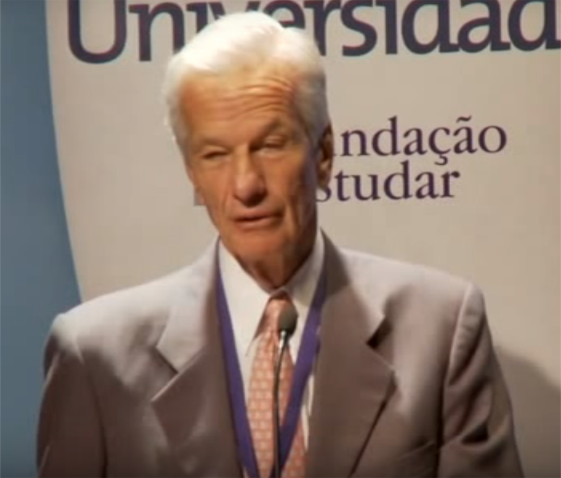
JORGE PAULO LEMANN
Building the world's largest brewery and buying fast food icons without spending a dime on marketing.
He bought cheap, cut costs, merged giant companies, and somehow turned a tiny Brazilian bank into a global consumer empire. The $52 billion Anheuser-Busch deal at $70 a share proved his operational playbook works anywhere. He never hires outside consultants and ran every deal through a three-man partnership that started in the 1970s. The quietest guy on the trading floor owns your beer and your favorite ketchup — though Kraft Heinz is now splitting itself back apart, which is its own verdict on the model.
Net Worth
$19.6 billion
Verified Sep 2026
Nationality
Brazilian-Swiss (dual citizenship)
Time Horizon
Generational
Risk Appetite
8 / 10
Fund
3G Capital
Net Worth Context
- · That's the GDP of a small country — around the size of Greenland.
- · Enough to buy an NBA team and keep $16B for snacks.
CAREER & BACKGROUND
Born in Rio de Janeiro on 26 August 1939 to Paul Lemann, a Swiss immigrant who founded the dairy company Leco, and Anna Yvette Truebner, a Brazilian of Swiss descent — which is where the dual citizenship comes from. Before any of the business, he was a serious athlete: five-time Brazilian national tennis champion, a Wimbledon competitor in 1962, and a Davis Cup player for both Switzerland and Brazil.
He has said the discipline of competitive sport is where the operating philosophy started.
He then began as a trainee at Credit Suisse in Geneva and spent his early twenties bouncing between finance and journalism, writing a business column for a Brazilian newspaper while moonlighting in banking. The real turning point arrived in 1971 when he co-founded Banco Garantia alongside Carlos Alberto Sicupira and Marcel Herrmann Telles.
They modeled it after Goldman Sachs but injected a ruthless Brazilian pragmatism. The bank became the premier investment house in Latin America.
The Asian financial crisis in 1998 forced a brutal reckoning. Massive trading losses on government debt wiped out over $100 million.
They sold the bank to Credit Suisse First Boston for $675 million to survive. Most people would have bought a yacht and retired.
Lemann pivoted immediately. He formed GP Investimentos and started buying real businesses.
He acquired the Lojas Americanas retail chain. He moved into breweries with Brahma and merged them into AmBev.
The 2008 acquisition of Anheuser-Busch locked his legacy in. He kept scaling through 3G Capital, buying Burger King, Heinz, and Tim Hortons along the way.
He never stopped looking for the next undervalued asset.
COMPANIES & ROLES
3G Capital is his main vehicle. It operates like a private holding company obsessed with consumer brands.
The playbook is brutally simple. You buy the whole company, cut the fat, install lean management, and hold it.
The signature deals are Anheuser-Busch, merged into AB InBev, and Kraft Heinz, where 3G partnered with Warren Buffett's Berkshire Hathaway — a company whose board approved a plan in September 2025 to split itself back into two. 3G also created Restaurant Brands International out of Burger King and Tim Hortons in 2014, and has been selling that stake down since 2019 rather than holding it forever.
More recently the firm bought the blinds maker Hunter Douglas. Before 3G, he ran Banco Garantia and GP Investimentos.
He buys companies to fix them, not to trade them.
INVESTING STYLE & PHILOSOPHY
He thinks like a mechanic, not a day trader. You do not just buy a stock and hope it goes up.
You buy the entire company, strip out the bloat, and fix the engine yourself. His style is active value investing with a heavy emphasis on operational control.
He ignores market noise and focuses entirely on margins and execution. He relies completely on his two lifelong partners, Sicupira and Telles.
They split the work, debate fiercely behind closed doors, and never let an outside consultant dictate terms. It is basically a family office with a Wall Street brain.
He buys what is cheap, makes it efficient, and waits patiently for the value to unlock.
THE PLAYBOOK
Risk Approach
He takes calculated bets but absolutely hates uncontrolled exposure. The 1998 Banco Garantia collapse taught him a brutal lesson about ambition without oversight.
He lost over $100 million on government debt trades and had to sell the firm he built from scratch. Since that day, he manages risk through rigid partnership structure.
Every major decision requires full alignment among the three founders. He splits risk by focusing on familiar consumer goods with strong, predictable cash flows.
He avoids complex derivatives and leveraged bets that lack a clear operational path. If the numbers do not work, they walk away immediately.
He prefers losing a little by waiting to losing everything by rushing.
Money Habits
He is notoriously private and rarely spends money on public displays of wealth. He splits his time between São Paulo, Rapperswil-Jona in Switzerland, and St.
Louis. His spending goes into operational efficiency, not luxury toys or flashy cars.
He channels his personal wealth into massive educational initiatives through Fundação Estudar and supports emerging entrepreneurs through Endeavor Brazil. He still works well into his eighties because he genuinely loves the problem-solving process.
A corporate retirement letter once made him furious. He wrote back saying he prefers to keep building things rather than sitting on a beach.
That attitude dictates his spending. He invests in schools, foundations, and long-term durability.
BIGGEST WIN
The $52 billion acquisition of Anheuser-Busch in 2008 stands as his crowning achievement. He and his partners merged AmBev with Interbrew first, then bought the iconic American brewer at $70 a share after an opening bid of $65 was rejected.
Critics called it completely insane. Most people thought the brand premium was untouchable.
He saw something entirely different. He saw massive bloat and wasted capital.
He installed zero-based budgeting, cut unnecessary overhead, and streamlined operations globally. The combined company became the undisputed king of beer.
It proved his lean model could scale across continents without breaking. The returns were astronomical.
BIGGEST MISTAKE
The 1998 collapse of Banco Garantia still stings. Asian financial crisis turbulence triggered uncontrolled trading on Brazilian government debt.
The partners lost over $100 million in a matter of months. They sold the bank to Credit Suisse for $675 million just to survive.
They lost the exact firm they built from scratch in the early 1970s. The experience forced a complete overhaul of how they manage leverage and trading risk.
It taught them a permanent lesson to never trade outside their operational expertise. Every single deal after that requires ironclad control and zero speculation.
FINANCIAL PHILOSOPHY
He believes good administration beats everything else every single time. A great product with lazy management will always fail.
A decent product with relentless execution will always win. He focuses on exactly four or five essential metrics and completely ignores the rest.
He dreams big but checks every single assumption against reality. He values people above products.
Hiring the right team, paying them well, and holding them accountable is the only real competitive advantage. He keeps things painfully simple.
Open communication, hard work, and zero tolerance for excuses. If a manager cannot find a replacement for themselves, they do not get promoted.
He treats corporate culture as the ultimate financial moat.
FAMILY & PERSONAL LIFE
He keeps his personal life strictly off the radar. He was first married to Maria Quental from 1966 to 1986, and they had three children.
He remarried Susanna Mally in 2005 and has three more children. A 1999 kidnapping attempt targeting his kids forced the entire family to relocate to Switzerland for safety.
He channels his family focus into education philanthropy rather than public appearances. His children are almost never mentioned in business contexts.
That is exactly how he wants it. He believes privacy is the only real luxury left.
EDUCATION
He attended the American School of Rio de Janeiro before heading to Harvard, where he took a bachelor's degree in economics in 1960. His time in Boston changed everything.
He developed a ruthless efficiency system by studying archived exams, interviewing previous students, and mapping out recurring professor patterns. He learned to identify the exact four or five essential things that actually matter in any complex problem.
He carried that exact filter into every boardroom meeting he attended. Harvard gave him the analytical playbook.
His business instincts came from the trenches in Sao Paulo.
BOOKS & RESOURCES
Became the literal Bible inside 3G Capital. Every acquisition, every cost cut, every management decision ran through Collins' framework. If you want to understand how Lemann thinks, that is the starting point
It covers the full story of how three Brazilian guys built one of the most aggressive acquisition machines in consumer goods history. From Brahma beer to Burger King to Kraft Heinz. The deals, the culture, the cost-cutting obsession
The other essential read. It profiles CEOs who allocated capital like Lemann does. Buy undervalued companies, strip out waste, redeploy cash into the next deal
As an Amazon Associate, Netfigo earns from qualifying purchases. Book links above may be affiliate links.
QUOTES (1)
Dreaming big or dreaming small take the same amount of effort so you might as well dream big.
NETFIGO SCORE
Proprietary 5-dimension investor rating
Risk Appetite
Contrarian Index
Track Record
Accessibility
Time Horizon
Related Profiles
Head-to-Head
Compare Jorge Paulo Lemann vs another investor.