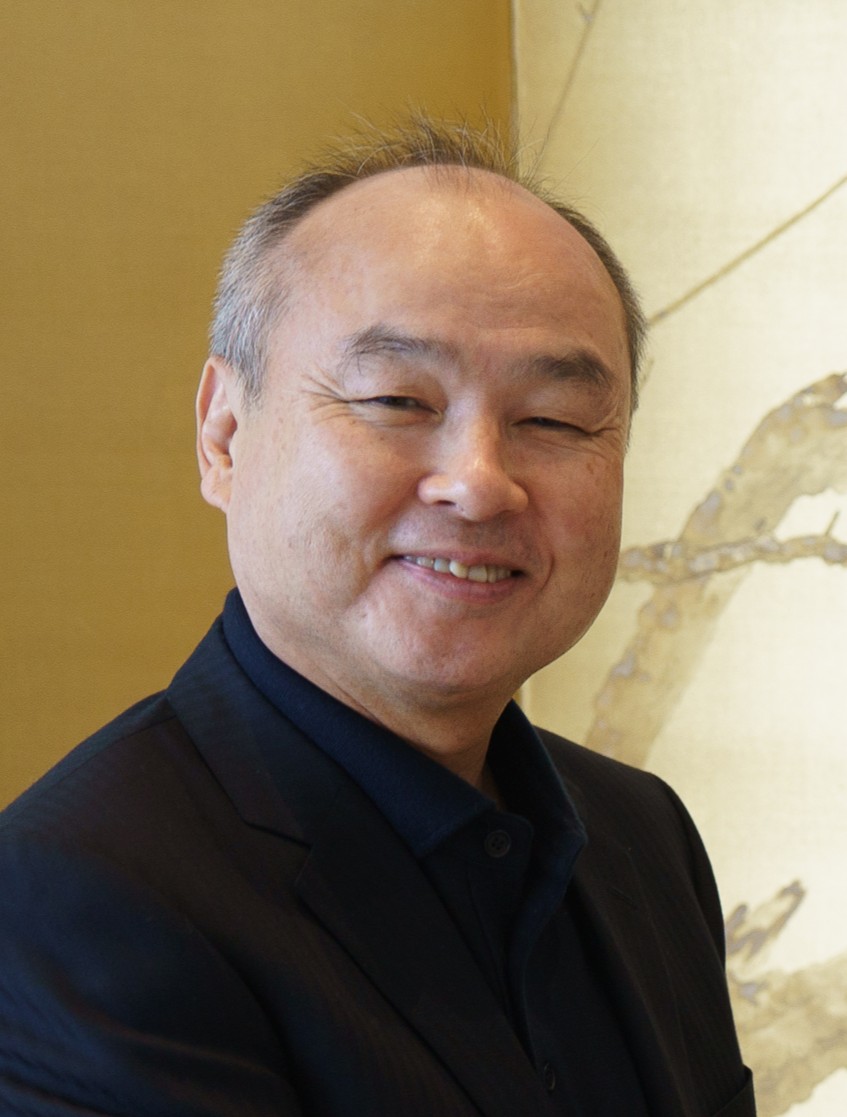
MASAYOSHI SON
The man who turned $20 million into $75 billion on Alibaba and then lost more money in a single year than almost anyone in history with WeWork and Vision Fund.
Masayoshi Son once had a net worth of $78 billion — and then watched $70 billion of it evaporate in the dot-com crash. Most people would retire. He kept going. He invested $20 million in a little Chinese e-commerce startup called Alibaba in 2000 and turned it into roughly $75 billion — possibly the greatest single venture bet in history. Then he raised $100 billion for the Vision Fund, backed WeWork at a $47 billion valuation, and proceeded to lose tens of billions in what analysts called the most expensive loss of judgment in startup investing. The man swings harder than anyone alive, wins bigger than almost anyone ever has, and loses in ways that defy comprehension. Somehow still standing.
Net Worth
$9 billion
Nationality
Japanese
Time Horizon
Generational
Risk Appetite
10 / 10
Net Worth Context
- · Still a billionaire — just the quiet kind at the end of the table.
CAREER & BACKGROUND
Masayoshi Son was born in 1957 in Tosu, Japan, to a family of Korean descent living in Japan under Japanese names — a detail that shaped his hunger to prove himself in a country where he was very much an outsider. He was relentlessly ambitious from childhood.
At 16, he cold-called Den Fujita, the man who brought McDonald's to Japan, just to ask for advice. Fujita told him to study computers in America.
Son took that literally.
He moved to California, finished high school in three weeks with a tutor, enrolled at Holy Names University, then transferred to UC Berkeley. While still a student, he started importing Space Invaders arcade machines from Japan and leasing them to local businesses.
He made $1 million before graduating. He also sold a pocket translator to Sharp for $1.7 million.
He was 21.
After graduating in 1980, he returned to Japan and founded SoftBank in 1981, initially as a software distribution company. He would set boxes of software on a table, hire two part-time staff, and give them a speech about how SoftBank would one day be a billion-dollar company.
Both employees quit. Son kept going.
SoftBank grew into Japan's leading software distributor. Then Son moved into publishing tech magazines, then internet infrastructure, then investments.
In 1994 he met Jerry Yang at a conference and almost invested in Yahoo — eventually he did invest, putting in $100 million in 1995 for a 37% stake. That became worth $3 billion when Yahoo IPO'd.
He was on a roll.
The Alibaba bet in 2000 is the one that defines everything. Son met Jack Ma in Beijing, spent 10 minutes listening to his pitch, and wired $20 million.
There was no business plan, virtually no revenue, and Jack Ma had failed his university entrance exams multiple times. Son's reasoning: he liked Ma's eyes.
That investment eventually grew to be worth roughly $75 billion — the most profitable venture investment in history.
But the dot-com crash hit Son harder than almost anyone. At the peak in 2000, his net worth was estimated at $78 billion — briefly making him the richest man in the world ahead of Bill Gates.
Within a year he had lost $70 billion of it. That's not a typo.
Seventy billion dollars, gone. The Guinness World Records listed it as the greatest personal financial loss in history.
He didn't declare bankruptcy. He didn't disappear.
He restructured, kept building, and started again.
The Vision Fund era, starting around 2017, was Son's attempt to do everything he'd done before but at a scale no one had ever tried. He raised $100 billion — mostly from Saudi Arabia's Public Investment Fund and Abu Dhabi's Mubadala — and started writing enormous checks to startups: WeWork, Uber, DoorDash, Grab, Ola, Slack, and dozens more.
The thesis was that AI and the internet would reshape every industry, and whoever owned the biggest positions in the leading companies would own the future.
The problem was the valuations. Son was paying prices that assumed perfect execution and unlimited runway.
When the market turned, the losses were brutal. The Vision Fund reported a loss of $27 billion in fiscal year 2022 — the largest annual loss in Japanese corporate history.
WeWork, which Son had backed at $47 billion, eventually filed for bankruptcy in 2023 at a valuation of essentially zero.
COMPANIES & ROLES
SoftBank is the mothership — a Japanese conglomerate Son founded in 1981 as a software distribution company and built into one of the world's largest tech investment vehicles. It now holds stakes in hundreds of companies across telecom, tech, and AI.
SoftBank also owns ARM Holdings, the British chip designer whose architecture runs virtually every smartphone on the planet. Son took ARM private in 2016 for $32 billion and took it public again in 2023 in one of the biggest IPOs of the year.
The Vision Fund is Son's most ambitious and most controversial project. Launched in 2017 with $100 billion in capital — largely from Saudi Arabia's Public Investment Fund ($45 billion) and Abu Dhabi's Mubadala ($15 billion) — it was the largest private equity fund ever raised.
It invested in Uber, WeWork, DoorDash, Grab, Ola, Slack, ByteDance, Didi, and over 80 other companies. Some worked.
Many didn't. A Vision Fund II followed, mostly funded by SoftBank itself.
Yahoo Japan is a joint venture Son helped create, which became one of Japan's dominant internet portals. Sprint was a $22 billion acquisition in 2013 that gave SoftBank a foothold in the US telecom market — Son tried to merge it with T-Mobile, was blocked by regulators, and eventually sold Sprint to T-Mobile in 2020.
He bought the US carrier Brightstar, the robot company Boston Dynamics (sold to Hyundai in 2021), and satellite internet company OneWeb.
Alibaba is still the crown jewel of his portfolio, though SoftBank has been steadily selling down its stake to raise cash. At its peak the holding was worth over $200 billion.
ARM is increasingly becoming the next defining bet — Son believes it will be the backbone of the AI era.
INVESTING STYLE & PHILOSOPHY
Son thinks in decades, not quarters. His mental model is what he calls the '300-year vision' — he literally writes business plans that extend 300 years into the future.
This sounds insane. For most people, it probably would be.
But it means he's willing to accept losses that would make conventional investors faint, because he's measuring himself against a timeline that no quarterly report can capture.
He bets on paradigm shifts. Not on companies, on eras.
He asked himself in 1995: what will the internet do to the world? He decided it would be as transformative as the industrial revolution.
Then he started writing enormous checks to the companies he thought would sit at the center of it. Some of those bets — Yahoo, Alibaba — were right in a way that generated returns most fund managers won't match in a career.
The pattern is: find a founder he believes in, meet them for a short time, make a gut decision, write a very large check, and move on. He famously gave Adam Neumann of WeWork a check for $4.4 billion after a 12-minute meeting — a story that is both impressive and catastrophic depending on how you look at it.
Son himself admitted later that he had the worse judgment in the WeWork deal and that Neumann's 'animal smell' had overwhelmed his analytical sense.
He also believes in owning 20–40% of the companies he backs and getting involved operationally, pushing portfolio companies to grow faster and spend more aggressively than they'd naturally want to. This accelerated growth strategy worked with DoorDash and some others.
It backfired spectacularly with WeWork and several others that burned cash faster than they could build real businesses.
At his core, Son is a trend investor with a venture mentality applied at the scale of a sovereign wealth fund. He wants to own the infrastructure of the next century.
Sometimes that looks like genius. Sometimes it looks like the most expensive hubris in modern finance.
Usually it's both simultaneously.
THE PLAYBOOK
Risk Approach
Son's relationship with risk is unlike anything in mainstream finance. He doesn't just accept the possibility of losing — he has actually lost $70 billion in a single crash and treated it as a lesson rather than a reason to stop.
After the dot-com collapse wiped out most of his net worth, he said in interviews that he cried for a week and then got back to work. That's either extraordinary resilience or a kind of psychological immunity to normal human risk aversion.
Possibly both.
He uses leverage extensively and isn't squeamish about it. SoftBank regularly borrows against its own holdings to fund new investments, creating a structure where if enough bets go wrong simultaneously, the whole thing could unravel.
In 2020, during the early COVID crash, SoftBank's stock fell so sharply that there was genuine market speculation about a liquidity crisis. Son responded by selling $41 billion in assets to shore up the balance sheet — which itself showed he understood the danger but had been willing to live right at the edge of it.
His mental model of risk is essentially: if you're right about the direction of a major technological shift, the risk of being too early or paying too much is manageable over a long enough time horizon. If you're wrong about the direction, no amount of conservatism saves you anyway.
That logic works when the underlying thesis is correct. It's catastrophic when it isn't — see WeWork, Katerra, or Greensill Capital, all Vision Fund investments that went to zero.
Money Habits
Son reportedly has a net worth that has fluctuated wildly — from $78 billion at the dot-com peak to effectively near-zero on paper and back again. He lives comfortably but isn't particularly ostentatious by the standards of global billionaires.
He owns a large residence in Tokyo and properties in California, but he's not known for superyachts or private islands.
His real 'habit' is reinvestment on a massive scale. He doesn't sit on cash.
SoftBank's structure means virtually everything flows back into new bets — ARM, AI startups, telecom assets, infrastructure plays. He once pledged to invest $50 billion in the United States over four years after a meeting with Donald Trump, standing next to him in Trump Tower in 2016.
He announced it as a done deal before any details were worked out.
He is known for working extremely long hours and maintaining an aggressive schedule even into his 60s. He's not a private person — he gives press conferences, does interviews, speaks at conferences, and has a public profile unusual for someone who runs what is essentially a holding company.
He's clearly in it for something beyond money. The legacy, the vision, the 300-year plan.
He says he wants SoftBank to still be operating and important in three centuries. For a man who has already lost $70 billion and made it back, that doesn't seem entirely implausible.
BIGGEST WIN
Alibaba. Full stop.
Son invested $20 million in Alibaba in 2000 — a 10-minute meeting with Jack Ma, no business plan, no due diligence in any conventional sense, just a gut feeling about the founder. That $20 million stake, after years of growth and Alibaba's IPO in 2014 (at the time the largest IPO in history at $25 billion), grew to be worth roughly $75 billion at its peak.
That's a 3,750x return. SoftBank still held over 25% of Alibaba through the mid-2010s.
To put that in context: if you had invested $20 million in the S&P 500 in 2000, you'd have around $100 million today. Son turned $20 million into $75 billion in the same period.
That's not better investing — that's a different category of outcome entirely.
He didn't sell most of it for two decades, riding it through Alibaba's regulatory crackdowns, Xi Jinping's tech sector pressure, and multiple market cycles. SoftBank has been selling down the position since the early 2020s to fund other investments and shore up its balance sheet, but even after those sales, the original bet remains one of the most profitable single investments any private investor has ever made.
BIGGEST MISTAKE
WeWork. Son backed the co-working company led by Adam Neumann at progressively higher valuations, ultimately pegging WeWork's worth at $47 billion in 2019 before its planned IPO.
The Vision Fund put in roughly $10.65 billion total. When WeWork filed its S-1 ahead of the IPO, analysts found: no path to profitability, bizarre governance structures that handed Neumann near-total control, and a business model that was essentially a leveraged real estate company being valued like a tech company.
The IPO collapsed. Neumann was ousted.
SoftBank had to step in with a rescue package, eventually owning most of WeWork itself, which made things worse. WeWork filed for bankruptcy in November 2023.
The investment went to roughly zero. SoftBank's total loss on WeWork has been estimated at around $14 billion.
Son was unusually candid about this one. In a 2019 earnings call he said his judgment in the WeWork investment was 'really bad' — a rare moment of direct accountability from someone who usually projects overwhelming confidence.
He said Neumann's 'animal smell' had clouded his judgment. The phrase was memorable.
The loss was worse.
WeWork wasn't an isolated case, though. The Vision Fund also lost heavily on Katerra (construction startup, $2 billion invested, went bankrupt), Greensill Capital (supply chain finance, billions in losses), and Oyo (Indian hotel chain that imploded spectacularly).
The pattern was similar in each case: inflated valuations, aggressive growth mandates, and founders who couldn't execute at the scale the money implied.
FINANCIAL PHILOSOPHY
Son talks often about the concept of 'information revolution' as an inevitability. His philosophy starts there: certain technological transitions are coming no matter what, and the only question is who will own them.
Once you accept that, the whole conventional risk calculus shifts. You're not asking 'is this company risky?' — you're asking 'is this company on the right side of history?'
He's also deeply influenced by the idea of the 'lonely contrarian' — the person willing to believe something important before everyone else does. He cites his own experience with Alibaba as the model.
In 2000, backing a Chinese e-commerce startup run by a former English teacher with no technical background was, by any standard analysis, a bad investment. It turned out to be the best investment in venture history.
The lesson he drew: conventional analysis misses the bets that actually change the world.
Son has said repeatedly that he wants his companies to be the 'No. 1 or No.
2' player in their category — he has no interest in funding also-rans. This shapes how he uses the Vision Fund: he'll back multiple companies in the same space specifically to ensure one of them wins the market, then consolidate.
He's also philosophically committed to the idea that AI will be the most transformative technology in human history — more so than fire, electricity, or the internet combined. ARM Holdings is central to this thesis.
He's been saying this for years and has been moving SoftBank's strategy accordingly, selling non-core assets and doubling down on AI infrastructure.
FAMILY & PERSONAL LIFE
Son was born to Mitsunori Son, a Korean-Japanese businessman, and grew up in Tosu, Saga Prefecture, in a family that lived in some financial hardship early on. His family background — of Korean descent but living in Japan under a Japanese name — is something he has spoken about publicly as a source of personal motivation and identity.
He married Masami Ono in 1984. They have two daughters.
He's notoriously private about his family life compared to his professional persona. His father Mitsunori reportedly had a strong entrepreneurial streak that Son credits as an early influence.
In terms of health: Son was diagnosed with chronic hepatitis in the 1980s and was told he had five years to live. He spent time in hospital reading voraciously — reportedly over 4,000 books in a few years — which he credits with shaping his long-term thinking.
He recovered and has spoken about the experience as transformative. Staring down mortality in your late 20s and coming out the other side with a 300-year business plan is, even by Son's standards, a notable pivot.
EDUCATION
Son moved from Japan to California at 16. He finished high school at Serramonte High School after hiring a tutor to compress three years of coursework into three weeks.
He then attended Holy Names University briefly before transferring to UC Berkeley, where he studied economics and computer science. He graduated in 1980.
What mattered at Berkeley wasn't the degree — it was the environment and the timing. He was surrounded by the early personal computer revolution, introduced to the ideas that would become the foundation of Silicon Valley, and was building businesses simultaneously with his studies.
By graduation he was already a millionaire. Berkeley gave him proximity to the right moment in history.
He made good use of it.
BOOKS & RESOURCES
Son hasnt written a conventional business book — his text is his career, his speeches, and his shareholder meetings, which run for hours and are required viewing if you want to understand how he thinks
His annual SoftBank World conference presentations, in which he lays out his AI thesis and the 300-year vision, are publicly available and are more revealing than most business books
He has cited Ryoma! — a multi-volume novel about the 19th-century Japanese revolutionary Ryoma Sakamoto — as one of the most important books in his life
He read it during his time in hospital and says it shaped his conviction that one person can change the course of history. It's a Japanese novel not widely available in English, but it tells you something important about how Son sees himself
The most comprehensive biography available in English translation
As an Amazon Associate, Netfigo earns from qualifying purchases. Book links above may be affiliate links.
QUOTES (6)
I was crying for a week. But after a week, I recovered and said, 'Okay, this is my challenge. I have to move forward.'
I want to put a smile on everyone's face. That's the reason I work so hard.
In my case, my judgment was really bad. I was in a way of love with the way that person, Adam, has his vision.
If you have a dream, you have to try it. You will regret it for the rest of your life if you don't.
The information revolution is going to be as big as — or even bigger than — the industrial revolution. This is just the beginning.
I met Jack Ma for maybe 10 minutes. No business plan, no revenue, nothing. I shook hands with him and invested $20 million.
NETFIGO SCORE
Proprietary 5-dimension investor rating
Risk Appetite
Contrarian Index
Track Record
Accessibility
Time Horizon
Related Profiles
Head-to-Head
Compare Masayoshi Son vs another investor.