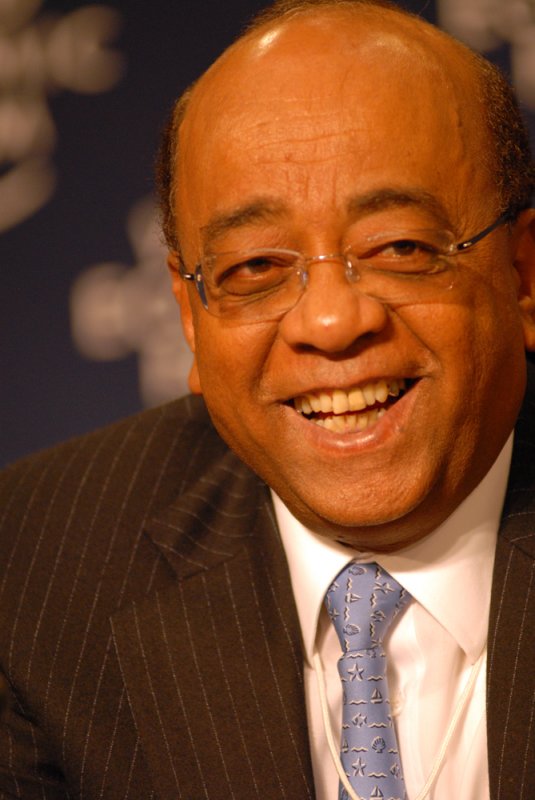
MO IBRAHIM
Founded Celtel — the telecom company that brought mobile phones to 100 million Africans — and created the Mo Ibrahim Prize for African leadership
Brought mobile phones to 100 million Africans when everyone said the continent was too poor for telecom. Mo Ibrahim built Celtel International from nothing into a $3.4 billion company spanning 14 African countries. Then he sold it and created the most exclusive prize in the world — $5 million plus $200,000 a year for life, given to an African head of state who actually governs well. Some years, nobody qualifies. That tells you everything about both the prize and the continent Ibrahim is trying to change.
Net Worth
$1.5 billion
Nationality
Sudanese-British
Time Horizon
Generational
Risk Appetite
7 / 10
Net Worth Context
- · Still a billionaire — just the quiet kind at the end of the table.
CAREER & BACKGROUND
Born in 1946 in northern Sudan. Studied engineering at the University of Alexandria in Egypt, then got a master's in electronics from the University of Bradford in England, followed by a PhD from the University of Birmingham.
Worked at British Telecom in the 1980s. In 1989, he founded Mobile Systems International (MSI), a consultancy that helped telecom companies design cellular networks.
MSI worked across Africa, and Ibrahim saw firsthand that the continent desperately needed mobile connectivity.
In 1998, he founded Celtel International to build mobile networks in Sub-Saharan Africa. The thesis was radical: that Africans would adopt mobile phones rapidly even without landline infrastructure, and that telecom companies could be profitable in markets everyone else considered too poor and too risky.
He was spectacularly right. Celtel grew to serve 24 million subscribers across 14 African countries.
In 2005, he sold Celtel to MTC Kuwait for $3.4 billion. Ibrahim's personal share was approximately $1.5 billion.
In 2006, he created the Mo Ibrahim Foundation and the Ibrahim Prize for Achievement in African Leadership — a $5 million award (plus $200,000 annually for life) given to former African heads of state who demonstrated excellent governance. The prize is deliberately set high to incentivize good leadership.
Several years, no prize has been awarded because no candidate met the criteria.
COMPANIES & ROLES
Celtel International was the big one — mobile networks in 14 African countries, sold for $3.4 billion. The Mo Ibrahim Foundation is his legacy project — focused on African governance.
The Ibrahim Index of African Governance ranks every African country on governance quality. He also co-founded Satya Capital, a private equity firm investing in Africa.
INVESTING STYLE & PHILOSOPHY
Ibrahim invests in African infrastructure and governance. His approach is long-term and impact-driven.
He saw mobile telecom as an infrastructure play that would transform the continent — and he was right. Post-Celtel, his investments focus on sectors that develop Africa: energy, agriculture, technology, and governance reform.
THE PLAYBOOK
Risk Approach
Very high historically. Building telecom networks in Sub-Saharan Africa in the late 1990s was considered insane by most investors.
Political instability, lack of infrastructure, corruption, and currency risk were all extreme. Ibrahim navigated it all because he understood the continent from decades of working there.
Money Habits
Ibrahim lives in London and Monaco. He's generous but focused — his philanthropy is entirely directed at African governance and development.
He doesn't collect sports teams or art. He collects data on African governance and publishes it for the world to see through the Ibrahim Index.
BIGGEST WIN
Celtel. Building a mobile network serving 24 million people across 14 African countries from scratch, then selling it for $3.4 billion.
The thesis — that Africa was ready for mobile — was visionary. Mobile phones have since transformed African economies, enabling mobile banking (M-Pesa), agricultural market access, and connectivity for hundreds of millions of people.
BIGGEST MISTAKE
Some years, nobody wins the Ibrahim Prize. The foundation's strict criteria mean that several years have passed with no award given.
While this proves the prize's integrity, critics argue it highlights how few African leaders meet basic governance standards, which can feel pessimistic about the continent Ibrahim loves.
FINANCIAL PHILOSOPHY
Build infrastructure that develops the continent. Ibrahim's philosophy is that Africa's greatest need is functional infrastructure and good governance.
Mobile phones transformed Africa not because of the technology, but because they gave people access to banking, information, and commerce for the first time. He applies this thinking to all his investments.
FAMILY & PERSONAL LIFE
Born in Sudan. British citizen.
Lives in London and Monaco. Very private about personal family life.
Known as a deeply thoughtful person who cares passionately about Africa's future.
EDUCATION
University of Alexandria (Egypt) — engineering. University of Bradford (UK) — MSc in electronics.
University of Birmingham (UK) — PhD. He's one of the most formally educated billionaires on the planet.
BOOKS & RESOURCES
On why the poorest countries fail to develop. Ibrahim's entire career is about proving this can change
On institutions and governance. The intellectual backbone of the Ibrahim Foundation's work
On leadership and governance in Africa. The standard Ibrahim measures other African leaders against
As an Amazon Associate, Netfigo earns from qualifying purchases. Book links above may be affiliate links.
QUOTES (5)
The prize is $5 million plus $200,000 a year for life. Some years, nobody qualifies. That tells you everything about African governance.
I sold Celtel for $3.4 billion. But the real value is that 100 million people can now call their families, check market prices, and send money by phone.
Everyone said Africa was too poor for mobile phones. 100 million subscribers later, I think the market disagreed.
Mobile phones didn't just connect Africa. They created African banking, African commerce, African information. The phone was the infrastructure.
Good governance is not charity. It's the foundation of everything — business, health, education, security. Without it, nothing works.
NETFIGO SCORE
Proprietary 5-dimension investor rating
Risk Appetite
Contrarian Index
Track Record
Accessibility
Time Horizon
Related Profiles
Head-to-Head
Compare Mo Ibrahim vs another investor.