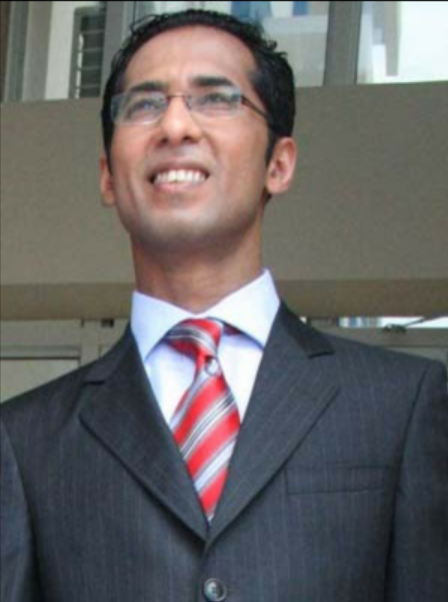
MOHAMMED DEWJI
CEO of MeTL Group, one of Africa's largest industrial conglomerates, and one of the continent's youngest self-made billionaires.
He took over his family's trading company at 26, when most MBAs are still figuring out expense reports, and turned it into a pan-African industrial giant operating in 11 countries. MeTL Group pulls in over $1.5 billion in annual revenue — flour, textiles, beverages, real estate, insurance. In 2018, he was kidnapped, held for nine days, and ransomed — and came back to work. If that doesn't tell you something about his relationship with the continent he's bet his life on, nothing will.
Net Worth
$1.5 billion
Nationality
Tanzanian
Time Horizon
Long-Term
Risk Appetite
8 / 10
Net Worth Context
- · Still a billionaire — just the quiet kind at the end of the table.
CAREER & BACKGROUND
Mohammed Dewji was born on October 28, 1975, in Dodoma, Tanzania, into a business family of Indian-origin. His grandfather Mohammed Enterprises Tanzania Limited was already a trading enterprise when Dewji graduated from Georgetown University in Washington DC with a double major in Finance and International Business.
In 1999, at age 24, he joined the family business. By 2000, he was CEO.
What he found was a traditional trading company. What he built over the next 20 years was an African industrial conglomerate with manufacturing operations across 11 countries.
Under his leadership, MeTL Group expanded aggressively into consumer goods production — flour milling, textiles, beverages, sugar, real estate, and insurance. Revenue grew from under $100 million when he joined to over $1.5 billion.
He served as a member of the Tanzanian Parliament from 2005 to 2015. Forbes Africa named him Person of the Year in 2013.
In October 2018, he was kidnapped from outside a Dar es Salaam hotel by armed men, held for nine days, and released after negotiations. He returned to work within weeks.
He has since become one of the most vocal advocates for African business investment.
COMPANIES & ROLES
MeTL Group (Mohammed Enterprises Tanzania Limited) — the main vehicle. Founded by his grandfather, it now operates in Tanzania, Uganda, Rwanda, DRC, Mozambique, Zambia, Zimbabwe, South Africa, and several other African markets.
Products span flour and grain milling, beverages, sugar, textiles, real estate, and insurance. It employs over 28,000 people across the continent.
MeTL Group is one of the largest employers in East and Central Africa. The holding company structure means Dewji can deploy capital across sectors and geographies with speed, which has been one of his main competitive advantages.
INVESTING STYLE & PHILOSOPHY
Dewji is not a stock picker — he is an operator who builds and acquires businesses. His approach is essentially buy-and-build inside Africa: identify sectors where the growing African middle class will drive demand, build manufacturing capacity ahead of that demand, and own the production rather than importing.
He has been one of the most consistent voices arguing that Africa is underinvested in manufacturing and that local production — not aid or imports — is the only sustainable path to prosperity. He bets on demographics and infrastructure.
He bet on East Africa in the 2000s before the narrative was popular. He is still betting on it.
THE PLAYBOOK
Risk Approach
Dewji operates in some of the most challenging business environments on the planet — political instability, currency volatility, infrastructure gaps, and occasional kidnapping aside. His tolerance for country risk is extremely high by any standard.
He has factories in the DRC. He runs operations in Zimbabwe.
These are not low-risk markets. His approach to managing that risk is operational: build redundancy, build local relationships, build supply chains that don't depend on fragile international links.
He does not hedge much. He absorbs.
Money Habits
Dewji is based in Dar es Salaam, where he runs the business day-to-day. He is known for intense work hours and a hands-on management style — he is not a passive capital allocator sitting in a family office.
He travels constantly across Africa visiting operations. He is philanthropic through the Mo Dewji Foundation, which focuses on education and healthcare in East Africa.
He lives well but is not known for the kind of conspicuous consumption associated with Gulf or Western billionaires. His lifestyle is grounded in Dar es Salaam, which is itself a statement about where he thinks the future is.
BIGGEST WIN
The single biggest win is what he did with MeTL Group's flour and grain milling operations. He identified early that rising African urbanisation would drive massive demand for processed staple foods, and he built the production capacity before that demand fully materialized.
The Tanzania and Uganda flour mills became cash machines as the regional population grew and urbanised. Combined with aggressive expansion into beverages and textiles, this set the foundation for the group's $1.5 billion revenue base.
Starting from under $100 million when he took over in 2000, that growth in 20 years in markets this difficult is the result.
BIGGEST MISTAKE
Dewji has talked candidly about the challenges of expanding too fast across too many geographies at once. In some markets — notably some Central African operations — the group stretched its management bandwidth and found it harder to maintain the operational quality that made it successful in its home markets.
He has acknowledged that sustainable Africa expansion requires depth of talent, not just capital, and that getting the people side right has been harder and slower than the investment side.
FINANCIAL PHILOSOPHY
Dewji believes Africa is the biggest long-term economic opportunity on earth, and he thinks most global capital is making a mistake by ignoring it. His philosophy is built on manufacturing and employment — not pure extraction or trading.
He thinks the continent needs to build things rather than export raw materials, and that local production creates the kind of interlocking economic activity that compounds over time. He is explicitly long-term and has said he is not building MeTL Group to sell it.
He is building it to employ the next generation of Africans. That is either a great mission or a business plan — he would say it is both.
FAMILY & PERSONAL LIFE
Dewji is married and has three children. He is Muslim and his faith has been publicly important to him, particularly after the 2018 kidnapping.
He has spoken about the experience as life-changing and deepening his sense of purpose. He is close to his family, who remain involved in the business — MeTL Group is fundamentally a family enterprise even as it has grown into a professional organisation.
EDUCATION
Georgetown University in Washington DC, where he studied Finance and International Business. He graduated in 1999.
Georgetown gave him a US education and a global network, but his real education was the African continent itself — specifically the daily reality of running operations in markets where nothing is straightforward.
BOOKS & RESOURCES
And colleagues is the analytical framework for understanding the investment case he has embodied
As an Amazon Associate, Netfigo earns from qualifying purchases. Book links above may be affiliate links.
QUOTES (5)
I chose to stay in Africa because I believe in Africa. I could have gone anywhere. I chose here.
Africa is the biggest untapped opportunity in the world. The question is not whether to invest in Africa — the question is how quickly.
Manufacturing is the only way Africa will create the jobs it needs. You cannot trade your way to development.
After what happened in 2018, I came back stronger. It reminded me why I do what I do. This continent needs people who refuse to leave.
NETFIGO SCORE
Proprietary 5-dimension investor rating
Risk Appetite
Contrarian Index
Track Record
Accessibility
Time Horizon
Related Profiles
Investors
Aliko Dangote
Two of Africa's most prominent industrialists, both betting on the continent's manufacturing potential. Dangote in West Africa, Dewji in East and Central Africa — different geographies, same core thesis.
Tony Elumelu
Both leading voices for African private sector-led development and entrepreneurship. Elumelu focuses on banking and startup investment, Dewji on manufacturing and industrial operations.
Head-to-Head
Compare Mohammed Dewji vs another investor.