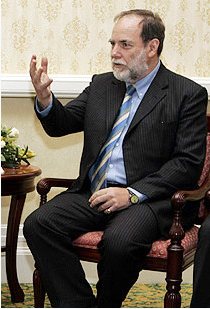
NICKY OPPENHEIMER
Former chairman of De Beers — the family that controlled 85% of the world's diamond supply for a century
His family literally controlled the global diamond market. Nicky Oppenheimer was the last family chairman of De Beers, the company that made diamonds expensive, made diamond engagement rings mandatory, and convinced the entire world that a clear rock was worth three months' salary. He sold the family's 40% stake to Anglo American in 2012 for $5.1 billion. Now he invests through Oppenheimer Generations, runs a massive conservation portfolio in southern Africa, and is worth $8 billion. The diamond king who cashed out at the top.
Net Worth
$8 billion
Nationality
South African
Time Horizon
Generational
Risk Appetite
4 / 10
Net Worth Context
- · Still a billionaire — just the quiet kind at the end of the table.
CAREER & BACKGROUND
Born in 1945 in Johannesburg, South Africa. Third-generation diamond dynasty — his grandfather Ernest founded Anglo American, and his father Harry ran De Beers.
Nicky was born into one of the wealthiest and most powerful families in Africa.
Educated at Harrow School in England and Christ Church, Oxford. Joined De Beers after university and rose through the ranks.
Became chairman of De Beers in 1998, succeeding his father.
Under his chairmanship, De Beers navigated enormous challenges: the rise of synthetic diamonds, the "blood diamonds" controversy (the Kimberley Process was established during his tenure), and competition from Russian and Australian producers that eroded De Beers' market share from 85% to around 35%.
In 2012, Oppenheimer sold the family's 40% stake in De Beers to Anglo American for $5.1 billion. It was the end of a century of Oppenheimer family control over the global diamond industry.
Post-De Beers, he created Oppenheimer Generations — a family office and investment vehicle focused on conservation, venture capital, agriculture, and infrastructure in Africa. He also owns Tswalu Kalahari, the largest private game reserve in South Africa.
COMPANIES & ROLES
De Beers was the family business — the diamond company that once controlled 85% of global supply. Oppenheimer Generations is his current vehicle — investments in conservation, agriculture, fintech, and African infrastructure.
He owns Tswalu Kalahari Reserve (the largest private game reserve in South Africa). He also invests in venture capital through Oppenheimer Generations Ventures.
INVESTING STYLE & PHILOSOPHY
Legacy stewardship transitioning to diversified investing. Oppenheimer ran a family monopoly for decades and then pivoted to a diversified investment approach.
His current style is patient, long-term, and focused on Africa — he invests in things that develop the continent: agriculture, infrastructure, fintech, and conservation.
THE PLAYBOOK
Risk Approach
Moderate now, but the family historically took enormous risks building and maintaining the diamond monopoly. Selling the De Beers stake was actually a risk-reduction move — diversifying from a single asset.
Oppenheimer now invests conservatively across multiple sectors.
Money Habits
Oppenheimer lives on Brenthurst, a 44-acre estate in Johannesburg — one of the most famous private properties in Africa. He owns Tswalu Kalahari, a 100,000-hectare game reserve.
He collects art. His lifestyle is old South African money — understated compared to tech billionaires but deeply rooted in land, heritage, and conservation.
BIGGEST WIN
Selling the De Beers stake for $5.1 billion in 2012. The timing was excellent — De Beers' market share had been declining for years, synthetic diamonds were emerging as a threat, and the diamond market was becoming more competitive.
Locking in $5.1 billion and diversifying the family wealth was a masterful exit.
BIGGEST MISTAKE
The erosion of De Beers' monopoly. Under the Oppenheimer family's watch, De Beers' market share fell from 85% to around 35%.
Russian and Australian producers broke free from the cartel. Lab-grown diamonds emerged.
The "diamonds are forever" marketing magic couldn't overcome supply economics. The monopoly that took a century to build unwound in decades.
FINANCIAL PHILOSOPHY
Build for generations, not quarters. The Oppenheimer family built De Beers over a century.
Nicky thinks in decades. His current investments in African conservation and infrastructure won't pay off for years.
He's also pragmatic — he sold De Beers when he recognized the monopoly era was ending rather than holding on for emotional reasons.
FAMILY & PERSONAL LIFE
Third-generation diamond dynasty. Married to Orcillia Lasch.
His son Jonathan is now involved in Oppenheimer Generations. The family is deeply embedded in South African business and philanthropy.
Major donors to education and conservation.
EDUCATION
Harrow School (England). Christ Church, Oxford University.
The classic British upper-class education path for a South African elite family.
BOOKS & RESOURCES
The Last Empire by Stefan Kanfer
The history of De Beers and the Oppenheimer family's century-long diamond monopoly
Diamonds, Gold and War by Martin Meredith
The broader history of southern African mining empires, including the Oppenheimers
The Big Conservation Lie by John Mbaria
A critical look at conservation in Africa. Relevant context for Oppenheimer's massive conservation investments
QUOTES (5)
My family controlled 85% of the world's diamonds for a century. Then the market changed. We sold. Timing matters more than sentimentality.
Diamonds aren't rare. We made them feel rare. That's the most successful marketing campaign in history.
Conservation isn't charity. It's infrastructure for the future of Africa.
Three generations built De Beers. I'm the one who had to decide when to let go. That was harder than anything my grandfather did.
Lab diamonds will get better and cheaper. That's why we sold. You don't fight technology. You adapt or exit.
NETFIGO SCORE
Proprietary 5-dimension investor rating
Risk Appetite
Contrarian Index
Track Record
Accessibility
Time Horizon
Related Profiles
Head-to-Head
Compare Nicky Oppenheimer vs another investor.