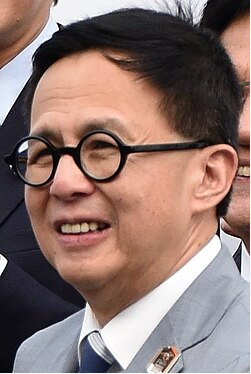
RICHARD LI
Building PCCW, Hong Kong's dominant telecom company, and founding pan-Asian insurer FWD Group.
Richard Li is the son of Li Ka-shing, for years the richest man in Asia, and he's spent his career both escaping and echoing that shadow. He sold STAR TV to Rupert Murdoch for about $950 million before he was 30. Then he bought Hong Kong Telecom in 2000 for around HK$230 billion, right before the dot-com crash. His critics said he overpaid. He did. But he kept PCCW standing, then quietly built FWD Group into a pan-Asian insurer with 38 million customers that listed in 2025. On his own terms, he's built something real.
Net Worth
$6.4 billion
Verified Oct 2026
Nationality
Hong Konger and Canadian
Time Horizon
Long-Term
Risk Appetite
8 / 10
Net Worth Context
- · Still a billionaire — just the quiet kind at the end of the table.
CAREER & BACKGROUND
Richard Li was born in 1966 in Hong Kong, the younger son of billionaire Li Ka-shing. While his older brother Victor was groomed to take over Cheung Kong Holdings, Richard went his own way.
He attended Menlo School in California and studied computer engineering at Stanford, leaving in 1987 without a degree.
After Stanford, he spent about three years managing money at an investment bank in Toronto, and picked up Canadian citizenship along the way. In 1990 he joined his father's Hutchison Whampoa.
His first big win came fast. In 1990 he founded STAR TV, a pan-Asian satellite TV network.
He sold it to Rupert Murdoch in two pieces in 1993 and 1995 for a total of about $950 million. He was in his twenties.
He used that money to set up Pacific Century Group in 1993 as his personal investment vehicle.
The defining move came in 2000. Richard bid around HK$230 billion for Cable & Wireless HKT, Hong Kong Telecom, through Pacific Century CyberWorks (PCCW).
It was the largest takeover in Asia at the time. The timing was catastrophic.
The deal was agreed in February 2000, weeks before the dot-com bubble burst, and closed that August. PCCW stock fell roughly 90% over the following years.
Richard spent the better part of a decade managing debt and rebuilding credibility.
PCCW survived and became Hong Kong's dominant fixed-line telecom and pay-TV operator. HKT Trust was spun off and listed in 2011 as a stable income vehicle.
In 2013, Richard made his next major move. He bought ING's insurance operations in Hong Kong, Macau and Thailand for about $2.1 billion to create FWD Group, then expanded through Japan, Vietnam, Indonesia, Malaysia and beyond.
FWD now serves more than 38 million customers across 10 Asian markets. After a 2022 IPO attempt stalled, FWD finally listed in Hong Kong on 7 July 2025 at about $6.15 billion.
COMPANIES & ROLES
PCCW is Richard's original big swing — Hong Kong's largest fixed-line telecom and pay-TV operator, born from the HKT acquisition in 2000. Despite brutal post-acquisition years, he kept it alive and profitable.
HKT Trust is the separately listed telecom arm, a dividend-paying vehicle that still generates reliable cash.
FWD Group is his real second act. He started acquiring undervalued insurance businesses across Asia in 2013 when pan-Asian insurance consolidation was deeply unfashionable.
FWD now covers Hong Kong, Thailand, Japan, Vietnam, the Philippines, Indonesia, Singapore, Macau, Cambodia, and Malaysia. It listed on the Hong Kong stock exchange in July 2025 and serves more than 38 million customers.
Pacific Century Group is his private holding company, sitting behind all of it — with additional stakes in real estate, finance, and early-stage technology investments.
INVESTING STYLE & PHILOSOPHY
Richard builds by buying. He looks for large, undervalued assets in Asian markets and acquires them.
The HKT playbook was: buy legacy telecom infrastructure, keep the cash flows, and slowly transform the business. FWD was the same logic applied to insurance — buy cheap Asian insurance books when they're out of fashion, bolt them together, and capture the rising Asian middle class.
He's not a stock picker. He's a dealmaker.
He thinks in decades, not quarters. His core conviction is that Asia's growing middle class will generate demand for financial services for 30+ years — making telecom, media, and insurance sensible long bets.
THE PLAYBOOK
Risk Approach
Richard Li is willing to swing big. The HKT acquisition was essentially a leveraged bet on Hong Kong's future as a digital hub, made at maximum valuation right before the crash.
He absorbed the consequences and kept building — which says something about his ability to hold through serious pain.
His risk approach isn't reckless, but it's definitely concentrated. He doesn't diversify broadly.
He makes large bets in sectors where he believes Asian structural growth gives him a long-term tailwind. The FWD build was the same: illiquid, complex, multi-market, multi-year.
Money Habits
Richard keeps a deliberately low profile for a man of his wealth and lineage. He doesn't maintain a public social media presence and rarely gives interviews.
He splits time between Hong Kong and overseas. He doesn't play the Hong Kong social scene the way his father did.
Li Ka-shing was a celebrated public figure. Richard is quieter by design.
BIGGEST WIN
Two of them, actually. The first was STAR TV.
He started it in 1990 and sold it to Rupert Murdoch for about $950 million by 1995, before he turned 30. That cash funded everything that came after.
The second is FWD Group. Starting in 2013 with ING's insurance books in Hong Kong, Macau and Thailand, Richard built a pan-Asian insurer covering 10 markets.
A 2022 IPO attempt stalled, but FWD listed in Hong Kong in July 2025 at a valuation of about $6.15 billion. He bought when insurance assets were cheap and Asian middle-class growth was underpriced.
The build proves the thesis.
BIGGEST MISTAKE
Buying Hong Kong Telecom in 2000 for around HK$230 billion. The deal was agreed in February 2000, and the dot-com peak was only weeks away.
PCCW's stock dropped roughly 90% over the following years. Shareholders who bought in at announcement prices suffered devastating losses.
Richard had bet heavily on internet infrastructure transforming HKT into a digital powerhouse. The long-term logic wasn't wrong, the timing was catastrophically wrong.
FINANCIAL PHILOSOPHY
Richard operates by a few clear beliefs. Asia is the biggest opportunity in the world — he believed this in 1990 and the numbers have backed him up.
He wants assets with recurring cash flows: telecom subscriptions, insurance premiums. He's willing to pay full price for the right strategic asset.
He thinks long but moves opportunistically when an acquisition window opens. His portfolio tells his philosophy more plainly than any interview.
FAMILY & PERSONAL LIFE
Richard Li has never married. He has three sons with his former partner, the actress Isabella Leong, who he dated from 2008 to 2011.
He is the younger son of Li Ka-shing, the Hong Kong ports, property and retail billionaire. His older brother Victor Li Tzar-kuoi took over as chairman of CK Hutchison Holdings.
The family is one of the most prominent in Hong Kong business history.
EDUCATION
Richard attended Menlo School in Atherton, California. He then studied computer engineering at Stanford University, but left in 1987 after three years without a degree.
Forbes lists him as a Stanford dropout. While there he worked as a McDonald's cashier and a golf caddy, which is a funny detail for a billionaire's son.
The Silicon Valley years shaped his conviction that technology would drive Asia's next wave of growth.
BOOKS & RESOURCES
Richard Li doesnt write books and rarely recommends them publicly.
Captures the mindset of building a dominant market position rather than competing in crowded markets — relevant to how Richard approaches telecom and insurance in Asia. It's also the lens he used on PCCW: own the infrastructure, don't fight in the middle
Essential for understanding how legacy industries get disrupted from below — which is both what PCCW feared and what FWD is doing to traditional insurance in Asia
As an Amazon Associate, Netfigo earns from qualifying purchases. Book links above may be affiliate links.
NETFIGO SCORE
Proprietary 5-dimension investor rating
Risk Appetite
Contrarian Index
Track Record
Accessibility
Time Horizon
Related Profiles
Investors
Li Ka-Shing
Li Ka-shing is Richard's father and the patriarch of one of Asia's most powerful business dynasties. Richard built PCCW and FWD in part to carve out his own identity separate from his father's Cheung Kong and Hutchison empire.
Masayoshi Son
Both made enormous concentrated bets on Asian technology infrastructure in the late 1990s. Son's SoftBank and Li's PCCW both suffered brutal corrections post-2000. Both survived and rebuilt — through telecom, insurance, and tech investments across the region.
Head-to-Head
Compare Richard Li vs another investor.