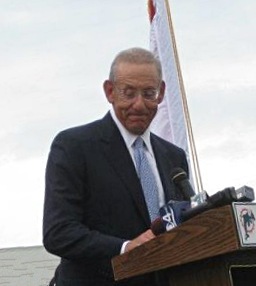
STEPHEN ROSS
Building Hudson Yards — the largest private real estate development in US history — and owning the Miami Dolphins.
Stephen Ross spent $25 billion building Hudson Yards on top of an active rail yard on Manhattan's West Side — a neighborhood that did not exist five years earlier. It is the largest private real estate development in American history. He also owns the Miami Dolphins, co-founded Equinox and SoulCycle, and turned Related Companies from a small affordable housing firm into a $60 billion real estate empire. The man builds entire neighborhoods. Most developers build buildings. Ross builds ZIP codes.
Net Worth
$12.3 billion
Nationality
American
Time Horizon
Long-Term
Risk Appetite
8 / 10
Net Worth Context
- · That's the GDP of a small country — around the size of Greenland.
- · Enough to buy an NBA team and keep $8B for snacks.
CAREER & BACKGROUND
Born in 1940 in Detroit, Michigan. Grew up in a middle-class Jewish family.
His mother was a schoolteacher. Got his undergraduate degree from the University of Michigan — later donated $378 million to the school, the largest gift in its history.
Got a law degree from Wayne State and a master's in taxation from NYU. Worked as a tax attorney at Bear Stearns in the 1960s.
Founded Related Companies in 1972 with $10,000. Started by building affordable housing using government tax credits — a niche nobody else wanted.
Pivoted to luxury development in the 1990s as he scaled up. Built the Time Warner Center at Columbus Circle in 2004 — a $1.7 billion mixed-use complex that proved he could do mega-projects.
Then the big one: Hudson Yards. Related Companies won the rights to develop the 28-acre site on Manhattan's far West Side in 2008.
Built an entirely new neighborhood over active rail yards — requiring a massive platform to be constructed over the trains. The $25 billion project includes 18 million square feet of commercial and residential space, a shopping mall, a hotel, a performing arts center, and the Vessel sculpture.
Bought the Miami Dolphins in 2009 for $1.1 billion. Also has stakes in Equinox, SoulCycle, and other lifestyle brands.
COMPANIES & ROLES
Related Companies — founder and chairman. One of the most prominent real estate firms in the US, with $60 billion in assets owned or under development.
Hudson Yards — the 28-acre, $25 billion mega-development on Manhattan's West Side. Time Warner Center — the twin-tower complex at Columbus Circle.
The Miami Dolphins — NFL team owner since 2009. Hard Rock Stadium — completely renovated.
Equinox — luxury fitness brand (Related is a major investor). SoulCycle — boutique cycling brand (Related was an early investor).
Related also develops affordable housing nationwide through its Related Affordable division.
INVESTING STYLE & PHILOSOPHY
Stephen Ross thinks bigger than almost anyone in real estate. His investing style is defined by mega-projects that other developers would not touch.
Hudson Yards required building a platform over active rail yards — an engineering challenge most developers would walk away from. He is comfortable with 10-year timelines and multi-billion-dollar budgets.
He diversifies within real estate — luxury residential, commercial office, retail, affordable housing, hospitality — but real estate is his entire world. He supplements with lifestyle investments (Equinox, SoulCycle) that align with his luxury demographic.
He finances through institutional partnerships, keeping Related's equity efficient while maintaining control.
THE PLAYBOOK
Risk Approach
Very high but calculated. Ross takes on projects that seem impossibly large, but he structures them with institutional partners, government tax incentives, and phased construction to manage the downside.
Hudson Yards involved dozens of institutional investors and lenders. He is not gambling with his own money on a single roll — he is orchestrating massive capital stacks.
The risk is in the vision and execution, not in reckless leverage. That said, betting $25 billion on a neighborhood that did not exist is not exactly conservative.
Money Habits
Lives large. Has a home in Palm Beach, a penthouse in New York, and a yacht.
He paid $1.1 billion for the Miami Dolphins. He donated $378 million to the University of Michigan — which renamed its business school the Stephen M.
Ross School of Business. He hosted a high-profile fundraiser for Donald Trump in 2019 at his home in the Hamptons, which led to a boycott of Equinox and SoulCycle.
He is a major collector of contemporary art. His lifestyle reflects his wealth — he does not hide it, but he is not flashy in the way some developers are.
He is more "quiet power" than "gold everything."
BIGGEST WIN
Hudson Yards. There is no other answer.
Stephen Ross built an entirely new neighborhood on Manhattan's West Side — 28 acres, $25 billion, 18 million square feet — on top of an active rail yard. He had to construct a massive platform over running trains before a single building could go up.
The project includes 16 skyscrapers, a luxury shopping center, a hotel, thousands of apartments, millions of square feet of office space, and the Vessel — a 150-foot honeycomb sculpture. Hudson Yards created a new ZIP code.
It transformed the far West Side from an industrial wasteland into one of the most expensive addresses in New York. Nothing else in American real estate development comes close in scale.
BIGGEST MISTAKE
The political backlash around Hudson Yards' tax incentives. Related Companies received approximately $6 billion in tax breaks and subsidies for Hudson Yards, which critics called a giveaway to a billionaire developer in an already-wealthy city.
The optics became a political liability — progressives used Hudson Yards as an example of everything wrong with developer-friendly tax policy. The Vessel also became a PR problem when it had to be closed due to multiple suicides.
None of these sunk the project financially, but they dented the narrative that Hudson Yards was a public benefit. Ross likely underestimated how much political scrutiny a $25 billion project would attract.
FINANCIAL PHILOSOPHY
Think bigger than everyone else, build what nobody else will attempt, and surround yourself with institutional capital to share the risk. Ross believes that great real estate development is about creating places, not buildings.
He has said that anyone can build a tower — the hard part is building a community. He also believes in affordable housing as a business, not just a social mission — he started there and maintains a major affordable housing division.
His philosophy combines vision with practical deal-making: dream enormous, then structure the financing so you survive if it takes twice as long as planned.
FAMILY & PERSONAL LIFE
Married to Kara Ross, a jewelry designer. Has children from previous marriages.
The family is prominent in New York and Palm Beach social circles. His relationship with the University of Michigan is essentially familial — he is the school's largest donor ever and its business school bears his name.
Born and raised in Detroit in a middle-class family.
EDUCATION
Bachelor's degree from the University of Michigan. Law degree from Wayne State University.
Master's in taxation from New York University School of Law. His tax expertise became the foundation of his career — he started by structuring affordable housing deals using tax credits, which taught him how to build complex financial structures around real estate projects.
BOOKS & RESOURCES
Ross has not published a personal reading list, but he has credited his legal and tax background with giving him a structural advantage in deal-making. He has recommended The Power Broker by Robert Caro
The biography of Robert Moses, the man who shaped modern New York through infrastructure — which is fitting given that Ross has arguably shaped modern Manhattan more than any other living developer. His practical education came from decades of building, starting with small affordable housing projects
QUOTES (6)
Hudson Yards is 28 acres built on top of running trains. We had to construct a platform over an active rail yard before laying a single brick. Nobody else wanted to touch it. That is exactly why we did.
I started with $10,000 and built affordable housing that nobody else wanted to build. Now I build neighborhoods. The principle is the same — find what other people will not do and do it better.
Anyone can build a building. The hard part is building a place — somewhere people want to live, work, eat, exercise, and spend their time. That is what Related does. We build places.
I gave $378 million to the University of Michigan because that school changed my life. I was a kid from Detroit who did not know what he wanted to do. Michigan showed me what was possible.
I bought the Dolphins for $1.1 billion and people said I overpaid. The franchise is now worth over $6 billion. Real estate taught me to buy assets that appreciate. An NFL team is just real estate with a scoreboard.
NETFIGO SCORE
Proprietary 5-dimension investor rating
Risk Appetite
Contrarian Index
Track Record
Accessibility
Time Horizon
Head-to-Head
Compare Stephen Ross vs another investor.