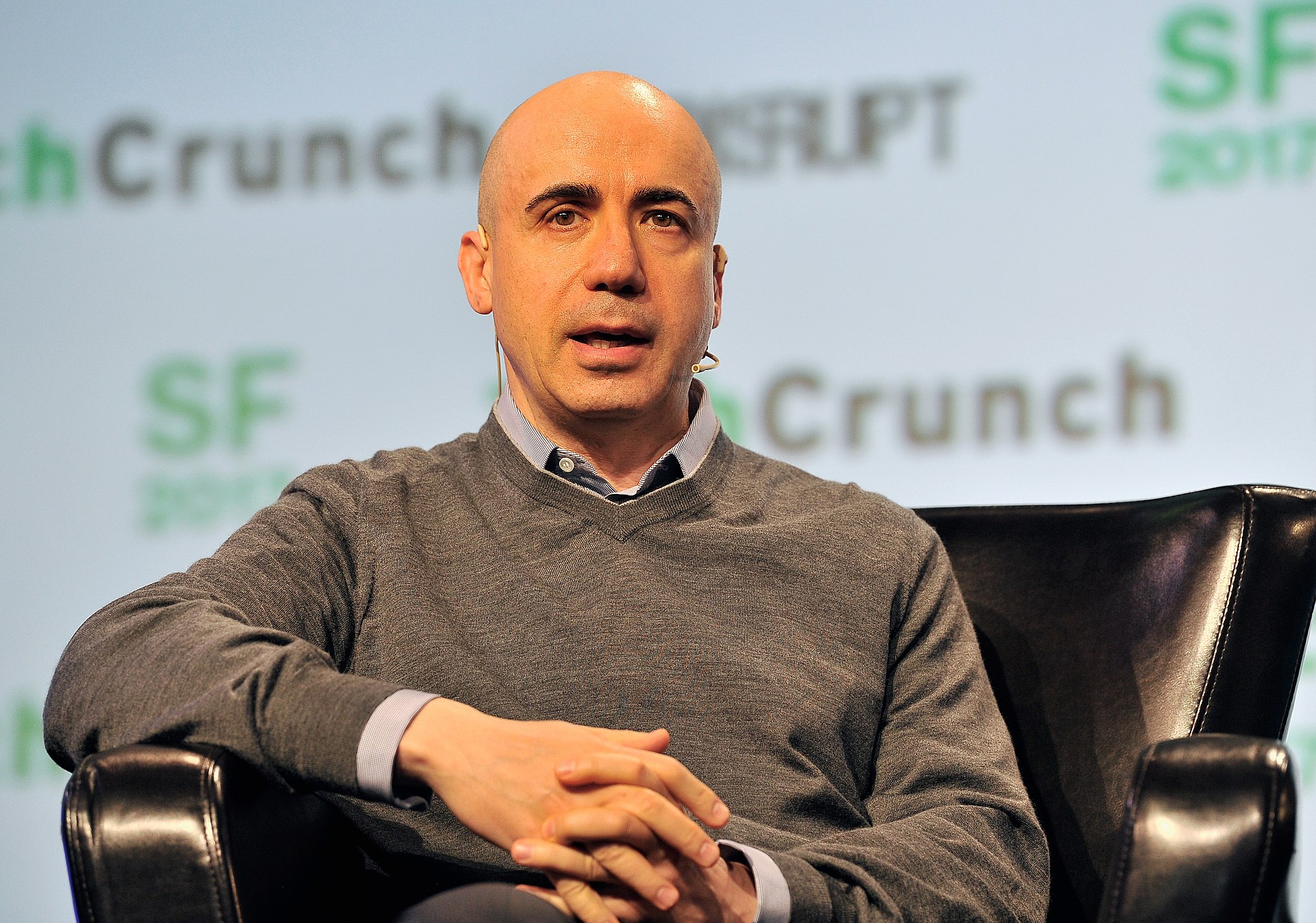
YURI MILNER
The physicist-turned-investor who wrote Facebook a $200 million check when nobody else would, then did it again and again with the best tech companies on Earth.
In 2009, Yuri Milner wired $200 million to Facebook at a $10 billion valuation. Every other serious investor thought he was insane. Facebook's actual IPO valuation three years later was $104 billion. He also got into Twitter, Airbnb, Spotify, and Xiaomi before those were household names — essentially betting that the internet would eat everything, and being right about it at a scale almost nobody else matched. The guy trained as a physicist, dropped out of a Wharton MBA, and built one of the most quietly dominant investment track records in tech history. He doesn't do TV. He doesn't do drama. He just keeps being right.
Net Worth
$7.3 billion
Nationality
Israeli-Russian
Time Horizon
Long-Term
Risk Appetite
8 / 10
Net Worth Context
- · Still a billionaire — just the quiet kind at the end of the table.
CAREER & BACKGROUND
Yuri Milner was born in Moscow in 1961, named after Yuri Gagarin — the first human in space. His parents were academics.
He studied physics at Moscow State University, which shapes everything about how he thinks even now. He wasn't going to be a physicist forever, though.
The Soviet Union was collapsing, and the opportunities were changing.
He got into the Wharton School of Business at the University of Pennsylvania in the early 1990s. He left without finishing his MBA.
That's not a failure — he left because the internet was happening and he needed to be in the room where it was happening, not in a classroom reading about it.
He went back to Russia and spent the 1990s in the early Russian tech scene. He worked at a World Bank subsidiary, then got involved with Mail.ru, Russia's answer to email and social networking.
He built it into a massive platform, eventually taking it public. But the real inflection point came when he founded DST Global in 2009.
DST — Digital Sky Technologies — was structured differently from traditional venture capital from day one. Milner wasn't interested in board seats.
He wasn't interested in control. He was interested in one thing: taking large minority stakes in the best internet companies at whatever stage they were at, often growth stage, when most traditional VCs had already deployed and most institutional investors weren't yet comfortable.
He found the gap between those two pools of capital and drove a truck through it.
The Facebook bet in 2009 made him famous. He then backed Groupon, Zynga, Twitter, and Airbnb in quick succession.
He led or co-led rounds in companies before they were public names. He moved fast, didn't demand control, and wrote checks that founders actually wanted to take.
That combination — being non-threatening to founders while still writing serious money — turned out to be a genuine competitive advantage in a market where every other investor was trying to grab a board seat.
DST Global has since invested in over 40 unicorns. Milner has also co-founded Breakthrough Prize, which he funds personally along with Mark Zuckerberg, Sergey Brin, and others — it pays $3 million to scientists doing breakthrough work, which is more than the Nobel Prize.
The man who named himself after a cosmonaut is literally funding the search for extraterrestrial intelligence through the Breakthrough Listen initiative.
COMPANIES & ROLES
DST Global is Milner's main vehicle. It's a growth-stage investment firm that writes big checks — sometimes hundreds of millions — into late-stage private tech companies.
The structure is deliberately founder-friendly: no board seats demanded, no operational interference. The pitch to founders is simple: take our money, keep control, grow faster.
That pitch worked on Zuckerberg, on the Airbnb founders, on the Spotify founders, and dozens more.
Mail.ru Group was where he made his first serious money. He helped build Russia's largest internet platform — email, social networking, games — and took it public.
It eventually became VK (VKontakte), Russia's version of Facebook. He's largely separated from Russian assets given geopolitical complications, but that's where the original capital base came from.
The DST portfolio at various points has included Facebook (pre-IPO stake that returned multiples), Twitter (invested before the IPO), Airbnb, Spotify, Xiaomi, Snapchat, WhatsApp (before the Facebook acquisition), Alibaba, Flipkart, and dozens more. The pattern is consistent: find the dominant player in a large internet market, pay a full price for a minority stake, hold it, collect the upside when it goes public or gets acquired.
Breakthrough Initiatives is his science philanthropy arm. He's committed over $100 million to Breakthrough Listen, the largest ever scientific program searching for signs of intelligent life in the universe.
For a guy who started as a physicist, this is the long game — funding the search for something that might take generations to find. That's a very long time horizon, even for Yuri Milner.
INVESTING STYLE & PHILOSOPHY
Milner operates on a single underlying thesis: the internet is the most important infrastructure ever built, and the companies that own dominant positions within it will compound value for decades. That's it.
Everything else flows from that.
His approach is sometimes called 'growth investing' but that undersells the discipline. He's not just buying things that are growing.
He's looking for network effects — businesses where every new user makes the product more valuable for every existing user. Facebook has it.
Airbnb has it. Spotify sort of has it.
Once a company achieves real network effects, displacing it becomes almost impossible. That's the moat he's looking for, even if he'd never use the word 'moat.'
The physics background matters here. He approaches investment the same way a scientist approaches a problem: build the model, find the signal in the noise, ignore the emotion.
When everyone else was scared of Facebook's valuation in 2009, Milner ran the numbers on global internet penetration, user growth trajectories, and advertising revenue potential. The conclusion was obvious to him.
The price looked high until you modeled what it could be worth in ten years — then it looked cheap.
He also doesn't try to be the smartest person in the room about operations. He backs founders who are better operators than he is.
His job is to identify the right horse, write the check, and get out of the way. No board seats means no ego — and no ego means founders actually want to work with him, which gives him deal flow that ego-driven investors never see.
And he moves fast. When the Facebook deal was happening, he structured it in weeks.
Most institutional processes take months. Speed is a genuine competitive advantage in venture because the best deals close fast — founders don't wait around for slow money.
THE PLAYBOOK
Risk Approach
Milner has a specific kind of high risk tolerance — he'll pay what looks like an absurd price for a great business, which most investors consider the riskiest thing you can do. Conventional finance says you buy things cheap.
Milner says the concept of 'cheap' doesn't apply to network-effect businesses that are winning their markets, because their intrinsic value is being systematically underestimated by people using the wrong models.
That said, he is concentrated in a specific thesis — internet platforms with network effects in large global markets. He's not diversified across industries, geographies, or asset classes the way a traditional portfolio manager would be.
If the internet thesis had been wrong, he would have been very wrong. He knew that.
He bet on it anyway because he'd done the math.
He also has a different relationship with paper losses than most investors. When late-stage private tech got hammered in 2022, DST portfolios took significant mark-downs on paper.
He didn't panic. He didn't need liquidity.
The structure of DST as a long-term vehicle insulates him from the forced selling that destroys most fund managers when sentiment turns.
The one thing he avoids is control risk — he deliberately does NOT take board seats, which means he can't be outvoted or outmaneuvered by other shareholders. He limits his downside by limiting his exposure to governance drama, which in Silicon Valley can be just as dangerous as market risk.
Money Habits
Milner is notably private for someone worth $7 billion. He split his time between Israel and Silicon Valley for years — he holds Israeli citizenship and has lived in Los Altos Hills in California.
He bought a 25,500-square-foot mansion in Los Altos Hills for $100 million in 2011, which was one of the most expensive residential purchases in California history at the time. So he's not exactly a minimalist.
But he's not loud about it either.
He drives relatively modest cars for his net worth. He doesn't have a fleet of private jets documented publicly.
He's not a fixture at the Monaco Grand Prix or the World Economic Forum cocktail circuit in the way that flashier billionaires are. His public appearances tend to be at science events and tech conferences, not charity galas.
He has committed personally to funding the Breakthrough Prize — which pays $3 million per laureate, annually, across mathematics, physics, and life sciences. He co-funds it with Mark Zuckerberg, Sergey Brin, Anne Wojcicki, and others.
The ceremony itself is famously lavish — nicknamed the 'Oscars of Science' — which is the one area where Milner clearly enjoys spectacle.
He also signed the Giving Pledge, committing to give away the majority of his wealth. For someone who grew up in the Soviet Union and made his money in the chaos of post-Soviet Russia and Silicon Valley, the Giving Pledge represents a genuine philosophical commitment — not just a PR move.
BIGGEST WIN
Facebook. Full stop.
In May 2009, DST Global invested $200 million in Facebook at a $10 billion valuation. This was a period when Facebook was still private, had no clear path to an IPO, and had just been through a period where its own internal valuation had been written down.
Microsoft had invested at a higher implied valuation in 2007 and was sitting on a paper loss. The conventional wisdom was that $10 billion was insane for a social network.
Milner bought it anyway. He then bought more.
DST ended up with roughly 5-10% of Facebook before the IPO through various secondary purchases and direct investment rounds.
Facebook's IPO in May 2012 valued the company at $104 billion. The shares eventually reached a market cap north of $1 trillion.
The specific DST return on the 2009 investment has been estimated at well over 10x — on hundreds of millions of dollars. In absolute dollar terms, it is one of the most profitable single venture investments ever made by a non-founding investor.
What made it remarkable wasn't just the money. It was the intellectual courage.
Milner modeled what the business could be worth and paid what the model said it was worth — not what the market sentiment said it was worth. Every other major investor passed or hedged.
He committed. That's the bet.
BIGGEST MISTAKE
The most visible stumble was Groupon. DST invested in Groupon before its 2011 IPO as part of a broader growth-stage strategy of backing platform businesses with strong user growth.
The IPO valued Groupon at about $13 billion, making it the largest internet IPO since Google at the time.
The stock cratered. Within a year of the IPO, Groupon had lost more than 75% of its value.
The business model turned out to be fundamentally weaker than it appeared — local merchants found the deals didn't generate repeat customers, the sales force was expensive to maintain, and the competitive moat basically didn't exist. Amazon launched a competitor.
Google had tried to buy Groupon for $6 billion before the IPO — they passed. That should have been a signal.
DST's losses on Groupon were estimated in the hundreds of millions. The lesson Milner reportedly took was that user growth metrics are not sufficient — you also need to verify that the business model creates genuine value for all parties (customer, merchant, platform) in a sustainable loop.
Groupon optimized for one-time transactions, which looked like growth but was actually churn with extra steps.
He also had exposure to several other companies that underperformed — Zynga being another notable one. The common thread in the misses was businesses where the network effect was shallower than it appeared at the growth stage.
FINANCIAL PHILOSOPHY
The core principle is that dominant internet platforms are mispriced by the market because most investors are using backward-looking metrics. Revenue multiples, P/E ratios, DCF models — none of those capture what a network-effect business is actually worth over a 15-year horizon.
You need a different model. You need to estimate the eventual size of the market, assume the winner takes most of it, and work backwards to what a stake is worth today.
He also believes that the cost of missing a great company is higher than the cost of overpaying for it. If Facebook had been worth half the $10 billion valuation he paid in 2009, he'd still have made a lot of money.
If he'd passed on Facebook entirely, that's a loss you can never recover. The asymmetry of outcomes means you should err toward investing in the obvious winners.
Founder quality is non-negotiable. He's said publicly that he looks for founders who are in it for the mission, not the exit.
Founders who want to build something lasting, not flip it. That's partly a filter for quality and partly a practical observation: those founders make better decisions over the long run because they're optimizing for the business, not for a near-term transaction.
And he genuinely believes in the civilizational importance of what he's funding. The Breakthrough Prize and Breakthrough Listen aren't philanthropy bolted on to a business career — they're an expression of the same worldview.
Science and technology are how humanity solves its biggest problems. Betting on them is rational whether you're investing money or donating it.
FAMILY & PERSONAL LIFE
Milner is married to Julia Milner, who is a co-founder of the Breakthrough Prize alongside him. They have children together.
Julia is an active co-architect of the Breakthrough initiatives — she's not just a spouse listed on a foundation board, she's genuinely involved in running it.
His father, Boris Milner, was a prominent Soviet economist who wrote extensively on organizational management. That background in rigorous analytical thinking about complex systems clearly influenced how Yuri approaches both investing and science.
He was named after Yuri Gagarin — his parents were obviously optimistic about the future of human exploration. The fact that he's now personally funding the search for extraterrestrial intelligence is the kind of biographical arc that writes itself.
The boy named after the first man in space grew up to fund humanity's attempt to find out if there's anyone else out there.
He became an Israeli citizen partly for practical reasons related to his international business activities, and has deep ties to both the Israeli tech ecosystem and Silicon Valley. He moved away from Russia significantly following the escalation of the Ukraine conflict, which complicated his relationship with some of his Russian-origin assets.
EDUCATION
Milner studied physics at Moscow State University, one of the most competitive academic programs in the Soviet Union. Physics gave him the quantitative toolkit and the habit of building models before drawing conclusions — both of which define how he invests.
He was then accepted to Wharton's MBA program and moved to the US in the early 1990s. He left without completing the degree.
Not because he failed — because the internet was starting and he needed to be operating in it, not studying it. Wharton wasn't where the opportunity was.
He made the call and left. In hindsight, probably the right decision.
BOOKS & RESOURCES
Milner hasnt written an investment book, and he rarely does the kind of extended interview where youd get a recommended reading list
But a few things are known to be central to his thinking
Essentially required reading for anyone doing what Milner does — understanding why dominant incumbents consistently fail to respond to disruptive new entrants. If you want to understand why Milner believed a social network was worth $10 billion when the prevailing media companies were worth less, this book explains the mental model
Covers the logic of monopoly and network effects in a way that mirrors Milner's investment thesis closely. Thiel and Milner move in overlapping circles for a reason — they're running the same underlying playbook from different angles
The kind of book Milner reportedly engages with seriously. It argues that human knowledge and progress are potentially unlimited if we keep asking the right questions. For someone funding the search for extraterrestrial life and giving $3 million prizes to physicists, that worldview is not incidental — it's foundational
As an Amazon Associate, Netfigo earns from qualifying purchases. Book links above may be affiliate links.
QUOTES (6)
The best companies are those that create a network where the more people join, the more valuable the network becomes for everyone.
We are not trying to be smarter than the founders. We are trying to identify who the great founders are and then support them.
The cost of missing a great company is much higher than the cost of overpaying for one. Asymmetry matters.
We are living at the most remarkable moment in human history. The internet is the most transformative technology since the printing press.
If there is other intelligent life in the universe, and we don't look, we will never know. That seems like a strange choice for a species that calls itself curious.
Physics teaches you one thing above all else: your intuitions are wrong and the model is right. Build the model. Trust the model.
NETFIGO SCORE
Proprietary 5-dimension investor rating
Risk Appetite
Contrarian Index
Track Record
Accessibility
Time Horizon
Related Profiles
Investors
Mark Zuckerberg
Milner's most famous investment — he wired $200M to Zuckerberg's Facebook in 2009 at a $10B valuation when every other serious investor passed. Co-funds the Breakthrough Prize with Zuckerberg.
Peter Thiel
Both Milner and Thiel were early Facebook investors operating on similar network-effects theses. Thiel via Founders Fund at seed stage; Milner at growth stage. They move in overlapping circles and share a worldview about technology monopolies.
Companies
Airbnb
DST Global was an early growth-stage investor in Airbnb, backing the company before it became a household name as part of Milner's broader strategy of identifying dominant platform businesses.
Spotify
DST Global backed Spotify before its IPO — a textbook Milner play: dominant platform with network effects in a large global market, funded at growth stage when most traditional VCs had already deployed.
Head-to-Head
Compare Yuri Milner vs another investor.