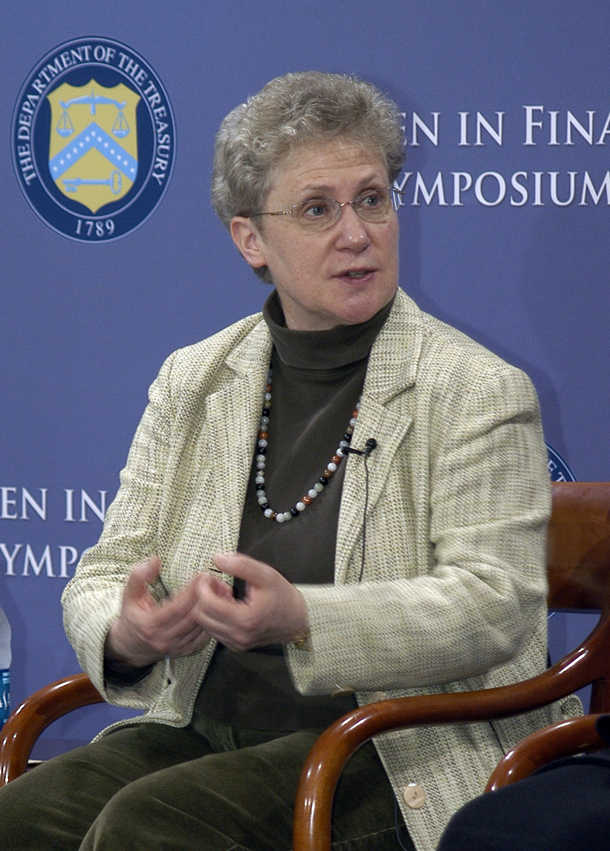
ABBY JOSEPH COHEN
Wall Street's most famous equity bull. Chief U.S. investment strategist at Goldman Sachs through the 1990s. Called the decade-long bull market early and correctly — then couldn't call the exit.
Abby Joseph Cohen was the most listened-to bull on Wall Street through the 1990s. She correctly called the tech-driven equity rally at Goldman Sachs when skeptics were everywhere — and she was right for most of a decade. In 1998, Goldman made her a partner and handed her the title of chief U.S. investment strategist. The problem? She stayed bullish into the dot-com collapse in 2000 and 2001. She stepped down from the strategist role in March 2008 — just months before the worst financial crisis in a generation. One of the best calls in Wall Street history. One of the worst exits.
Net Worth
$15M–$25M (estimated)
Nationality
American
Time Horizon
Long-Term
Risk Appetite
7 / 10
CAREER & BACKGROUND
Abby Joseph Cohen started her career as a quantitative analyst at the Federal Reserve Bank of New York, then moved through T. Rowe Price and Kidder Peabody before joining Goldman Sachs in 1990 as a portfolio strategist.
Through the early 1990s she was making bullish calls on U.S. equities when Wall Street wasn't ready to believe them.
She was right. The S&P 500 climbed roughly 430% from 1990 to its peak in 2000.
Goldman recognized the signal and made her a partner in 1998 — the same year she was named chief U.S. investment strategist.
At her peak, her market calls moved markets. Portfolio managers across the country adjusted positions based on her S&P 500 targets.
She set a year-end 1999 target of 1,650. The index closed at 1,469.
Close enough. She kept setting bullish targets through 2000 and 2001 even as the dot-com bubble burst around her.
She stepped down from the chief strategist role in March 2008, replaced by David Kostin. She stayed at Goldman in an advisory capacity and later became a professor at Cornell University's Johnson School.
COMPANIES & ROLES
Goldman Sachs was Cohen's professional home for nearly 20 years — she joined in 1990 and spent the rest of her active career there. Before Goldman, she worked at T.
Rowe Price in Baltimore and at Kidder Peabody in New York as a portfolio strategist. She started at the Federal Reserve Bank of New York as a quantitative analyst straight out of graduate school.
Post-Goldman, she has focused on academia at Cornell University's Johnson School of Management, teaching economics and global markets.
INVESTING STYLE & PHILOSOPHY
Cohen is a fundamental macro strategist. She builds market views from the top down: start with GDP growth expectations, overlay corporate earnings estimates, factor in interest rate dynamics, and translate all of that into an S&P 500 price target.
She doesn't pick individual stocks — she tells institutions how much of their portfolio should be in equities. Her bullish reputation was built on a consistent belief that U.S.
corporate earnings power justifies owning stocks for the long term. She uses quantitative models but explains them in plain language, which is part of why her calls resonated with such a wide audience.
THE PLAYBOOK
Risk Approach
Cohen ran on the bullish side for most of her career and rarely called for defensive positioning. She is not a permabull in the dismissive sense — she has real models behind her views — but her instinct leans toward equity ownership over cash or bonds.
The risk is staying too long when conditions change. That is exactly what happened in 2000 and 2008.
Money Habits
Cohen is not known for flashy living. She built her wealth through a long career at Goldman Sachs, including partner-level compensation, but has never made headlines for extravagant spending.
She has been involved in charitable causes connected to education and economic mobility. She reportedly keeps a disciplined household budget that does not match her Wall Street income level.
BIGGEST WIN
The 1990s bull market call. Starting in the early 1990s, Cohen recommended overweighting U.S.
equities when valuations were being questioned and economic uncertainty was high. She stayed bullish through the technology rally, correctly predicting that corporate earnings growth would justify elevated multiples.
The S&P 500 rose roughly 430% from 1990 to its peak. Clients who listened made serious money.
BIGGEST MISTAKE
Not turning bearish in 1999 and 2000 fast enough. Cohen was still setting bullish S&P 500 targets even as the dot-com bubble inflated to absurd levels.
Her credibility was so tied to the bull market that pivoting felt like a betrayal of her own decade of calls. By 2001, the damage was done.
Her reputation never fully recovered among the crowd that wanted her to call the exit.
FINANCIAL PHILOSOPHY
Equities represent ownership in businesses, and businesses reflect the long-term compounding power of human ingenuity. Short-term market volatility is not the same as long-term risk.
Over any meaningful time horizon, owning stakes in productive enterprises beats holding cash or bonds. The job of a strategist is to separate the economic signal from the market noise and act on the signal.
FAMILY & PERSONAL LIFE
Married to David Cohen, an economic consultant. They have two daughters.
The family is based in New York. Cohen has spoken about balancing a demanding Wall Street career with family life during an era when women in senior finance positions were far fewer than today.
EDUCATION
BA in economics and mathematics from George Washington University. MBA from Cornell University's Johnson School of Management.
Her quantitative background — particularly her time at the Federal Reserve after graduation — gave her the model-building foundation that defined her career.
BOOKS & RESOURCES
The foundational text for anyone thinking seriously about equities
The longer, harder version that forms the bedrock of fundamental analysis
A book she has recommended for understanding market efficiency and the limits of active management
A framework for identifying high-quality growth businesses that complements her macro work
As an Amazon Associate, Netfigo earns from qualifying purchases. Book links above may be affiliate links.
QUOTES (6)
The stock market is not the economy. But over long periods, the two tend to rhyme.
Corporate America has repeatedly demonstrated an ability to adapt and grow earnings even in difficult environments.
Investors who confuse short-term market movements with long-term fundamental risk make very expensive mistakes.
Our models suggest the equity market remains undervalued relative to its earnings potential.
The role of a strategist is to provide clarity when markets are generating noise.
A rising trend in corporate earnings is the most powerful engine behind a sustained bull market.
NETFIGO SCORE
Proprietary 5-dimension investor rating
Risk Appetite
Contrarian Index
Track Record
Accessibility
Time Horizon
Related Profiles
Investors
Ken Fisher
Both are known for sustained bullish equity views built on fundamental earnings analysis. Fisher and Cohen represent the institutional sell-side tradition of calling market direction from macro fundamentals.
Peter Lynch
Both Lynch and Cohen championed long-term equity ownership during the 1990s bull market. Lynch did it through individual stock selection at Fidelity; Cohen did it through top-down macro calls at Goldman Sachs.
Warren Buffett
Cohen's fundamental belief in the long-term compounding power of U.S. equities mirrors Buffett's core philosophy. She expressed it through macro strategy and S&P 500 targets; he expresses it through individual business ownership.
Head-to-Head
Compare Abby Joseph Cohen vs another investor.