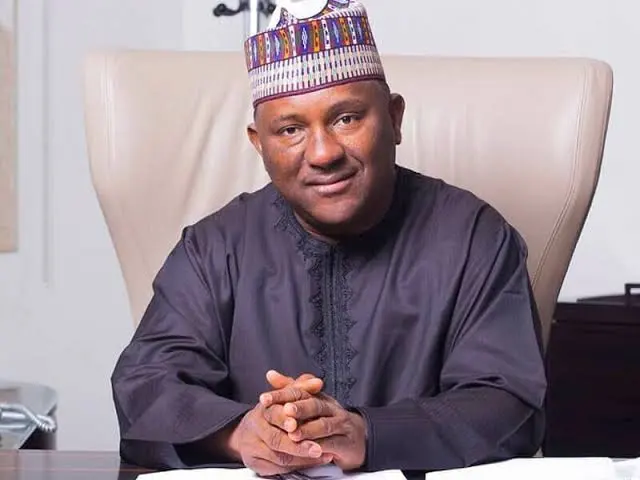
ABDUL SAMAD RABIU
Building Nigeria's BUA Group into a multi-billion dollar industrial empire across cement, sugar, and essential food staples.
He started with a commodity trading desk and built Nigeria's most profitable industrial engine while everyone else debated digital trends. Abdul Samad Rabiu does not chase hype. He pours concrete, mills flour, and refines sugar. His 2020 merger created a cement giant that now dominates the national construction boom. Boring sectors, massive scale, relentless focus. He just owns the supply chain.
Net Worth
$11.2 billion
Nationality
Nigerian
Time Horizon
Generational
Risk Appetite
8 / 10
Net Worth Context
- · Could buy every NFL team simultaneously and still have $-48B left.
- · Earns roughly $10,654 per minute — assuming 5% annual return.
CAREER & BACKGROUND
He cut his teeth in the family business, IRS Group, learning the ropes of Nigerian commerce early on. In 1988, he struck out on his own with BUA International Limited.
The initial play was simple commodity trading. He bought and moved rice, flour, and steel.
It was unglamorous work. But it gave him the cash flow and logistics network he needed for bigger moves.
By the mid-1990s, he pivoted from moving goods to making them. He secured a landmark deal with the government-owned Delta Steel Company.
Instead of just supplying raw materials, he started trading finished steel products. The margin expanded.
The footprint grew. He eventually took over Nigerian Oil Mills.
He launched flour-milling plants in Lagos and Kano by 2005. Then came sugar.
In 2008, he commissioned a massive refinery that broke an eight-year monopoly. Every move followed the same pattern.
Find a shortage. Fix the supply.
Scale aggressively.
He took that template into cement in 2009. He bought into the state-controlled Cement Company of Northern Nigeria.
He then bet nearly a billion dollars on a greenfield plant in Edo State that critics called too big. It opened in 2015.
The 2020 merger cemented his legacy, creating one of the largest listed companies on the Nigerian Stock Exchange. He did not just build a business.
He built infrastructure.
COMPANIES & ROLES
BUA Group is the umbrella. It handles cement, flour, sugar, pasta, edible oils, and port logistics across Nigeria.
Revenue tops $2.6 billion annually. BUA Cement Plc is the crown jewel.
It is the second-biggest cement producer in Nigeria. The 2020 listing merged his private cement operations with a public shell into a single, highly liquid stock.
BUA Foods Plc followed in 2022. It packages and distributes household staples.
The model is vertical integration. He controls the ports where raw imports arrive.
He runs the mills that process them. He owns the logistics that deliver the final product.
That stack gives him pricing power in an economy with massive inflation and currency swings. There is also ASR Africa, launched in 2021.
It is not a business. It is his philanthropic vehicle.
It directs capital into health and education across West Africa.
INVESTING STYLE & PHILOSOPHY
He does not speculate. He buys factories.
His approach is entirely operational and defensive. He looks for essential goods that people need regardless of the economic cycle.
Food and shelter basics. He treats business expansion like infrastructure development.
You do not build it fast and hope it works. You pour capital, secure supply chains, and wait for the country to catch up to your capacity.
He is heavily focused on backward integration. That means replacing costly imports with domestic production.
He buys local raw materials. He trains local workers.
He cuts out the middlemen. The strategy is slow, capital-intensive, and brutally practical.
It ignores Silicon Valley valuations in favor of steady cash flow and physical assets that appreciate with inflation.
THE PLAYBOOK
Risk Approach
He bets on scarcity and necessity. He is willing to drop over a billion dollars on a single greenfield cement plant in a region with volatile power and logistics.
That requires a high tolerance for operational risk and regulatory friction. He mitigates currency risk by focusing on essential goods that people buy even when the naira weakens.
He does not hedge with financial derivatives. He hedges by owning the physical supply chain.
If he loses money, it is not because of a bad stock tip. It is because construction slows down or import licenses get delayed.
He absorbs macroeconomic shocks through scale. He is comfortable with illiquid, long-term bets.
He is not comfortable with financial leverage without underlying assets to back it up.
Money Habits
The man recently bought a Bombardier Global 8000 in 2025. It is the fastest civilian aircraft flying today.
It can go from Lagos to New York nonstop. That is a clear signal of how he values time and connectivity.
Beyond the jet, there is not much public noise about personal luxury cars or flashy vacations. He channels capital back into BUA expansion and his philanthropy foundation.
He lives like someone who measures wealth in production capacity, not consumer goods. His charity targets education and healthcare in West Africa, often funded directly from dividends.
He does not post about it. He just deploys it.
The lifestyle is quiet until it is time to sign a multibillion-dollar acquisition. Then the machinery moves fast.
BIGGEST WIN
The $3.3 billion 2020 merger that formed BUA Cement Plc is the headline. It was not just a financial restructuring.
It combined his private Edo State cement complex with the publicly listed Sokoto Cement. The result was Nigeria's third-largest company by market cap overnight.
The Edo plant itself was a massive gamble. It cost over a billion dollars and took years to build in a region with weak infrastructure.
But it created 6 million metric tonnes of annual capacity. When it hit the public market in 2020, it rewarded patient capital and delivered a massive liquidity event.
He turned a regional industrial asset into a publicly traded blue-chip stock. The combined valuation of BUA Cement and BUA Foods crossed $15 billion shortly after listing.
He captured the premium that comes from scaling domestic manufacturing before the market fully appreciates it.
BIGGEST MISTAKE
Public records do not show a glaring, high-cost failure in his operating history. The Nigerian business environment is notoriously rough.
Currency devaluations, port bottlenecks, and regulatory shifts eat margins daily. His risk comes from overbuilding capacity too fast during currency crashes, which ties up capital in expensive local assets while import costs surge.
If he missed the mark anywhere, it was likely in the early days of sugar refining, where breaking monopolies often invited heavy political and infrastructural friction before profits stabilized. The lesson is straightforward in emerging markets.
Scale is your shield, but it is also your anchor. You have to keep cash reserves thick enough to survive policy shocks while you are building the pipeline.
FINANCIAL PHILOSOPHY
Control the supply. Own the raw materials.
If you do not control where the product comes from, you do not control your margins. That is the core rule.
He believes in backward integration above everything else. Instead of relying on volatile global shipping lanes, he processes inputs locally.
He focuses on sectors where demand is non-negotiable. Cement, sugar, flour.
Markets do not disappear. They just grow with the population.
He also believes in timing. You build capacity before the peak demand hits.
You absorb the upfront pain while competitors wait for certainty. Patience here is not passive.
It is strategic waiting. Let others chase quick returns.
He builds the pipes that deliver the water.
FAMILY & PERSONAL LIFE
His business instincts were not learned in an MBA program. They were inherited.
His father, Khalifah Isyaku Rabiu, was a major Nigerian industrialist in the 1970s and 1980s. Abdul Samad grew up watching how physical goods moved through West Africa.
Details about his wife and children remain strictly out of the public eye. He keeps his personal life locked down, preferring his industrial operations to make the noise.
The family legacy is not about celebrity. It is about keeping control of the core industries that run the country.
He has positioned BUA to be passed down as an ongoing enterprise rather than a liquidated portfolio.
EDUCATION
He studied Economics at Capital University in the United States. He did not stay in the West to chase corporate banking.
He came back with a macro lens and went straight into the family trading business. That economics background explains his obsession with supply, demand, and import substitution.
He reads markets in terms of physical shortages and currency flows rather than technical charts. The degree gave him the framework.
The Nigerian economy gave him the battlefield.
BOOKS & RESOURCES
He does not publish business manifestos or recommend reading lists publicly
His strategy is written in factory outputs, not book pages. For anyone trying to understand the industrialist playbook in emerging markets, two books capture the exact mindset he operates with
Breaks down why investing in real production beats financial speculation in developing economies
Shows how domestic manufacturing supply chains win through relentless operational focus. These align directly with his approach to backward integration and capital deployment
As an Amazon Associate, Netfigo earns from qualifying purchases. Book links above may be affiliate links.
NETFIGO SCORE
Proprietary 5-dimension investor rating
Risk Appetite
Contrarian Index
Track Record
Accessibility
Time Horizon
Related Profiles
Head-to-Head
Compare Abdul Samad Rabiu vs another investor.