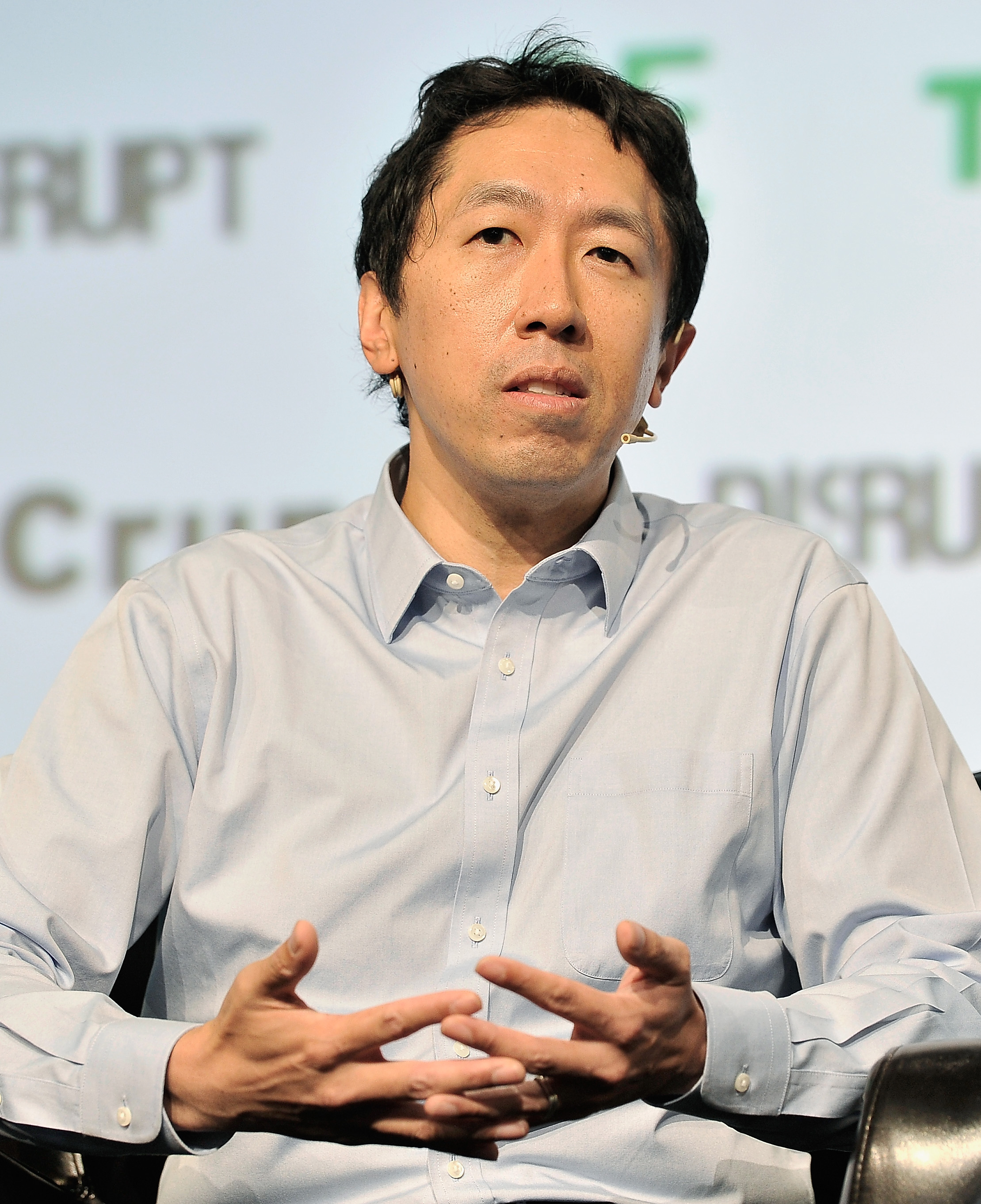
ANDREW NG
Co-founded Coursera and Google Brain. Stanford professor who taught more people about AI and machine learning than anyone in history.
Andrew Ng taught a free Stanford machine learning class online and 100,000 people enrolled. That class became Coursera, now a public company with more than 160 million registered learners. He then co-founded Google Brain, the project that kicked off Google's AI dominance. He was chief scientist at Baidu. He started AI Fund, Landing AI, and DeepLearning.AI, and joined Amazon's board in 2024. He has been the most important educator in AI for over a decade. If you have taken any online AI course, there is a good chance Andrew Ng was your professor.
Net Worth
Not publicly disclosed
Verified Sep 2026
Nationality
British-American
Time Horizon
Long-Term
Risk Appetite
5 / 10
CAREER & BACKGROUND
Andrew Yan-Tak Ng was born in London on 18 April 1976 to Hong Kong immigrant parents. He grew up in Hong Kong and Singapore.
He studied at Carnegie Mellon (B.S. 1997), MIT (M.S.
1998), and UC Berkeley (PhD 2002). He joined Stanford's faculty in 2002 and quickly became one of the leading researchers in machine learning and robotics.
In 2011, he co-founded Google Brain with Jeff Dean, Greg Corrado and Rajat Monga, which proved that deep learning could work at scale using Google's computing infrastructure. In 2012, he and Daphne Koller co-founded Coursera after Ng's Stanford machine learning class attracted 100,000+ online students.
In 2014, Baidu recruited him as chief scientist to build their AI lab. He left Baidu in March 2017 and launched AI Fund (a venture studio), Landing AI (which applies AI to manufacturing), and DeepLearning.AI (online education).
Amazon appointed him to its board of directors in April 2024. He remains an adjunct professor at Stanford.
COMPANIES & ROLES
Coursera (NYSE: COUR) — co-founded in 2012, now a publicly traded online education platform. Google Brain — co-founded in 2011, became the foundation of Google's AI research.
Landing AI — founded 2017, applies computer vision and AI to manufacturing and industry. AI Fund — a venture studio launched in 2018 with $175 million.
DeepLearning.AI — his online education platform. He was also chief scientist at Baidu (2014-2017), joined Amazon's board of directors in April 2024, and maintains his Stanford professorship.
INVESTING STYLE & PHILOSOPHY
Ng invests like a builder. He doesn't buy stocks or trade markets.
He creates companies around specific AI applications, funds them through AI Fund, and scales them. His investment thesis is simple: AI will transform every industry, and the people who build the tools and education to enable that transformation will capture enormous value.
He focuses on practical AI — not flashy demos, but actual business applications in manufacturing, healthcare, agriculture. He also invests in education infrastructure because he believes the biggest bottleneck for AI adoption is talent, not technology.
THE PLAYBOOK
Risk Approach
Ng is moderate on risk. He's never been a pure startup gambler.
He built his career on solid academic credentials and then moved into entrepreneurship with the safety net of Stanford, Google, and Baidu behind him. His ventures are calculated — AI Fund is structured as a studio that reduces risk by building companies systematically rather than betting on lone founders.
He takes the risk of starting new companies but hedges it with his expertise, network, and personal brand. He has never made a reckless bet.
Money Habits
Ng lives in the Bay Area and maintains a relatively modest lifestyle for his wealth. He is known for his generosity with time — he personally responds to students, attends education events, and makes himself accessible in a way that's unusual for someone at his level.
He dresses casually. He doesn't seek publicity beyond what's needed for his companies and educational mission.
His primary indulgence appears to be his work itself — he works intensely and across multiple companies simultaneously.
BIGGEST WIN
Google Brain. Ng, Jeff Dean, Greg Corrado and Rajat Monga demonstrated that deep learning could work at massive scale using Google's infrastructure.
The project trained a neural network on 10 million YouTube thumbnails, and it learned to recognize cats without being told what a cat was. The paper went viral.
Google Brain became the core of Google's AI strategy and directly led to improvements in Google Search, Google Translate, Google Photos, and eventually the development of transformer models. It is hard to overstate how much of modern AI traces back to this project.
Coursera is also a massive win — the platform passed 160 million registered learners.
BIGGEST MISTAKE
Leaving Baidu. Ng joined Baidu in 2014 with ambitious plans to build a world-class AI research lab in China.
He left in 2017, and accounts differ on why. The lab produced good work but never achieved the transformative impact Ng envisioned.
Cultural and bureaucratic challenges within a large Chinese tech company proved difficult to navigate. Ng has been diplomatic about it, but the move consumed three years that he could have spent building his own companies.
It also raised questions about technology transfer that became politically complicated as US-China tech tensions escalated.
FINANCIAL PHILOSOPHY
Ng believes AI is the new electricity — it will transform every industry the way electrification did a century ago. He believes the biggest opportunity in AI is not building chatbots but applying AI to traditional industries (manufacturing, agriculture, healthcare) where the impact is enormous but the glamour is low.
He believes in democratizing AI through education — he's taught more people about machine learning than any human being alive. He believes that AI anxiety is overblown and that the technology is overwhelmingly beneficial.
FAMILY & PERSONAL LIFE
Ng is married to Carol Reiley, a roboticist and entrepreneur who co-founded Drive.ai (later acquired by Apple). They married in 2014 and have two children, a daughter born in 2019 and a son born in 2021.
Both his parents emigrated from Hong Kong: his father, Ronald Paul Ng, was a haematologist and lecturer at UCL Medical School who once tried to program a computer to diagnose patients, which is where Ng first saw code. His mother, Tisa Ho, was an arts administrator who worked at the London Film Festival and went on to run major arts organisations.
The family moved to Singapore in 1984 when he was eight, and he graduated from Raffles Institution. He has said his multicultural upbringing was critical to his ability to work across different cultures and institutions.
EDUCATION
Carnegie Mellon University (B.S. 1997, triple major in computer science, statistics and economics).
MIT (M.S. 1998, electrical engineering and computer science).
UC Berkeley (Ph.D. 2002, computer science).
Stanford (adjunct professor). He has one of the most impressive academic pedigrees in technology.
BOOKS & RESOURCES
Pattern Recognition and Machine Learning by Christopher Bishop is another recommendation.
As an Amazon Associate, Netfigo earns from qualifying purchases. Book links above may be affiliate links.
QUOTES (1)
AI is the new electricity.
NETFIGO SCORE
Proprietary 5-dimension investor rating
Risk Appetite
Contrarian Index
Track Record
Accessibility
Time Horizon
Related Profiles
Head-to-Head
Compare Andrew Ng vs another investor.