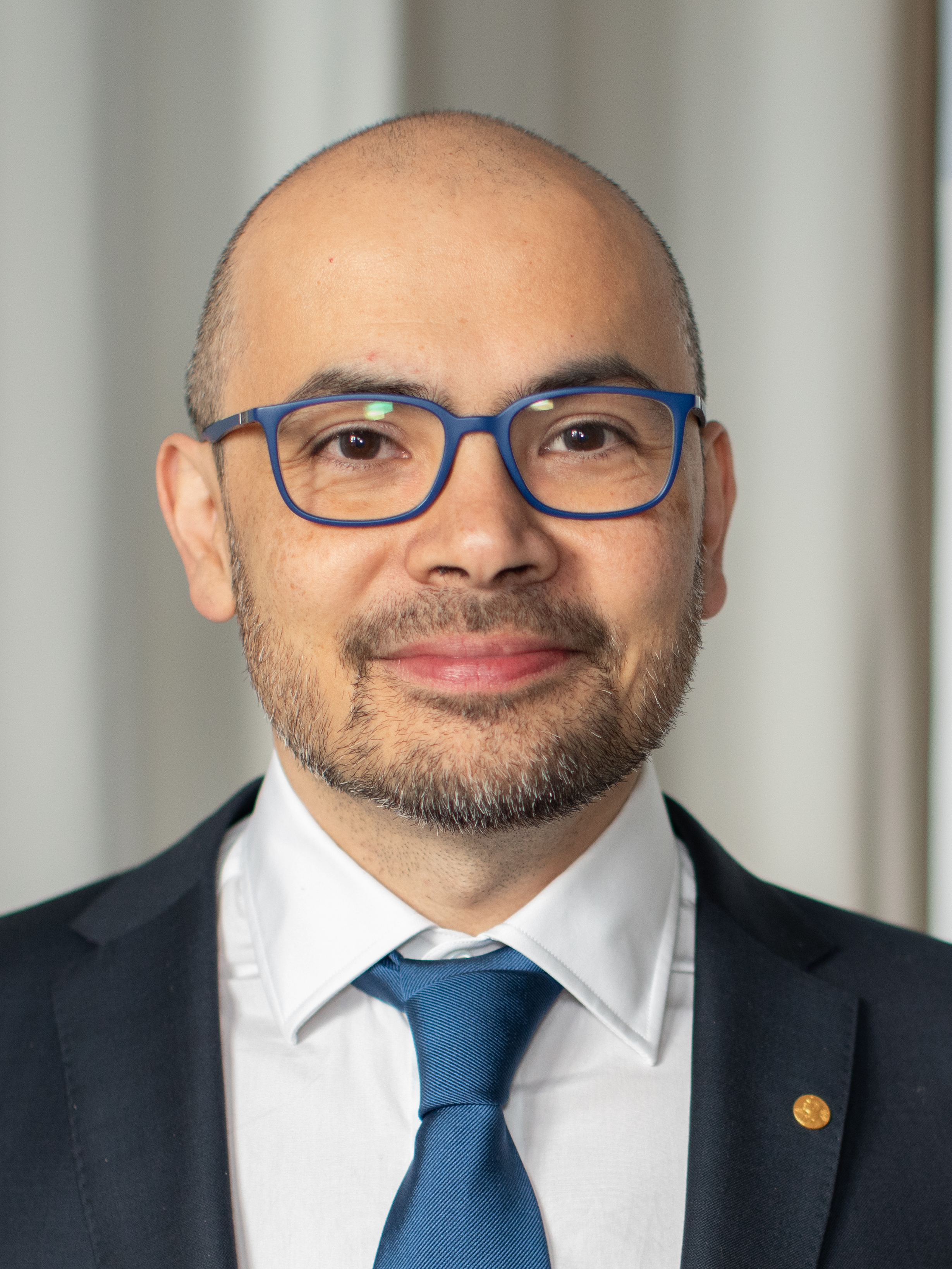
DEMIS HASSABIS
Co-founded DeepMind and built AlphaGo, AlphaFold, and some of the most important AI systems in history. Won the Nobel Prize in Chemistry in 2024.
Demis Hassabis was a chess prodigy at 4, a game designer at 17, a neuroscience PhD at Cambridge, and a co-founder of DeepMind at 34. Then his AI beat the world champion at Go — a game so complex that experts said AI wouldn't crack it for another 20 years. Then AlphaFold solved protein folding, a 50-year-old grand challenge in biology. He won the Nobel Prize in Chemistry in 2024 for it. Google bought DeepMind for $500 million in 2014. It was the best acquisition in Google's history, and it wasn't close.
Net Worth
$1.5 Billion
Nationality
British
Time Horizon
Generational
Risk Appetite
8 / 10
Net Worth Context
- · Still a billionaire — just the quiet kind at the end of the table.
CAREER & BACKGROUND
Demis Hassabis was born in London in 1976. His father is Greek-Cypriot and his mother is Singaporean-Chinese.
He was a chess prodigy, reaching master level by age 13 — at one point the second-highest-rated player in the world for his age. At 17, he co-designed and programmed Theme Park, a hit video game that sold millions of copies for Bullfrog Productions.
He studied computer science at Cambridge, graduating with a double first. He then founded Elixir Studios, a video game company that made two commercially unsuccessful games before shutting down.
He went back to academia, earning a PhD in cognitive neuroscience at University College London, studying imagination and memory. In 2010, he co-founded DeepMind with Shane Legg and Mustafa Suleiman, with the mission to "solve intelligence, and then use that to solve everything else." In 2013, DeepMind published a paper showing an AI that learned to play Atari games at superhuman levels from raw pixels.
Google acquired DeepMind in January 2014 for approximately $500 million. In 2016, DeepMind's AlphaGo defeated Lee Sedol, the world champion at Go, 4-1.
In 2020, AlphaFold predicted the 3D structure of virtually every known protein — solving a 50-year grand challenge in biology. Hassabis won the Nobel Prize in Chemistry in 2024.
COMPANIES & ROLES
DeepMind is the main event, now operating as Google DeepMind within Alphabet. Before that, Elixir Studios was his game company (2000-2005).
He has no major portfolio of investments or holdings outside of his DeepMind/Google compensation. His wealth comes primarily from the Google acquisition and his subsequent role leading Google DeepMind.
He holds the position of CEO of Google DeepMind and VP of Engineering and Research at Alphabet. DeepMind's creations include AlphaGo, AlphaFold, AlphaStar, Gemini (Google's foundation model), and numerous other AI systems.
INVESTING STYLE & PHILOSOPHY
Hassabis is not a traditional investor. He's a scientist-entrepreneur who bets everything on one thesis: that artificial general intelligence is achievable and will transform every field of science.
His "investment" is intellectual capital and time, not financial capital. He chose to sell DeepMind to Google not for the money but for access to Google's compute resources — the GPU clusters needed to train large AI models.
Every decision he makes is optimized for the mission of building beneficial AGI, not for financial returns.
THE PLAYBOOK
Risk Approach
Hassabis is extremely risk-tolerant when it comes to intellectual bets and extremely cautious when it comes to AI safety. He bet his career on the idea that neuroscience-inspired AI could achieve general intelligence — a thesis most AI researchers thought was too ambitious.
He accepted the risk of being acquired by Google, knowing it might limit his independence but would give him the resources to go faster. On the safety side, he has been one of the most vocal AI leaders about the need for careful, responsible development.
He has said repeatedly that AGI could be the most dangerous technology humans have ever created if not developed safely.
Money Habits
Hassabis is extremely private about his personal life and modest in lifestyle. He lives in London.
He is not known for extravagant spending. He plays chess and other strategy games for recreation.
He is deeply intellectual — colleagues describe him as one of the most intense thinkers they've ever met. He attends AI safety conferences and scientific meetings rather than tech industry social events.
His lifestyle reflects his priorities: almost all of his time and energy goes into DeepMind and the quest for AGI.
BIGGEST WIN
AlphaFold. Solving protein structure prediction — a 50-year grand challenge in biology — is arguably the single most impactful AI application to date.
The AlphaFold Protein Structure Database made the predicted structures of over 200 million proteins freely available to researchers worldwide. Scientists have called it transformative for drug discovery, disease understanding, and biological research.
It won the CASP14 competition by such a wide margin that the competition effectively ended. Then it won Hassabis the Nobel Prize in Chemistry.
AlphaGo's victory over Lee Sedol in 2016 was also a watershed — it proved that AI could master a domain long thought to require human intuition.
BIGGEST MISTAKE
Elixir Studios. After the success of Theme Park and his Cambridge degree, Hassabis founded a game company that produced Republic: The Revolution and Evil Genius.
Neither was commercially successful. The company shut down in 2005.
It was a painful failure — Hassabis has said he learned more from Elixir's failure than from anything else. The games were too ambitious for the technology of the time.
The experience taught him to match ambition with available resources, which he applied perfectly at DeepMind by joining Google specifically for the compute.
FINANCIAL PHILOSOPHY
Hassabis believes intelligence is the most powerful force in the universe, and that understanding and recreating it artificially will solve most other problems. He believes AI development must be grounded in neuroscience — understanding how the brain works should inform how we build AI systems.
He believes in open science for fundamental research (AlphaFold was made freely available) but controlled deployment for dangerous capabilities. He has said the next decade will be the most important in human history because of AI.
FAMILY & PERSONAL LIFE
Hassabis is married to Teresa Sherald, an Italian molecular biologist. They have two children.
He is private about his family. His background is multicultural — Greek-Cypriot father, Singaporean-Chinese mother, raised in North London.
He has spoken about how his multicultural upbringing gave him a perspective on problems that transcended any single tradition.
EDUCATION
University of Cambridge (B.A., Computer Science, Double First). University College London (Ph.D., Cognitive Neuroscience).
His PhD research on imagination and episodic memory directly informed DeepMind's approach to AI — the idea that intelligence requires the ability to simulate and plan, not just pattern match.
BOOKS & RESOURCES
Hassabis hasnt authored a mainstream book yet.
Covers the AGI future Hassabis is building toward
Provides context on the AI approaches DeepMind has explored
Hassabis has recommended Godel, Escher, Bach by Douglas Hofstadter as the book that first made him think about intelligence and consciousness.
As an Amazon Associate, Netfigo earns from qualifying purchases. Book links above may be affiliate links.
QUOTES (5)
The next decade will be the most important in human history because of AI.
Solve intelligence, then use that to solve everything else.
AlphaFold is a proof point that AI can accelerate scientific discovery by orders of magnitude.
Chess taught me to think deeply about complex problems. Neuroscience taught me how the brain does it. AI is about building both.
If we get AI right, it could be the most beneficial technology in human history. If we get it wrong, it could be the most dangerous.
NETFIGO SCORE
Proprietary 5-dimension investor rating
Risk Appetite
Contrarian Index
Track Record
Accessibility
Time Horizon
Related Profiles
Head-to-Head
Compare Demis Hassabis vs another investor.